



In a lift, when will the apparent weight become twice the actual weight?
Answer
 Verified
530.7k+ views
Hint: Before going to the question let us first know about apparent weight. The apparent weight of an object is a feature of items that relates to how heavy it is in physics. When the force of gravity acting on an object is not balanced by an equal but opposing normal force, the apparent weight of the object will differ from the weight of the object.
Complete step-by-step solution:
The elevator and the occupant are starting their journey on a lower floor in this example. The elevator, often known as a lift, moves upward. Because the person's inertia would prefer him to remain stationary, the elevator floor and scale must push up on him to propel him higher with the elevator. To stimulate the person's bulk upward, the scale must press upward with greater power on the person. This occurs when the scale and the human come into closer contact.
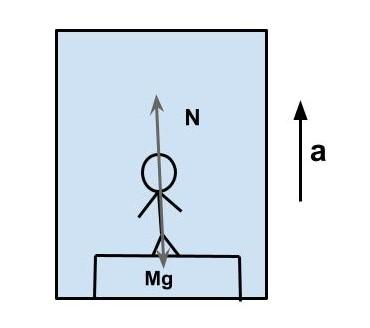
As a result, the Normal Force is stronger, and the reading on the scale is more than the genuine weight. \[F = ma\] operating on the person, according to Newton's 2nd Law.
The person's total acceleration is upward (with the elevator). As a result, the parameter \['ma'\] is positive (upward).
The force of gravity acting downward, \[ - W = - mg\] , and the supporting normal force are the only external forces acting on the person.
while the lift is travelling up with g acceleration.
\[R{\text{ }} = {\text{ }}m{\text{ }}\left( {g + a} \right){\text{ }} = {\text{ }}m{\text{ }}\left( {g + g} \right){\text{ }} = {\text{ }}2mg\]
As a result, the perceived weight becomes twice the actual weight when climbing up and speeding up (acceleration and is positive).
Note:The weight you 'feel' is your apparent weight. When you're falling, you'll have a sense of weightlessness. As a result, the apparent weight is zero. When you're in an elevator that's speeding up, you'll notice that you're getting heavier. As a result, the apparent weight increases.
Complete step-by-step solution:
The elevator and the occupant are starting their journey on a lower floor in this example. The elevator, often known as a lift, moves upward. Because the person's inertia would prefer him to remain stationary, the elevator floor and scale must push up on him to propel him higher with the elevator. To stimulate the person's bulk upward, the scale must press upward with greater power on the person. This occurs when the scale and the human come into closer contact.
As a result, the Normal Force is stronger, and the reading on the scale is more than the genuine weight. \[F = ma\] operating on the person, according to Newton's 2nd Law.
The person's total acceleration is upward (with the elevator). As a result, the parameter \['ma'\] is positive (upward).
The force of gravity acting downward, \[ - W = - mg\] , and the supporting normal force are the only external forces acting on the person.
while the lift is travelling up with g acceleration.
\[R{\text{ }} = {\text{ }}m{\text{ }}\left( {g + a} \right){\text{ }} = {\text{ }}m{\text{ }}\left( {g + g} \right){\text{ }} = {\text{ }}2mg\]
As a result, the perceived weight becomes twice the actual weight when climbing up and speeding up (acceleration and is positive).
Note:The weight you 'feel' is your apparent weight. When you're falling, you'll have a sense of weightlessness. As a result, the apparent weight is zero. When you're in an elevator that's speeding up, you'll notice that you're getting heavier. As a result, the apparent weight increases.
Recently Updated Pages
Three beakers labelled as A B and C each containing 25 mL of water were taken A small amount of NaOH anhydrous CuSO4 and NaCl were added to the beakers A B and C respectively It was observed that there was an increase in the temperature of the solutions contained in beakers A and B whereas in case of beaker C the temperature of the solution falls Which one of the following statements isarecorrect i In beakers A and B exothermic process has occurred ii In beakers A and B endothermic process has occurred iii In beaker C exothermic process has occurred iv In beaker C endothermic process has occurred

Master Class 11 Social Science: Engaging Questions & Answers for Success
Master Class 11 Physics: Engaging Questions & Answers for Success
Master Class 11 Maths: Engaging Questions & Answers for Success
Master Class 11 Economics: Engaging Questions & Answers for Success
Master Class 11 Computer Science: Engaging Questions & Answers for Success
Three beakers labelled as A B and C each containing 25 mL of water were taken A small amount of NaOH anhydrous CuSO4 and NaCl were added to the beakers A B and C respectively It was observed that there was an increase in the temperature of the solutions contained in beakers A and B whereas in case of beaker C the temperature of the solution falls Which one of the following statements isarecorrect i In beakers A and B exothermic process has occurred ii In beakers A and B endothermic process has occurred iii In beaker C exothermic process has occurred iv In beaker C endothermic process has occurred
Master Class 11 Social Science: Engaging Questions & Answers for Success
Master Class 11 Physics: Engaging Questions & Answers for Success
Trending doubts
One Metric ton is equal to kg A 10000 B 1000 C 100 class 11 physics CBSE
There are 720 permutations of the digits 1 2 3 4 5 class 11 maths CBSE
State and prove Bernoullis theorem class 11 physics CBSE
Draw a diagram of a plant cell and label at least eight class 11 biology CBSE
Difference Between Prokaryotic Cells and Eukaryotic Cells
Discuss the various forms of bacteria class 11 biology CBSE