




In a group of 26 persons 8 take tea but not coffee and 16 take tea. How many of them take coffee but not tea?
Answer
 Verified
599.4k+ views
Hint: Venn Diagram: Venn diagram is a technique that uses circles to show the relationship between the events that which event is included or not. With these Venn diagrams, events can be calculated easily. Here \[n(A \cup B) = n(A) + n(B) - n(A \cap B)\].
Where \[n(A \cup B)\] is the number of the event which is the union of \[A\& B\] and \[n(A \cap B)\] is the number of events which is the intersection of \[A\& B\].
Complete step-by-step answer:
Let us denote the person who drinks tea as ‘T’ and who drinks coffee as ‘C’. Also (T-C) be the persons who take tea but not coffee and (C-T) be those who take coffee but not tea.
$n(T \cup C) = 16$
$n(T - C) = 8$
$n(T) = 16$
To find $n(C - T) = ?$
$n(T - C) = 8$
$n(T) = 16$
$n(C - T) = ?$
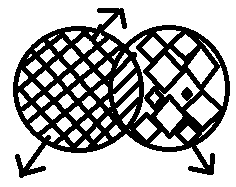
Here, $n(C - T) = n(C \cup T) - n(T)$
=$26 - 16$
=$10$
Therefore 10 people take coffee but not tea.
Note: 1) Union is the collection of all events except repetition.
2) Intersection is the only repeated or the same events in the events.
3) Subset is that which is taken from the set. Here B is the proper subset of A which is taken from A.
4) n (A – B) is the number of events where A went is happening but B is not.

Where \[n(A \cup B)\] is the number of the event which is the union of \[A\& B\] and \[n(A \cap B)\] is the number of events which is the intersection of \[A\& B\].
Complete step-by-step answer:
Given, total persons = 26.
Let us denote the person who drinks tea as ‘T’ and who drinks coffee as ‘C’. Also (T-C) be the persons who take tea but not coffee and (C-T) be those who take coffee but not tea.
Given, $n(T) = 16$
$n(T \cup C) = 16$
$n(T - C) = 8$
$n(T) = 16$
To find $n(C - T) = ?$
$n(T - C) = 8$
$n(T) = 16$
$n(C - T) = ?$
Here, $n(C - T) = n(C \cup T) - n(T)$
=$26 - 16$
=$10$
Therefore 10 people take coffee but not tea.
Note: 1) Union is the collection of all events except repetition.
2) Intersection is the only repeated or the same events in the events.
3) Subset is that which is taken from the set. Here B is the proper subset of A which is taken from A.
4) n (A – B) is the number of events where A went is happening but B is not.
Recently Updated Pages
Master Class 12 Economics: Engaging Questions & Answers for Success

Master Class 12 English: Engaging Questions & Answers for Success
Master Class 12 Social Science: Engaging Questions & Answers for Success
Master Class 12 Maths: Engaging Questions & Answers for Success
Master Class 12 Physics: Engaging Questions & Answers for Success
Master Class 9 General Knowledge: Engaging Questions & Answers for Success
Trending doubts
One Metric ton is equal to kg A 10000 B 1000 C 100 class 11 physics CBSE
Difference Between Prokaryotic Cells and Eukaryotic Cells
Two of the body parts which do not appear in MRI are class 11 biology CBSE
Find the value of the expression given below sin 30circ class 11 maths CBSE
1 ton equals to A 100 kg B 1000 kg C 10 kg D 10000 class 11 physics CBSE
Draw a diagram of nephron and explain its structur class 11 biology CBSE