




In a garden a boy is swinging in the standing position how will the time period of the swing be affected if the boy sits down on the swing?
Answer
 Verified
568.5k+ views
Hint: We have to take the effective length of a simple pendulum into account here. The effective length of a basic pendulum is the distance between the points of suspension and the centre of the bob. The longer the length of the string, the longer the pendulum falls; and thus the longer the duration of the pendulum or the swing back and forth. The greater the amplitude or angle, the farther the pendulum goes; and therefore, the longer the period.
Complete solution:
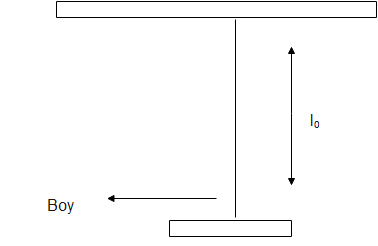
The whole system's angular momentum will be constant during this swing. So, angular momentum $=I\ \omega $ (where I is the system's moment of inertia and $\omega $ is the angular velocity).
Now when the boy sits down, the moment of inertia increases, well that's because, here we calculate the moment of inertia along that axis, from where the swing swings to and fro.
So, initially, his head was closer to the swing point than his legs, so his body mass was distributed along the radius, but the whole mass went towards the circumference when sitting, so I increased.
Now as the angular momentum is preserved, it is necessary to decrease $I\omega $ Now, we know, $T=\dfrac{2 \pi}{\omega}$ to increase I
We can also define Time period as this equation:
$T=\dfrac{1}{2 \pi} \sqrt{\dfrac{I}{m g L}}$
So, if $\omega$ decreases, it increases the time period.
Note:
Depending on the length of the individual sitting or standing on the swing, the time period of a swing can also vary. Since the time period is directly proportional to the square root of the swing's length, the time period may increase if the length increases and vice versa.
Complete solution:
The whole system's angular momentum will be constant during this swing. So, angular momentum $=I\ \omega $ (where I is the system's moment of inertia and $\omega $ is the angular velocity).
Now when the boy sits down, the moment of inertia increases, well that's because, here we calculate the moment of inertia along that axis, from where the swing swings to and fro.
So, initially, his head was closer to the swing point than his legs, so his body mass was distributed along the radius, but the whole mass went towards the circumference when sitting, so I increased.
Now as the angular momentum is preserved, it is necessary to decrease $I\omega $ Now, we know, $T=\dfrac{2 \pi}{\omega}$ to increase I
We can also define Time period as this equation:
$T=\dfrac{1}{2 \pi} \sqrt{\dfrac{I}{m g L}}$
So, if $\omega$ decreases, it increases the time period.
Note:
Depending on the length of the individual sitting or standing on the swing, the time period of a swing can also vary. Since the time period is directly proportional to the square root of the swing's length, the time period may increase if the length increases and vice versa.
Recently Updated Pages
Basicity of sulphurous acid and sulphuric acid are

Master Class 12 English: Engaging Questions & Answers for Success
Master Class 12 Social Science: Engaging Questions & Answers for Success
Master Class 12 Maths: Engaging Questions & Answers for Success
Master Class 12 Economics: Engaging Questions & Answers for Success
Master Class 12 Physics: Engaging Questions & Answers for Success
Trending doubts
Which are the Top 10 Largest Countries of the World?
Draw a labelled sketch of the human eye class 12 physics CBSE
Draw ray diagrams each showing i myopic eye and ii class 12 physics CBSE
Giving reasons state the signs positive or negative class 12 physics CBSE
Explain esterification reaction with the help of a class 12 chemistry CBSE
What is defined as a solenoid Depict a diagram with class 12 physics CBSE