




In a equilateral \[\Delta ABC\], \[D\] is a point on \[BC\] such that \[BD = \dfrac{1}{3}BC\].Prove that \[9{\left( {AD} \right)^2} = 7{\left( {AB} \right)^2}\].
Answer
 Verified
615.9k+ views
Hint: First of all, construct a perpendicular in \[\Delta ABC\]. Proof that the triangles formed by this perpendicular are equal by using RHS congruence. Then use Pythagoras’s theorem to prove the given statement. So, use this concept to reach the solution of the given problem.
Complete step-by-step answer:
Given in equilateral \[\Delta ABC\], \[D\] is a point on \[BC\] such that \[BD = \dfrac{1}{3}BC\].
Let draw \[AE \bot BC\] in \[\Delta ABC\], as shown in the below figure:
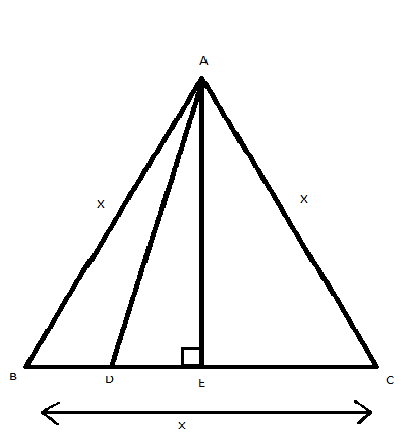
Since all sides of an equilateral triangle is equal, we have
\[AB = BC = AC\]
Let \[AB = BC = AC = x\]
Given \[BD = \dfrac{1}{3}BC\]
\[ \Rightarrow BD = \dfrac{1}{3}x\]
In \[\Delta AEB\] and \[\Delta AEC\]
\[
\Rightarrow AE = AE{\text{ }}\left[ {{\text{common}}} \right] \\
\Rightarrow AB = AC{\text{ }}\left[ {{\text{Both }}x{\text{ as it is equilateral triangle}}} \right] \\
\Rightarrow \angle AEB = \angle AEC{\text{ }}\left[ {{\text{Both 9}}{{\text{0}}^0}{\text{ as }}AE \bot BC} \right] \\
\]
Hence by RHS congruency
\[\Delta AEB \cong \Delta AEC\]
By common property of congruence triangle, we have \[BE = EC\]
So, \[BE = EC = \dfrac{1}{2}BC\]
\[BE = EC = \dfrac{1}{2}x{\text{ }}\left[ {\because BC = x} \right]\]
So, we have
\[
\Rightarrow BE = \dfrac{x}{2} \\
\Rightarrow BD + DE = \dfrac{x}{2} \\
\Rightarrow \dfrac{x}{3} + DE = \dfrac{x}{2} \\
\Rightarrow DE = \dfrac{x}{2} - \dfrac{x}{3} = \dfrac{{3x - 2x}}{6} \\
\therefore DE = \dfrac{x}{6} \\
\]
Using Pythagoras theorem i.e.,
\[{\left( {{\text{Hypotenuse}}} \right)^2} = {\left( {{\text{Height}}} \right)^2} + {\left( {{\text{Base}}} \right)^2}\]
Now in right \[\Delta AEB\]
\[
\Rightarrow A{B^2} = A{E^2} + B{E^2} \\
\Rightarrow {x^2} = A{E^2} + {\left( {\dfrac{x}{2}} \right)^2} \\
\Rightarrow A{E^2} = {x^2} - \dfrac{{{x^2}}}{4} \\
\therefore A{E^2} = \dfrac{{3{x^2}}}{4}........................................................\left( 1 \right) \\
\]
Similarly, in right \[\Delta AED\] using Pythagoras’s theorem we have
\[
\Rightarrow A{D^2} = A{E^2} + D{E^2} \\
\Rightarrow A{D^2} = \dfrac{{3{x^2}}}{4} + {\left( {\dfrac{x}{6}} \right)^2}{\text{ }}\left[ {{\text{From 1}}} \right] \\
\Rightarrow A{D^2} = \dfrac{{27{x^2} + {x^2}}}{{36}} \\
\Rightarrow A{D^2} = \dfrac{{7{x^2}}}{9} \\
\therefore 9A{D^2} = 7A{B^2}{\text{ }}\left[ {\because AB = x} \right] \\
\]
Hence proved.
Note: Pythagoras’s theorem states that “In a right-angled triangle, the square of the hypotenuse side is equal to the sum of the squares of the other two sides”. In two right-angled triangles, if the length of the hypotenuse and one side of one triangle is equal to the length of the other triangle, then the two triangles are congruent.
Complete step-by-step answer:
Given in equilateral \[\Delta ABC\], \[D\] is a point on \[BC\] such that \[BD = \dfrac{1}{3}BC\].
Let draw \[AE \bot BC\] in \[\Delta ABC\], as shown in the below figure:
Since all sides of an equilateral triangle is equal, we have
\[AB = BC = AC\]
Let \[AB = BC = AC = x\]
Given \[BD = \dfrac{1}{3}BC\]
\[ \Rightarrow BD = \dfrac{1}{3}x\]
In \[\Delta AEB\] and \[\Delta AEC\]
\[
\Rightarrow AE = AE{\text{ }}\left[ {{\text{common}}} \right] \\
\Rightarrow AB = AC{\text{ }}\left[ {{\text{Both }}x{\text{ as it is equilateral triangle}}} \right] \\
\Rightarrow \angle AEB = \angle AEC{\text{ }}\left[ {{\text{Both 9}}{{\text{0}}^0}{\text{ as }}AE \bot BC} \right] \\
\]
Hence by RHS congruency
\[\Delta AEB \cong \Delta AEC\]
By common property of congruence triangle, we have \[BE = EC\]
So, \[BE = EC = \dfrac{1}{2}BC\]
\[BE = EC = \dfrac{1}{2}x{\text{ }}\left[ {\because BC = x} \right]\]
So, we have
\[
\Rightarrow BE = \dfrac{x}{2} \\
\Rightarrow BD + DE = \dfrac{x}{2} \\
\Rightarrow \dfrac{x}{3} + DE = \dfrac{x}{2} \\
\Rightarrow DE = \dfrac{x}{2} - \dfrac{x}{3} = \dfrac{{3x - 2x}}{6} \\
\therefore DE = \dfrac{x}{6} \\
\]
Using Pythagoras theorem i.e.,
\[{\left( {{\text{Hypotenuse}}} \right)^2} = {\left( {{\text{Height}}} \right)^2} + {\left( {{\text{Base}}} \right)^2}\]
Now in right \[\Delta AEB\]
\[
\Rightarrow A{B^2} = A{E^2} + B{E^2} \\
\Rightarrow {x^2} = A{E^2} + {\left( {\dfrac{x}{2}} \right)^2} \\
\Rightarrow A{E^2} = {x^2} - \dfrac{{{x^2}}}{4} \\
\therefore A{E^2} = \dfrac{{3{x^2}}}{4}........................................................\left( 1 \right) \\
\]
Similarly, in right \[\Delta AED\] using Pythagoras’s theorem we have
\[
\Rightarrow A{D^2} = A{E^2} + D{E^2} \\
\Rightarrow A{D^2} = \dfrac{{3{x^2}}}{4} + {\left( {\dfrac{x}{6}} \right)^2}{\text{ }}\left[ {{\text{From 1}}} \right] \\
\Rightarrow A{D^2} = \dfrac{{27{x^2} + {x^2}}}{{36}} \\
\Rightarrow A{D^2} = \dfrac{{7{x^2}}}{9} \\
\therefore 9A{D^2} = 7A{B^2}{\text{ }}\left[ {\because AB = x} \right] \\
\]
Hence proved.
Note: Pythagoras’s theorem states that “In a right-angled triangle, the square of the hypotenuse side is equal to the sum of the squares of the other two sides”. In two right-angled triangles, if the length of the hypotenuse and one side of one triangle is equal to the length of the other triangle, then the two triangles are congruent.
Recently Updated Pages
Master Class 10 Computer Science: Engaging Questions & Answers for Success

Master Class 10 General Knowledge: Engaging Questions & Answers for Success
Master Class 10 English: Engaging Questions & Answers for Success
Master Class 10 Social Science: Engaging Questions & Answers for Success
Master Class 10 Maths: Engaging Questions & Answers for Success
Master Class 10 Science: Engaging Questions & Answers for Success
Trending doubts
What is the median of the first 10 natural numbers class 10 maths CBSE
The draft of the Preamble of the Indian Constitution class 10 social science CBSE
Which women's tennis player has 24 Grand Slam singles titles?
Who gave "Inqilab Zindabad" slogan?
Why is there a time difference of about 5 hours between class 10 social science CBSE
Who is the Brand Ambassador of Incredible India?