




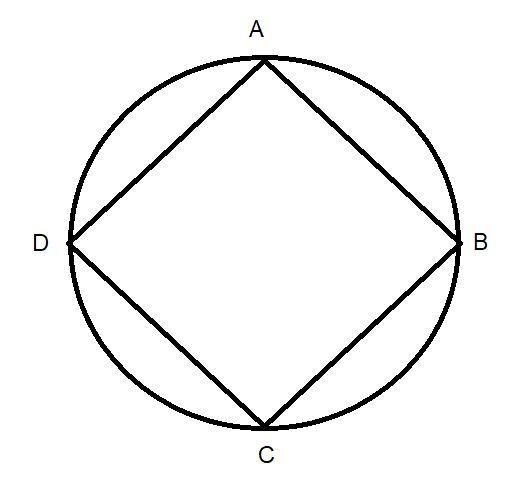
In a cyclic quadrilateral ABCD, $\angle A = {(2x + 4)^\circ},\angle B = {(y + 3)^\circ},\angle C = {(2y + 10)^\circ}$ and $\angle D = {(4x - 5)^\circ}$ . Find the measure of each angle.
Answer
 Verified
615.9k+ views
Hint: - Here we go through the property of cyclic quadrilateral as we know that the opposite angles of a cyclic quadrilateral are supplementary and we apply the properties to form the equation.
Complete step-by-step answer:
Here in the question it is given that ABCD is a cyclic quadrilateral in which the angles are given as,
$\angle A = {(2x + 4)^\circ},\angle B = {(y + 3)^\circ},\angle C = {(2y + 10)^\circ}$ And $\angle D = {(4x - 5)^\circ}$
Now as we know the sum of opposite angles in cyclic quadrilateral are supplementary (means sum of the two angles is ${180^\circ}$ ) so we can say that,
$\angle A + \angle C = {180^\circ}$ [Sum of angles in cyclic quadrilateral are supplementary]
$ \Rightarrow 2x + 4 + 2y + 10 = 180 \\
\Rightarrow 2x + 2y = 166 \\ $
$\therefore x + y = 83$ …………….. Let it be as equation (1).
Now similarly,
$\angle B + \angle D = {180^\circ}$ [Sum of angles in cyclic quadrilateral are supplementary]
$ \Rightarrow y + 3 + 4x - 5 = 180 \\
\Rightarrow 4x + y = 182 \\ $
$\therefore 4x + y = 182$ …………….. Let it be as equation (2).
Subtracting equation (1) from equation (2) we get,
$ \Rightarrow 3x = 99 \\
\Rightarrow x = 33 \\ $
Substituting value of x in equation (1) we get,
$\Rightarrow 33 + y = 83 \\
\Rightarrow y = 50 \\ $
Now put the values of x and y in the angles to get the required angles.
$ \Rightarrow \angle A = {(2x + 4)^\circ} = (2 \times 33 + 4) = {70^\circ} \\
\Rightarrow \angle B = {(y + 3)^\circ} = (50 + 3) = {53^\circ} \\
\Rightarrow \angle C = {(2y + 10)^\circ} = (2 \times 50 + 10) = {110^\circ} \\
\Rightarrow \angle D = {(4x - 5)^\circ} = (4 \times 33 - 5) = {127^\circ} \\ $
Note: - Whenever we face such a question the key concept for solving the question is to first try to make the diagrams and apply the properties of the given figure and we also know that two variables are solved from two equations. So by the property of the figure try to make two equations to find out the variables.
Complete step-by-step answer:
Here in the question it is given that ABCD is a cyclic quadrilateral in which the angles are given as,
$\angle A = {(2x + 4)^\circ},\angle B = {(y + 3)^\circ},\angle C = {(2y + 10)^\circ}$ And $\angle D = {(4x - 5)^\circ}$
Now as we know the sum of opposite angles in cyclic quadrilateral are supplementary (means sum of the two angles is ${180^\circ}$ ) so we can say that,
$\angle A + \angle C = {180^\circ}$ [Sum of angles in cyclic quadrilateral are supplementary]
$ \Rightarrow 2x + 4 + 2y + 10 = 180 \\
\Rightarrow 2x + 2y = 166 \\ $
$\therefore x + y = 83$ …………….. Let it be as equation (1).
Now similarly,
$\angle B + \angle D = {180^\circ}$ [Sum of angles in cyclic quadrilateral are supplementary]
$ \Rightarrow y + 3 + 4x - 5 = 180 \\
\Rightarrow 4x + y = 182 \\ $
$\therefore 4x + y = 182$ …………….. Let it be as equation (2).
Subtracting equation (1) from equation (2) we get,
$ \Rightarrow 3x = 99 \\
\Rightarrow x = 33 \\ $
Substituting value of x in equation (1) we get,
$\Rightarrow 33 + y = 83 \\
\Rightarrow y = 50 \\ $
Now put the values of x and y in the angles to get the required angles.
$ \Rightarrow \angle A = {(2x + 4)^\circ} = (2 \times 33 + 4) = {70^\circ} \\
\Rightarrow \angle B = {(y + 3)^\circ} = (50 + 3) = {53^\circ} \\
\Rightarrow \angle C = {(2y + 10)^\circ} = (2 \times 50 + 10) = {110^\circ} \\
\Rightarrow \angle D = {(4x - 5)^\circ} = (4 \times 33 - 5) = {127^\circ} \\ $
Note: - Whenever we face such a question the key concept for solving the question is to first try to make the diagrams and apply the properties of the given figure and we also know that two variables are solved from two equations. So by the property of the figure try to make two equations to find out the variables.
Recently Updated Pages
Basicity of sulphurous acid and sulphuric acid are

Master Class 10 English: Engaging Questions & Answers for Success
Master Class 10 Social Science: Engaging Questions & Answers for Success
Master Class 10 Computer Science: Engaging Questions & Answers for Success
Class 10 Question and Answer - Your Ultimate Solutions Guide
Master Class 10 General Knowledge: Engaging Questions & Answers for Success
Trending doubts
Which country won the ICC Men's ODI World Cup in 2023?
In cricket, how many legal balls are there in a standard over?
Explain the Treaty of Vienna of 1815 class 10 social science CBSE
A boat goes 24 km upstream and 28 km downstream in class 10 maths CBSE
What does "powerplay" mean in limited-overs cricket?
What is the "Powerplay" in T20 cricket?