




In a class of 80 students numbered 1 to 80, all odd numbered students opt for cricket, students whose numbers are divisible by 5 opt for football and those whose numbers are divisible by 7 opt for hockey. The number of students who do not opt any of the three games, is
A. $13$
B. $24$
C. $28$
D. $52$
E. $67$
Answer
 Verified
630k+ views
Hint: In this question we will use the counting principles and set representation. Collect all the required information from the statements and then put those values for the answer .The formulae used in this question is : $n\left( {A \cup B \cup C} \right) = n\left( A \right) + n\left( B \right) + n\left( C \right) - n\left( {A \cap B} \right) - n\left( {B \cap C} \right) - n\left( {A \cap C} \right) + n\left( {A \cap B \cap C} \right).$ (i)
Complete step-by-step answer:
We can also solve these types of questions with the help of venn diagrams.
Let the events A,B,C be defined as:
A: students opt for cricket
B: students opt for football
C: students opt for hockey
Given that, total number of students = 80
Number of students opting for cricket ,football and hockey is $n\left( A \right) = 40,n\left( B \right) = 16,n\left( C \right) = 11$ respectively.
According to the question ,
$\therefore $ Number of students opt for cricket and football both ,$n\left( {A \cap B} \right) = 8$
Number of students opt for hockey and football both , $n\left( {B \cap C} \right) = 2$
Number of students opt for cricket and hockey both, $n\left( {A \cap C} \right) = 6$
Number of students opt for all the three games ,
To get the number of students to opt for any game ,we have to put these values in equation (i).
$ \Rightarrow \ n\left( {A \cup B \cup C} \right) = n\left( A \right) + n\left( B \right) + n\left( C \right) - n\left( {A \cap B} \right) - n\left( {B \cap C} \right) - n\left( {A \cap C} \right) + n\left( {A \cap B \cap C} \right)$
$ \Rightarrow n\left( {A \cup B \cup C} \right) = 40 + 16 + 11 - 8 - 2 - 6 + 1 = 68 - 16$.
$ \Rightarrow n\left( {A \cup B \cup C} \right) = 52$
Now we know that , for an event A
$n\left( {notA} \right) = n\left( U \right) - n\left( A \right)$
Here, $n\left( {A' \cup B' \cup C'} \right) = $ total number of students -$n\left( {A \cup B \cup C} \right)$
$ \Rightarrow n\left( {A' \cup B' \cup C'} \right) = 80 - 52 = 28$
Hence , the number of students who do not opt any of the three games is 28.
So, the correct answer is option (C).
Note: In this question first we have to make the events and then the participants of those events separately, then get the intersection of those events (if occurring). After this put these values in the counting’s principle formula. Simply by doing calculations , we will get the total number of participants who are actually playing any of the three games and then by subtracting it from the total number of participants we will get the required answer.
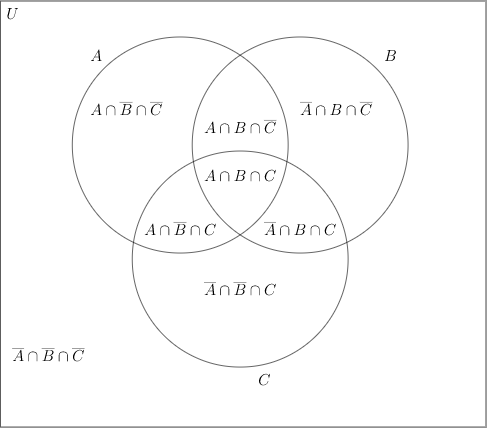
Complete step-by-step answer:
We can also solve these types of questions with the help of venn diagrams.
Let the events A,B,C be defined as:
A: students opt for cricket
B: students opt for football
C: students opt for hockey
Given that, total number of students = 80
Number of students opting for cricket ,football and hockey is $n\left( A \right) = 40,n\left( B \right) = 16,n\left( C \right) = 11$ respectively.
According to the question ,
$\therefore $ Number of students opt for cricket and football both ,$n\left( {A \cap B} \right) = 8$
Number of students opt for hockey and football both , $n\left( {B \cap C} \right) = 2$
Number of students opt for cricket and hockey both, $n\left( {A \cap C} \right) = 6$
Number of students opt for all the three games ,
To get the number of students to opt for any game ,we have to put these values in equation (i).
$ \Rightarrow \ n\left( {A \cup B \cup C} \right) = n\left( A \right) + n\left( B \right) + n\left( C \right) - n\left( {A \cap B} \right) - n\left( {B \cap C} \right) - n\left( {A \cap C} \right) + n\left( {A \cap B \cap C} \right)$
$ \Rightarrow n\left( {A \cup B \cup C} \right) = 40 + 16 + 11 - 8 - 2 - 6 + 1 = 68 - 16$.
$ \Rightarrow n\left( {A \cup B \cup C} \right) = 52$
Now we know that , for an event A
$n\left( {notA} \right) = n\left( U \right) - n\left( A \right)$
Here, $n\left( {A' \cup B' \cup C'} \right) = $ total number of students -$n\left( {A \cup B \cup C} \right)$
$ \Rightarrow n\left( {A' \cup B' \cup C'} \right) = 80 - 52 = 28$
Hence , the number of students who do not opt any of the three games is 28.
So, the correct answer is option (C).
Note: In this question first we have to make the events and then the participants of those events separately, then get the intersection of those events (if occurring). After this put these values in the counting’s principle formula. Simply by doing calculations , we will get the total number of participants who are actually playing any of the three games and then by subtracting it from the total number of participants we will get the required answer.
Recently Updated Pages
Master Class 11 Social Science: Engaging Questions & Answers for Success

Master Class 11 Physics: Engaging Questions & Answers for Success
Master Class 11 Maths: Engaging Questions & Answers for Success
Master Class 11 Economics: Engaging Questions & Answers for Success
Master Class 11 Computer Science: Engaging Questions & Answers for Success
Master Class 11 Chemistry: Engaging Questions & Answers for Success
Trending doubts
One Metric ton is equal to kg A 10000 B 1000 C 100 class 11 physics CBSE
There are 720 permutations of the digits 1 2 3 4 5 class 11 maths CBSE
1 Quintal is equal to a 110 kg b 10 kg c 100kg d 1000 class 11 physics CBSE
State and prove Bernoullis theorem class 11 physics CBSE
Difference Between Prokaryotic Cells and Eukaryotic Cells
Which among the following are examples of coming together class 11 social science CBSE