




In 2003, the chemistry Nobel Prize was awarded for which of the following work?
(A) Aquaporins
(B) ${Na}^{+}$ channels
(C) ${Ca}^{++}$ channels
(D) Methyl chavicol
Answer
 Verified
586.8k+ views
Hint: In 2003, the chemistry Nobel Prize was awarded for the work which was also known as water channels. They are channel proteins mostly forming the intrinsic proteins that form pores in the cell membrane or any other membrane of a cell.
Complete step by step answer:
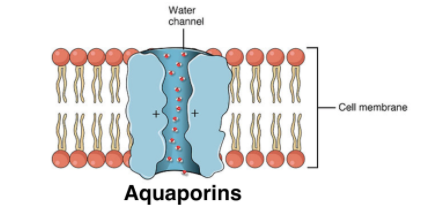
Water channels are also called Aquaporins. The cell membranes of a range of different bacteria, fungi, animals, and plant cells contain aquaporins through which water can flow faster into and out of the cell than by diffusing through the phospholipid bilayer. In the year 2003 Nobel prize in Chemistry was awarded jointly with Peter Agre for the discovery of aquaporins and Roderick MacKinnon for his work on the structure and mechanism of potassium channels.
So, the correct answer is ‘Aquaporins’.
Additional Information: Aquaporin proteins are composed of a bundle of 6 transmembrane $\alpha$-helices. they're embedded within the cell wall. The amino and carboxyl ends face the within of the cell. The amino and carboxyl halves resemble one another, apparently repeating a pattern of nucleotides. According to some researchers, this was created or developed by the doubling of a formerly half-sized gene. Between the helices are five regions (A – E) that loop into or out of the cell wall, two of them hydrophobic (B, E), with an asparagine–proline–alanine ("NPA motif") pattern. They create a particular hourglass shape, making the water channel narrow within the middle and wider at each end.
Note: In mammals, there are thirteen known types of aquaporins, and six of these are located in the kidney, but the existence of many more are suspected. In plants, aquaporins are found specifically in the vacuolar membrane, in addition to the plasma membrane of plants.
Complete step by step answer:
Water channels are also called Aquaporins. The cell membranes of a range of different bacteria, fungi, animals, and plant cells contain aquaporins through which water can flow faster into and out of the cell than by diffusing through the phospholipid bilayer. In the year 2003 Nobel prize in Chemistry was awarded jointly with Peter Agre for the discovery of aquaporins and Roderick MacKinnon for his work on the structure and mechanism of potassium channels.
So, the correct answer is ‘Aquaporins’.
Additional Information: Aquaporin proteins are composed of a bundle of 6 transmembrane $\alpha$-helices. they're embedded within the cell wall. The amino and carboxyl ends face the within of the cell. The amino and carboxyl halves resemble one another, apparently repeating a pattern of nucleotides. According to some researchers, this was created or developed by the doubling of a formerly half-sized gene. Between the helices are five regions (A – E) that loop into or out of the cell wall, two of them hydrophobic (B, E), with an asparagine–proline–alanine ("NPA motif") pattern. They create a particular hourglass shape, making the water channel narrow within the middle and wider at each end.
Note: In mammals, there are thirteen known types of aquaporins, and six of these are located in the kidney, but the existence of many more are suspected. In plants, aquaporins are found specifically in the vacuolar membrane, in addition to the plasma membrane of plants.
Recently Updated Pages
Master Class 11 Business Studies: Engaging Questions & Answers for Success

Master Class 11 Computer Science: Engaging Questions & Answers for Success
Master Class 11 Economics: Engaging Questions & Answers for Success
Master Class 11 Social Science: Engaging Questions & Answers for Success
Master Class 11 English: Engaging Questions & Answers for Success
Master Class 11 Chemistry: Engaging Questions & Answers for Success
Trending doubts
Draw a diagram of nephron and explain its structur class 11 biology CBSE
Explain zero factorial class 11 maths CBSE
Chemical formula of Bleaching powder is A Ca2OCl2 B class 11 chemistry CBSE
Name the part of the brain responsible for the precision class 11 biology CBSE
The growth of tendril in pea plants is due to AEffect class 11 biology CBSE
One Metric ton is equal to kg A 10000 B 1000 C 100 class 11 physics CBSE