




Where is the image of an object formed in the human eye?
A. Iris
B. Pupil
C. Retina
D. Cornea
Answer
 Verified
609.6k+ views
Hint: When the light rays enter a sharp focusing point on the retina of the human eye; it acts as a film on the camera which receives the image and passes to the cornea. The internal lenses of the eyes are focused by the cornea. It transforms this high image falling on the lens brain and we can see the object.
Complete answer:
The human eye forms the image of an object at its retina, which acts as a screen for forming images. Retina is the innermost layer of the eye in most vertebrates. The optic of the eye creates a focused two dimensional image of the visual world on the retina. Then retina translates that image into electrical neural impulses to the brain to create the visual perception.
Hence, the correct answer is option (C).
Additional information:
The cornea and lens form a system which acts as a lens. For clear vision a real image must be projected on the light sensitive retina. Retina lies at a fixed distance from the lens. The lens of the eye can adjust its power to produce an image at different distances.
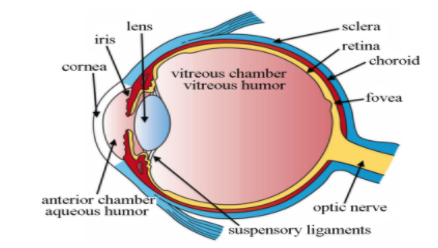
The centre of the image falls on the fovea. Fovea has greatest density for light receptors and also the greatest sharpness in the visual field. The pupil along with the chemical adaptation allows the eye to detect light intensities.
Our eyes can perform a vast number of functions, which includes; sense direction, movement, sophisticated colors, and distance. Visual nerve impulse processing begins with interconnections in the retina and continues in the brain.
Note: The eye can adjust its focal length and power for the production of a real image, this process is called accommodation. For close vision, the eye can accommodate fully with its greatest power, while for distant vision, the eye is totally relaxed with lowest power. If the eye loses its ability to accommodate then the condition is called presbyopia. Presbyopia can be corrected by using a converging lens to add power for close vision.
Complete answer:
The human eye forms the image of an object at its retina, which acts as a screen for forming images. Retina is the innermost layer of the eye in most vertebrates. The optic of the eye creates a focused two dimensional image of the visual world on the retina. Then retina translates that image into electrical neural impulses to the brain to create the visual perception.
Hence, the correct answer is option (C).
Additional information:
The cornea and lens form a system which acts as a lens. For clear vision a real image must be projected on the light sensitive retina. Retina lies at a fixed distance from the lens. The lens of the eye can adjust its power to produce an image at different distances.
The centre of the image falls on the fovea. Fovea has greatest density for light receptors and also the greatest sharpness in the visual field. The pupil along with the chemical adaptation allows the eye to detect light intensities.
Our eyes can perform a vast number of functions, which includes; sense direction, movement, sophisticated colors, and distance. Visual nerve impulse processing begins with interconnections in the retina and continues in the brain.
Note: The eye can adjust its focal length and power for the production of a real image, this process is called accommodation. For close vision, the eye can accommodate fully with its greatest power, while for distant vision, the eye is totally relaxed with lowest power. If the eye loses its ability to accommodate then the condition is called presbyopia. Presbyopia can be corrected by using a converging lens to add power for close vision.
Recently Updated Pages
Master Class 11 English: Engaging Questions & Answers for Success

Master Class 11 Social Science: Engaging Questions & Answers for Success
Master Class 11 Maths: Engaging Questions & Answers for Success
Master Class 11 Biology: Engaging Questions & Answers for Success
Master Class 11 Physics: Engaging Questions & Answers for Success
Master Class 11 Chemistry: Engaging Questions & Answers for Success
Trending doubts
One Metric ton is equal to kg A 10000 B 1000 C 100 class 11 physics CBSE
Difference Between Prokaryotic Cells and Eukaryotic Cells
1 ton equals to A 100 kg B 1000 kg C 10 kg D 10000 class 11 physics CBSE
Find the value of the expression given below sin 30circ class 11 maths CBSE
Two of the body parts which do not appear in MRI are class 11 biology CBSE
What are hard magnetic materials class 11 physics CBSE