




Ileum is characterised by the presence of
a) Brunner's glands and villi
b) Brunner's gland and Peyer's patches
c) Peyer's patches and villi
d) Brunner's gland and Taenia coli
Answer
 Verified
552.6k+ views
Hint: Small intestine is one of the most important organs of the digestive system that plays a major role in the food digestion process. Here, the majority of food is digested, that is, broken down in simpler form.
Complete Solution:
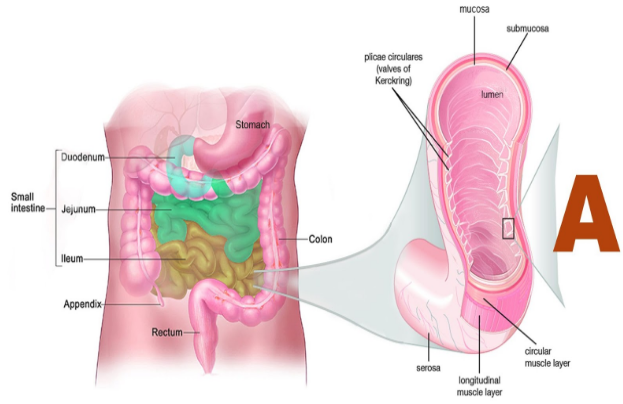
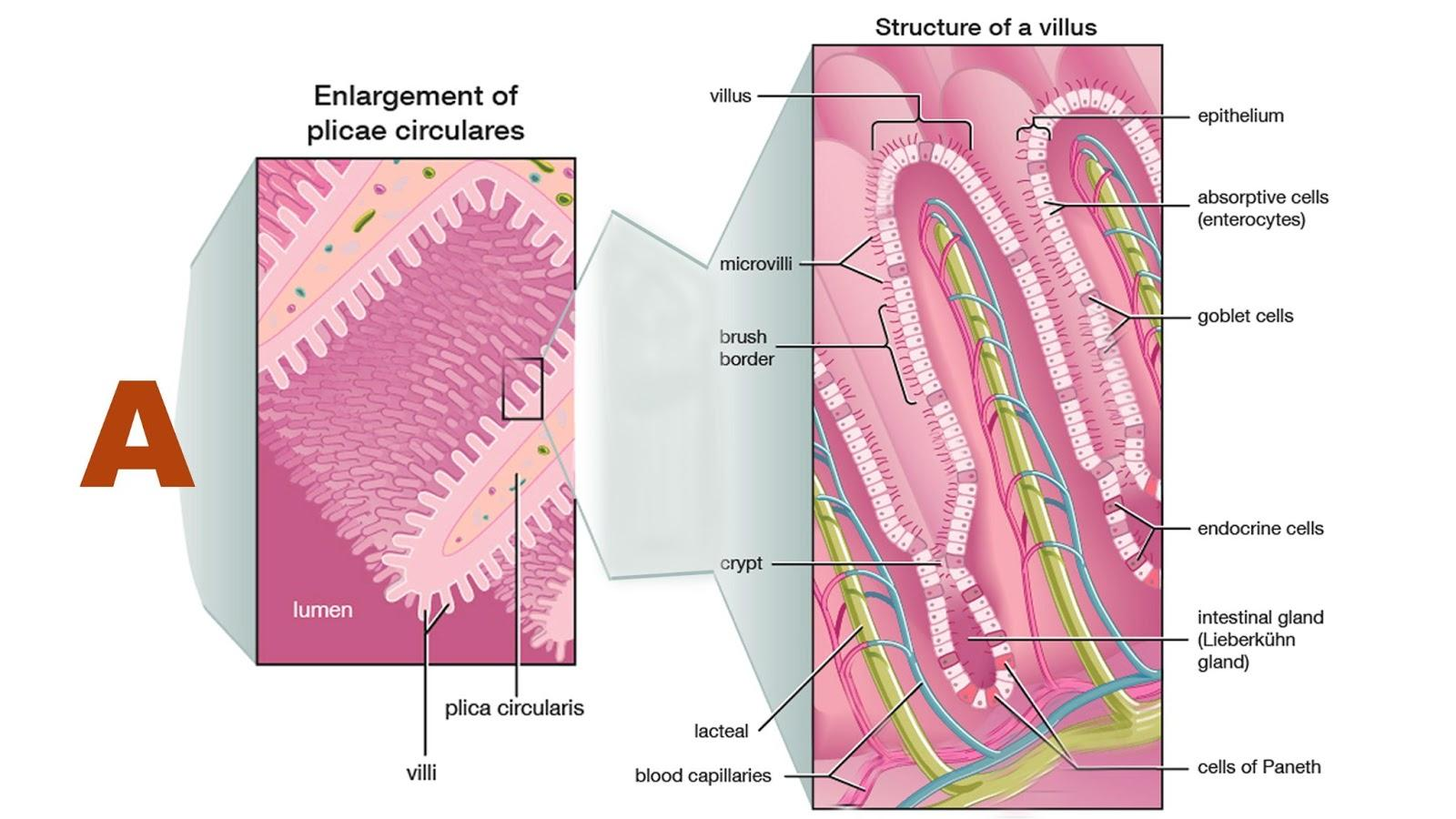
The small intestine is present below the stomach. It appears to be wrapped in between the muscles of the large intestine. It is the longest organ of the body that extends upto seven meters in humans. It consists of several brush-like muscular structures on its inner wall called villi. They increase its surface area that makes the absorption process easy. Other than this, the small intestine is divided into three parts. These are:
Duodenum: It is the starting part of the intestine that connects to the stomach through pylorus. It is concerned with absorption of Iron and vitamin B9.
Jejunum: It is the middle portion of the small intestine. It is present in the left side of the abdominal cavity. It is concerned with absorption of vitamin B9, sugars, amino acids, etc.
Ileum: It is the last portion of the small intestine. It extends to join with the large intestine through the ileocecal valve. It is concerned with absorption of vitamin B12, bile salts and undigested food of jejunum. It also consists of some patches called Peyer's patches. These are lymphatic tissues by origin that are concerned with managing and monitoring of intestinal bacterias. They eradicate pathogens to avoid any kind of health issue for the body. Therefore, we can say that option C is the correct answer as ileum consists of both Peyer's patches and villi.
Note:
Brunner's glands are present in the duodenum. They are concerned with managing the acidic content of fluid released from the stomach that is chyme. Taenia coli are present in the large intestine that are concerned with maintaining peristaltic movement of large intestine muscles.
Complete Solution:
The small intestine is present below the stomach. It appears to be wrapped in between the muscles of the large intestine. It is the longest organ of the body that extends upto seven meters in humans. It consists of several brush-like muscular structures on its inner wall called villi. They increase its surface area that makes the absorption process easy. Other than this, the small intestine is divided into three parts. These are:
Duodenum: It is the starting part of the intestine that connects to the stomach through pylorus. It is concerned with absorption of Iron and vitamin B9.
Jejunum: It is the middle portion of the small intestine. It is present in the left side of the abdominal cavity. It is concerned with absorption of vitamin B9, sugars, amino acids, etc.
Ileum: It is the last portion of the small intestine. It extends to join with the large intestine through the ileocecal valve. It is concerned with absorption of vitamin B12, bile salts and undigested food of jejunum. It also consists of some patches called Peyer's patches. These are lymphatic tissues by origin that are concerned with managing and monitoring of intestinal bacterias. They eradicate pathogens to avoid any kind of health issue for the body. Therefore, we can say that option C is the correct answer as ileum consists of both Peyer's patches and villi.
Note:
Brunner's glands are present in the duodenum. They are concerned with managing the acidic content of fluid released from the stomach that is chyme. Taenia coli are present in the large intestine that are concerned with maintaining peristaltic movement of large intestine muscles.
Recently Updated Pages
Master Class 11 Social Science: Engaging Questions & Answers for Success

Master Class 11 Chemistry: Engaging Questions & Answers for Success
Master Class 12 Business Studies: Engaging Questions & Answers for Success
Master Class 12 Chemistry: Engaging Questions & Answers for Success
Master Class 12 Biology: Engaging Questions & Answers for Success
Class 12 Question and Answer - Your Ultimate Solutions Guide
Trending doubts
One Metric ton is equal to kg A 10000 B 1000 C 100 class 11 physics CBSE
Difference Between Prokaryotic Cells and Eukaryotic Cells
How many of the following diseases can be studied with class 11 biology CBSE
Two of the body parts which do not appear in MRI are class 11 biology CBSE
Which of the following enzymes is used for carboxylation class 11 biology CBSE
Explain zero factorial class 11 maths CBSE