




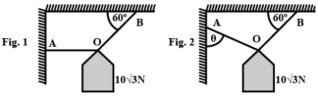
If you can change location of the point A on the wall and hence the orientation of the string OA without altering the orientation of the string OB as shown in figure -II. What angle should the string OA make with the wall so that a minimum tension is developed in it?
Answer
 Verified
592.5k+ views
Hint: In this question, as the suspended object is in equilibrium, then all the forces acting on it is balanced. We need to equate both the horizontal and the vertical components of the forces working on the body, then simultaneously solving those equations will give us our desired result.
Complete step by step answer:
From the given diagram, we get that all the forces are balanced;
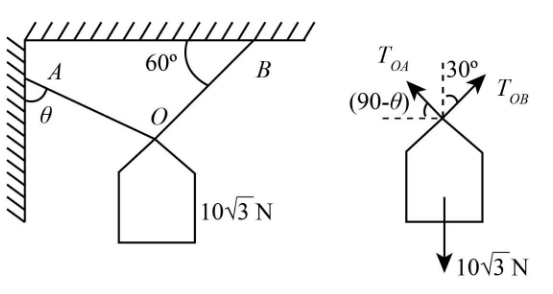
Let us consider the tension acting on the string OA is \[{T_{OA}}\] , and the tension working on the string OB is \[{T_{OB}}\].
Equating the horizontal forces acting on the junction point;
\[\begin{array}{l}
\;\;\;\;{T_{OA}}\sin \theta = {T_{OB}}\cos {\rm{ 6}}{{\rm{0}}^ \circ }\\
\Rightarrow {T_{OA}}\sin \theta = {T_{OB}} \times \dfrac{1}{2}\\
\Rightarrow {T_{OB}} = 2{T_{OA}}\sin \theta
\end{array}\] ……(i)
Equating the vertical forces acting on the junction point;
\[{T_{OA}}\cos \theta + {T_{OB}}\sin \;{60^ \circ } = 10\sqrt 3 \] ……(ii)
Substituting the value obtained from expression (i) in expression (ii), we have;
\[\begin{array}{l}
{\rm{ }}{T_{OA}}\cos \theta + 2{T_{OA}}\sin \theta \times \dfrac{{\sqrt 3 }}{2} = 10\sqrt 3 \\
\Rightarrow {T_{OA}}\left( {\cos \theta + \sqrt 3 \sin \theta } \right) = 10\sqrt 3 \\
\Rightarrow {T_{OA}} = \dfrac{{10\sqrt 3 }}{{\cos \theta + \sqrt 3 \sin \theta }}
\end{array}\] ……(iii)
For the value of tension in string OA to be minimum, the denominator in expression (iii) must have the maximum possible value.
On analyzing the value of the denominator for all the possible values of \[\theta \] we have;
Let,\[f(\theta ) = \cos \theta + \sqrt 3 \sin \theta \]
Now, \[\begin{array}{c}
f'(\theta ) = - \sin \theta + \sqrt 3 \cos \theta \\
= \sqrt 3 \cos \theta - \sin \theta
\end{array}\]
To find the saddle point we substitute \[f'(\theta ) = 0\], then we get;
\[\begin{array}{c}
\;\;\;\sqrt 3 \cos \theta - \sin \theta = 0\\
{\rm{or,}}\;\;\;\;\;\;\;\;\;\;\;\;\;\;\;\sin \theta = \sqrt 3 \cos \theta \\
{\rm{or,}}\;\;\;\;\;\;\;\;\;\;\;\;\;\;\dfrac{{\sin \theta }}{{\cos \theta }} = \sqrt 3 \\
{\rm{or, }}\;\;\;\;\;\;\;\;\;\;\;\;\;\;{\rm{tan}}\theta = \sqrt 3 \\
{\rm{or,}}\;\;\;\;\;\;\;\;\;\;\;\;\;\;\;\tan \theta = 1.732\\
{\rm{or,}}\;\;\;\;\;\;\;\;\;\;\;\;\;\;\;\tan \theta = \tan {\left( {60} \right)^ \circ }\\
{\rm{or,}}\;\;\;\;\;\;\;\;\;\;\;\;\;\;\;\;\;\;\;\;\theta = {60^ \circ }
\end{array}\]
Differentiating \[f'\left( \theta \right)\] again, we get;
\[f''\left( \theta \right) = - \left( {\sqrt 3 \sin \theta + \cos \theta } \right)\]
Substituting \[\theta = {60^ \circ }\]in the above equation we get;
\[\begin{array}{c}
f''({60^ \circ }) = - (\sqrt 3 \sin {60^ \circ } + \cos {60^ \circ })\\
= - \left( {\dfrac{3}{2} + \dfrac{1}{2}} \right)\\
= - 2
\end{array}\]
So, \[f({60^ \circ }) = \sqrt 3 \sin {60^ \circ } + \cos {60^ \circ } = \dfrac{3}{2} + \dfrac{1}{2} = 2\] , is the point of maxima.
Hence, the term \[\cos \theta + \sqrt 3 \sin \theta \] attains a maximum value of 2 at an angle, \[\theta \]= \[{60^ \circ }\]and the value of tension at this angle will be minimum.
Therefore, the string should make an angle of \[{60^ \circ }\]with the wall to develop minimum tension.
Additional Information: Any extra force unbalanced force will throw the system out of equilibrium.
Note: In the current question, we take into consideration that in the process of changing the angle is made very slowly so that no added external force is included in the system, as such external force might disrupt the equilibrium of the system. The condition of equilibrium must be maintained through the entire process for the above expressions to be applicable.
Complete step by step answer:
From the given diagram, we get that all the forces are balanced;
Let us consider the tension acting on the string OA is \[{T_{OA}}\] , and the tension working on the string OB is \[{T_{OB}}\].
Equating the horizontal forces acting on the junction point;
\[\begin{array}{l}
\;\;\;\;{T_{OA}}\sin \theta = {T_{OB}}\cos {\rm{ 6}}{{\rm{0}}^ \circ }\\
\Rightarrow {T_{OA}}\sin \theta = {T_{OB}} \times \dfrac{1}{2}\\
\Rightarrow {T_{OB}} = 2{T_{OA}}\sin \theta
\end{array}\] ……(i)
Equating the vertical forces acting on the junction point;
\[{T_{OA}}\cos \theta + {T_{OB}}\sin \;{60^ \circ } = 10\sqrt 3 \] ……(ii)
Substituting the value obtained from expression (i) in expression (ii), we have;
\[\begin{array}{l}
{\rm{ }}{T_{OA}}\cos \theta + 2{T_{OA}}\sin \theta \times \dfrac{{\sqrt 3 }}{2} = 10\sqrt 3 \\
\Rightarrow {T_{OA}}\left( {\cos \theta + \sqrt 3 \sin \theta } \right) = 10\sqrt 3 \\
\Rightarrow {T_{OA}} = \dfrac{{10\sqrt 3 }}{{\cos \theta + \sqrt 3 \sin \theta }}
\end{array}\] ……(iii)
For the value of tension in string OA to be minimum, the denominator in expression (iii) must have the maximum possible value.
On analyzing the value of the denominator for all the possible values of \[\theta \] we have;
Let,\[f(\theta ) = \cos \theta + \sqrt 3 \sin \theta \]
Now, \[\begin{array}{c}
f'(\theta ) = - \sin \theta + \sqrt 3 \cos \theta \\
= \sqrt 3 \cos \theta - \sin \theta
\end{array}\]
To find the saddle point we substitute \[f'(\theta ) = 0\], then we get;
\[\begin{array}{c}
\;\;\;\sqrt 3 \cos \theta - \sin \theta = 0\\
{\rm{or,}}\;\;\;\;\;\;\;\;\;\;\;\;\;\;\;\sin \theta = \sqrt 3 \cos \theta \\
{\rm{or,}}\;\;\;\;\;\;\;\;\;\;\;\;\;\;\dfrac{{\sin \theta }}{{\cos \theta }} = \sqrt 3 \\
{\rm{or, }}\;\;\;\;\;\;\;\;\;\;\;\;\;\;{\rm{tan}}\theta = \sqrt 3 \\
{\rm{or,}}\;\;\;\;\;\;\;\;\;\;\;\;\;\;\;\tan \theta = 1.732\\
{\rm{or,}}\;\;\;\;\;\;\;\;\;\;\;\;\;\;\;\tan \theta = \tan {\left( {60} \right)^ \circ }\\
{\rm{or,}}\;\;\;\;\;\;\;\;\;\;\;\;\;\;\;\;\;\;\;\;\theta = {60^ \circ }
\end{array}\]
Differentiating \[f'\left( \theta \right)\] again, we get;
\[f''\left( \theta \right) = - \left( {\sqrt 3 \sin \theta + \cos \theta } \right)\]
Substituting \[\theta = {60^ \circ }\]in the above equation we get;
\[\begin{array}{c}
f''({60^ \circ }) = - (\sqrt 3 \sin {60^ \circ } + \cos {60^ \circ })\\
= - \left( {\dfrac{3}{2} + \dfrac{1}{2}} \right)\\
= - 2
\end{array}\]
So, \[f({60^ \circ }) = \sqrt 3 \sin {60^ \circ } + \cos {60^ \circ } = \dfrac{3}{2} + \dfrac{1}{2} = 2\] , is the point of maxima.
Hence, the term \[\cos \theta + \sqrt 3 \sin \theta \] attains a maximum value of 2 at an angle, \[\theta \]= \[{60^ \circ }\]and the value of tension at this angle will be minimum.
Therefore, the string should make an angle of \[{60^ \circ }\]with the wall to develop minimum tension.
Additional Information: Any extra force unbalanced force will throw the system out of equilibrium.
Note: In the current question, we take into consideration that in the process of changing the angle is made very slowly so that no added external force is included in the system, as such external force might disrupt the equilibrium of the system. The condition of equilibrium must be maintained through the entire process for the above expressions to be applicable.
Recently Updated Pages
Basicity of sulphurous acid and sulphuric acid are

Master Class 11 Business Studies: Engaging Questions & Answers for Success
Master Class 11 Computer Science: Engaging Questions & Answers for Success
Master Class 11 Economics: Engaging Questions & Answers for Success
Master Class 11 Social Science: Engaging Questions & Answers for Success
Master Class 11 English: Engaging Questions & Answers for Success
Trending doubts
One Metric ton is equal to kg A 10000 B 1000 C 100 class 11 physics CBSE
The largest wind power cluster is located in the state class 11 social science CBSE
Explain zero factorial class 11 maths CBSE
State and prove Bernoullis theorem class 11 physics CBSE
What steps did the French revolutionaries take to create class 11 social science CBSE
Which among the following are examples of coming together class 11 social science CBSE