




If V is the volume of the parallelepiped having three coterminous edges as $\overrightarrow a $, $\overrightarrow b $and $\overrightarrow c $, then the volume of the parallelepiped having three coterminous edges as:
$\overrightarrow \alpha = \left( {\overrightarrow a .\overrightarrow a } \right)\overrightarrow a + \left( {\overrightarrow a .\overrightarrow b } \right)\overrightarrow c + \left( {\overrightarrow a .\overrightarrow c } \right)\overrightarrow c $ , $\overrightarrow \beta = \left( {\overrightarrow a .\overrightarrow b } \right)\overrightarrow a + \left( {\overrightarrow b .\overrightarrow b } \right)\overrightarrow b + \left( {\overrightarrow b .\overrightarrow c } \right)\overrightarrow c $, $\overrightarrow \gamma = \left( {\overrightarrow a .\overrightarrow c } \right)\overrightarrow a + \left( {\overrightarrow b .\overrightarrow c } \right)\overrightarrow b + \left( {\overrightarrow c .\overrightarrow c } \right)\overrightarrow c $ is
A.$V^3$
B.$3V$
C.$V^2$
D.$2V$
Answer
 Verified
593.7k+ views
Hint: We will calculate the required volume of the parallelepiped using the volume V of the given parallelepiped. The volume of the parallelepiped is given as: [$\overrightarrow a $ $\overrightarrow b $ $\overrightarrow c $] where $\overrightarrow a $, $\overrightarrow b $ and $\overrightarrow c $ are the edges of the parallelepiped. We will first calculate the unknown volume of the parallelepiped using the formula of the volume of the parallelepiped and then upon simplification by using the identity [$\overrightarrow a $ $\overrightarrow b $ $\overrightarrow c $] = $\left| {\begin{array}{*{20}{c}}
x&y&z \\
m&n&o \\
p&q&r
\end{array}} \right|$ where $\overrightarrow a = x\widehat i + y\widehat j + z\widehat k$, $\widehat b = m\widehat i + n\widehat j + o\widehat k$and $\widehat c = p\widehat i + q\widehat j + r\widehat k$then, we will use the given volume V = [$\overrightarrow a $ $\overrightarrow b $ $\overrightarrow c $] to calculate the required volume.
Complete step-by-step answer:
We are given that the volume of the parallelepiped having three coterminous edges $\overrightarrow a $, $\overrightarrow b $ and $\overrightarrow c $is: V
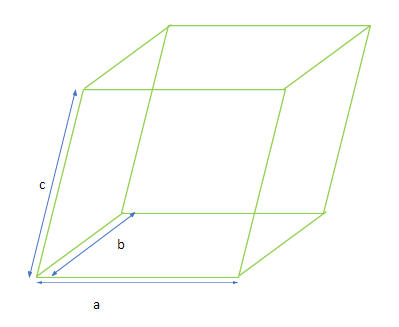
We need to find the volume of the parallelepiped having three coterminous edges as:
$\overrightarrow \alpha = \left( {\overrightarrow a .\overrightarrow a } \right)\overrightarrow a + \left( {\overrightarrow a .\overrightarrow b } \right)\overrightarrow c + \left( {\overrightarrow a .\overrightarrow c } \right)\overrightarrow c $ , $\overrightarrow \beta = \left( {\overrightarrow a .\overrightarrow b } \right)\overrightarrow a + \left( {\overrightarrow b .\overrightarrow b } \right)\overrightarrow b + \left( {\overrightarrow b .\overrightarrow c } \right)\overrightarrow c $, $\overrightarrow \gamma = \left( {\overrightarrow a .\overrightarrow c } \right)\overrightarrow a + \left( {\overrightarrow b .\overrightarrow c } \right)\overrightarrow b + \left( {\overrightarrow c .\overrightarrow c } \right)\overrightarrow c $
We know that the formula of the volume of the parallelepiped is given by the formula:
Volume = [$\overrightarrow a $ $\overrightarrow b $ $\overrightarrow c $] where $\overrightarrow a $, $\overrightarrow b $and $\overrightarrow c $ are the edges of the parallelepiped
The required volume of the parallelepiped will be: $\left[ \alpha \right.$ $\beta $ $\left. \gamma \right]$
$ \Rightarrow $volume = $\left| {\begin{array}{*{20}{c}}
{\left( {\overrightarrow a .\overrightarrow a } \right)\overrightarrow a }&{\left( {\overrightarrow a .\overrightarrow b } \right)\overrightarrow b }&{\left( {\overrightarrow a .\overrightarrow c } \right)\overrightarrow c } \\
{\left( {\overrightarrow a .\overrightarrow b } \right)\overrightarrow a }&{\left( {\overrightarrow b .\overrightarrow b } \right)\overrightarrow b }&{\left( {\overrightarrow b .\overrightarrow c } \right)\overrightarrow c } \\
{\left( {\overrightarrow a .\overrightarrow c } \right)\overrightarrow a }&{\left( {\overrightarrow b .\overrightarrow c } \right)\overrightarrow b }&{\left( {\overrightarrow c .\overrightarrow c } \right)\overrightarrow c }
\end{array}} \right|$
Or, we can write this by using the identity [$\overrightarrow a $ $\overrightarrow b $ $\overrightarrow c $] = $\left| {\begin{array}{*{20}{c}}
x&y&z \\
m&n&o \\
p&q&r
\end{array}} \right|$ where $\overrightarrow a = x\widehat i + y\widehat j + z\widehat k$, $\widehat b = m\widehat i + n\widehat j + o\widehat k$and $\widehat c = p\widehat i + q\widehat j + r\widehat k$,as:
$ \Rightarrow $volume = $\left| {\begin{array}{*{20}{c}}
{\left( {\overrightarrow a .\overrightarrow a } \right)}&{\left( {\overrightarrow a .\overrightarrow b } \right)}&{\left( {\overrightarrow a .\overrightarrow c } \right)} \\
{\left( {\overrightarrow a .\overrightarrow b } \right)}&{\left( {\overrightarrow b .\overrightarrow b } \right)}&{\left( {\overrightarrow b .\overrightarrow c } \right)} \\
{\left( {\overrightarrow a .\overrightarrow c } \right)}&{\left( {\overrightarrow b .\overrightarrow c } \right)}&{\left( {\overrightarrow c .\overrightarrow c } \right)}
\end{array}} \right|\left[ {\overrightarrow a } \right.$ $\overrightarrow b $ $\left. {\overrightarrow c } \right]$
Similarly, using the identity again, we can write this as:
$ \Rightarrow $volume = $\left| {\begin{array}{*{20}{c}}
{\overrightarrow a }&{\overrightarrow b }&{\overrightarrow c } \\
{\overrightarrow a }&{\overrightarrow b }&{\overrightarrow c } \\
{\overrightarrow a }&{\overrightarrow b }&{\overrightarrow c }
\end{array}} \right|$\[\left[ {\overrightarrow a } \right.\] $\overrightarrow b $ $\left. {\overrightarrow c } \right]$\[\left[ {\overrightarrow a } \right.\] $\overrightarrow b $ $\left. {\overrightarrow c } \right]$
$ \Rightarrow $volume = \[\left[ {\overrightarrow a } \right.\] $\overrightarrow b $ $\left. {\overrightarrow c } \right]$\[\left[ {\overrightarrow a } \right.\] $\overrightarrow b $ $\left. {\overrightarrow c } \right]$\[\left[ {\overrightarrow a } \right.\] $\overrightarrow b $ $\left. {\overrightarrow c } \right]$= \[\left[ {\overrightarrow a } \right.\] $\overrightarrow b $ ${\left. {\overrightarrow c } \right]^3}$
Now, we know that the volume V = \[\left[ {\overrightarrow a } \right.\] $\overrightarrow b $ $\left. {\overrightarrow c } \right]$
$ \Rightarrow $ volume of the required parallelepiped in terms of $ V = V^3$.
Hence, option(A) is correct.
Note: In such questions, you may get confused while solving the box product and you must be careful while using the identity to simplify the required volume of the given parallelepiped.
You may also solve this question by simplifying the volume using the formula of calculating the area of cross product or by using identities of the determinants.
x&y&z \\
m&n&o \\
p&q&r
\end{array}} \right|$ where $\overrightarrow a = x\widehat i + y\widehat j + z\widehat k$, $\widehat b = m\widehat i + n\widehat j + o\widehat k$and $\widehat c = p\widehat i + q\widehat j + r\widehat k$then, we will use the given volume V = [$\overrightarrow a $ $\overrightarrow b $ $\overrightarrow c $] to calculate the required volume.
Complete step-by-step answer:
We are given that the volume of the parallelepiped having three coterminous edges $\overrightarrow a $, $\overrightarrow b $ and $\overrightarrow c $is: V
We need to find the volume of the parallelepiped having three coterminous edges as:
$\overrightarrow \alpha = \left( {\overrightarrow a .\overrightarrow a } \right)\overrightarrow a + \left( {\overrightarrow a .\overrightarrow b } \right)\overrightarrow c + \left( {\overrightarrow a .\overrightarrow c } \right)\overrightarrow c $ , $\overrightarrow \beta = \left( {\overrightarrow a .\overrightarrow b } \right)\overrightarrow a + \left( {\overrightarrow b .\overrightarrow b } \right)\overrightarrow b + \left( {\overrightarrow b .\overrightarrow c } \right)\overrightarrow c $, $\overrightarrow \gamma = \left( {\overrightarrow a .\overrightarrow c } \right)\overrightarrow a + \left( {\overrightarrow b .\overrightarrow c } \right)\overrightarrow b + \left( {\overrightarrow c .\overrightarrow c } \right)\overrightarrow c $
We know that the formula of the volume of the parallelepiped is given by the formula:
Volume = [$\overrightarrow a $ $\overrightarrow b $ $\overrightarrow c $] where $\overrightarrow a $, $\overrightarrow b $and $\overrightarrow c $ are the edges of the parallelepiped
The required volume of the parallelepiped will be: $\left[ \alpha \right.$ $\beta $ $\left. \gamma \right]$
$ \Rightarrow $volume = $\left| {\begin{array}{*{20}{c}}
{\left( {\overrightarrow a .\overrightarrow a } \right)\overrightarrow a }&{\left( {\overrightarrow a .\overrightarrow b } \right)\overrightarrow b }&{\left( {\overrightarrow a .\overrightarrow c } \right)\overrightarrow c } \\
{\left( {\overrightarrow a .\overrightarrow b } \right)\overrightarrow a }&{\left( {\overrightarrow b .\overrightarrow b } \right)\overrightarrow b }&{\left( {\overrightarrow b .\overrightarrow c } \right)\overrightarrow c } \\
{\left( {\overrightarrow a .\overrightarrow c } \right)\overrightarrow a }&{\left( {\overrightarrow b .\overrightarrow c } \right)\overrightarrow b }&{\left( {\overrightarrow c .\overrightarrow c } \right)\overrightarrow c }
\end{array}} \right|$
Or, we can write this by using the identity [$\overrightarrow a $ $\overrightarrow b $ $\overrightarrow c $] = $\left| {\begin{array}{*{20}{c}}
x&y&z \\
m&n&o \\
p&q&r
\end{array}} \right|$ where $\overrightarrow a = x\widehat i + y\widehat j + z\widehat k$, $\widehat b = m\widehat i + n\widehat j + o\widehat k$and $\widehat c = p\widehat i + q\widehat j + r\widehat k$,as:
$ \Rightarrow $volume = $\left| {\begin{array}{*{20}{c}}
{\left( {\overrightarrow a .\overrightarrow a } \right)}&{\left( {\overrightarrow a .\overrightarrow b } \right)}&{\left( {\overrightarrow a .\overrightarrow c } \right)} \\
{\left( {\overrightarrow a .\overrightarrow b } \right)}&{\left( {\overrightarrow b .\overrightarrow b } \right)}&{\left( {\overrightarrow b .\overrightarrow c } \right)} \\
{\left( {\overrightarrow a .\overrightarrow c } \right)}&{\left( {\overrightarrow b .\overrightarrow c } \right)}&{\left( {\overrightarrow c .\overrightarrow c } \right)}
\end{array}} \right|\left[ {\overrightarrow a } \right.$ $\overrightarrow b $ $\left. {\overrightarrow c } \right]$
Similarly, using the identity again, we can write this as:
$ \Rightarrow $volume = $\left| {\begin{array}{*{20}{c}}
{\overrightarrow a }&{\overrightarrow b }&{\overrightarrow c } \\
{\overrightarrow a }&{\overrightarrow b }&{\overrightarrow c } \\
{\overrightarrow a }&{\overrightarrow b }&{\overrightarrow c }
\end{array}} \right|$\[\left[ {\overrightarrow a } \right.\] $\overrightarrow b $ $\left. {\overrightarrow c } \right]$\[\left[ {\overrightarrow a } \right.\] $\overrightarrow b $ $\left. {\overrightarrow c } \right]$
$ \Rightarrow $volume = \[\left[ {\overrightarrow a } \right.\] $\overrightarrow b $ $\left. {\overrightarrow c } \right]$\[\left[ {\overrightarrow a } \right.\] $\overrightarrow b $ $\left. {\overrightarrow c } \right]$\[\left[ {\overrightarrow a } \right.\] $\overrightarrow b $ $\left. {\overrightarrow c } \right]$= \[\left[ {\overrightarrow a } \right.\] $\overrightarrow b $ ${\left. {\overrightarrow c } \right]^3}$
Now, we know that the volume V = \[\left[ {\overrightarrow a } \right.\] $\overrightarrow b $ $\left. {\overrightarrow c } \right]$
$ \Rightarrow $ volume of the required parallelepiped in terms of $ V = V^3$.
Hence, option(A) is correct.
Note: In such questions, you may get confused while solving the box product and you must be careful while using the identity to simplify the required volume of the given parallelepiped.
You may also solve this question by simplifying the volume using the formula of calculating the area of cross product or by using identities of the determinants.
Recently Updated Pages
Master Class 11 Social Science: Engaging Questions & Answers for Success

Master Class 11 Physics: Engaging Questions & Answers for Success
Master Class 11 Maths: Engaging Questions & Answers for Success
Master Class 11 Economics: Engaging Questions & Answers for Success
Master Class 11 Computer Science: Engaging Questions & Answers for Success
Master Class 11 Chemistry: Engaging Questions & Answers for Success
Trending doubts
One Metric ton is equal to kg A 10000 B 1000 C 100 class 11 physics CBSE
There are 720 permutations of the digits 1 2 3 4 5 class 11 maths CBSE
1 Quintal is equal to a 110 kg b 10 kg c 100kg d 1000 class 11 physics CBSE
State and prove Bernoullis theorem class 11 physics CBSE
Difference Between Prokaryotic Cells and Eukaryotic Cells
Discuss the various forms of bacteria class 11 biology CBSE