




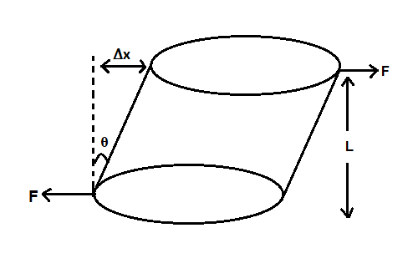
If two equal and opposite deforming forces are applied parallel to the cross sectional area of the cylinder as shown in the figure, there is relative displacement b/w the opposite faces of the cylinder. The ratio $\Delta x$ to $L$ is known as
(a) Longitudinal strain
(b) Volumetric strain
(c) Shearing strain
(d) Poisson’s ratio
Answer
 Verified
597.6k+ views
Hint:: This relates to the ratio of change in configuration to the original configuration. So, it deals with strain. Strain is the ratio of change in length after deformation to the original length. Strain has no units.
Complete step by step answer:
It is defined as the angle by which the plane perpendicular to the fixed surface of the block is rotated under the action of a tangential force, it is denoted by $\theta $.
We know that the value of tangent function is the ratio of the opposite side and adjacent side to the angle. Here $\Delta x$ is the opposite side length and L is the adjacent side length to the angle $\theta $
Therefore, $\tan \theta = \dfrac{{\Delta x}}{L}$
Strain is the measure of how much an object is deformed. It is the ratio of change in length to the original length.Here as we can see, the strain is a tangential function.Therefore, the strain is a tangential strain. Tangential strain is also known as Shearing strain.
Hence, the correct one is Option C, Shearing strain.
Note: Longitudinal strain is the change in the longitudinal length to the original length whereas tangential strain occurs when the deforming force acts parallel to the surface area and there is a change in the displacement of the plane over distance of that surface from the opposite plane after deforming. These two strains are almost similar in definition and formula, but they are different. Do not be muddled about these strains.
Complete step by step answer:
It is defined as the angle by which the plane perpendicular to the fixed surface of the block is rotated under the action of a tangential force, it is denoted by $\theta $.
We know that the value of tangent function is the ratio of the opposite side and adjacent side to the angle. Here $\Delta x$ is the opposite side length and L is the adjacent side length to the angle $\theta $
Therefore, $\tan \theta = \dfrac{{\Delta x}}{L}$
Strain is the measure of how much an object is deformed. It is the ratio of change in length to the original length.Here as we can see, the strain is a tangential function.Therefore, the strain is a tangential strain. Tangential strain is also known as Shearing strain.
Hence, the correct one is Option C, Shearing strain.
Note: Longitudinal strain is the change in the longitudinal length to the original length whereas tangential strain occurs when the deforming force acts parallel to the surface area and there is a change in the displacement of the plane over distance of that surface from the opposite plane after deforming. These two strains are almost similar in definition and formula, but they are different. Do not be muddled about these strains.
Recently Updated Pages
Master Class 11 Social Science: Engaging Questions & Answers for Success

Master Class 11 Physics: Engaging Questions & Answers for Success
Master Class 11 Maths: Engaging Questions & Answers for Success
Master Class 11 Economics: Engaging Questions & Answers for Success
Master Class 11 Computer Science: Engaging Questions & Answers for Success
Master Class 11 Chemistry: Engaging Questions & Answers for Success
Trending doubts
One Metric ton is equal to kg A 10000 B 1000 C 100 class 11 physics CBSE
There are 720 permutations of the digits 1 2 3 4 5 class 11 maths CBSE
1 Quintal is equal to a 110 kg b 10 kg c 100kg d 1000 class 11 physics CBSE
State and prove Bernoullis theorem class 11 physics CBSE
Difference Between Prokaryotic Cells and Eukaryotic Cells
Which among the following are examples of coming together class 11 social science CBSE