




If two chords of a circle are equidistant from the center of the circle then they are
(a)Equal to each other
(b)Not equal to each other
(c)Intersect each other
(d)None of these
Answer
 Verified
603.3k+ views
Hint: Draw a circle, let AB and CD be the chords and E the center. Prove that the triangle, AEB and CED are congruent. Draw \[EF\bot AB\] & \[EG\bot CD\]. Prove that the triangle AEF, BEF, CEG, DEG are similar to each other. Then by CPCT prove that EF = EG i.e. the chords are equidistant from the center.
Complete step-by-step answer:
Let's consider AB and CD are the two chords of the circle. Let E be the center of the circle. It is said that the two chords are equidistant from the center of the circle.
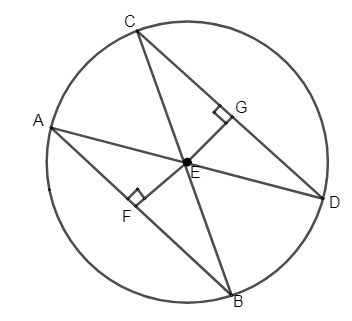
Hence we can say that AB and CD are equidistant from point E.
Now let us join EA, EB, EC and ED. Thus we get two triangles \[\Delta AEB\] and \[\Delta CED\]. Let us check if they are congruent.
EA = EB = EC = ED, all there are the radius of the circle. Thus all the radii in a triangle are the same. Hence by SSS congruence we can say that three sides of \[\Delta AEB\] is equal to three sides of \[\Delta CED\]. Hence we can say that \[\Delta AEB\] and \[\Delta CED\] are similar.
\[\therefore \Delta AEB\cong \Delta CED\]
Now let us draw the altitudes of the isosceles triangles. Let EF be the altitude in \[\Delta EAB\] and EG be the altitude in \[\Delta CED\]. Thus we can say that, \[EF\bot AB\] & \[EG\bot CD\].
We know that as \[EF\bot AB\], the angle made will be \[{{90}^{\circ }}\].
i.e. \[\angle EFA=\angle EFB={{90}^{\circ }}\], they are right angles.
Similarly, as \[EG\bot CD\], the angle made will be right angles,
i.e. \[\angle EGC=\angle EGD={{90}^{\circ }}\]
Thus we can say that,
\[\angle EFA=\angle EFB=\angle EGC=\angle EGD\], all right angles are equal.
Thus we can say from the figure, \[\Delta AEF,\Delta BEF,\Delta CGE\] and \[\Delta GDE\] are equal as per AAS criteria, which is two angles and one side are equal i.e.
In \[\Delta AEF\] and \[\Delta BEF\]
EA = EB [radius of the circle]
\[\angle EFA=\angle EFB={{90}^{\circ }}\] [right angles]
\[\angle AEF=\angle BEF\] [angle subtended by the radius of the circle is equal]
\[\therefore \Delta AEF\cong \Delta BEF\] [similar by AAS criteria]
Similarly, we can say that,
\[\Delta AEF\cong \Delta BEF\cong \Delta CEG\cong \Delta DEG\]
Hence by CPCT [corresponding parts of the congruent triangle] we can say that, EF = EG.
Hence EF and EG are equal. AB and CD are equidistant from the center of the center E.
Thus if two chords are equidistant from the center of a circle, then the chords are equal.
Hence, if two chords are equidistant from the center the center of the circle then they are equal to each other.
\[\therefore \] Option (a) is the correct answer.
Note: We have been told that EF = EG.
\[\therefore \] In \[\Delta AEF\], where AE = r, applying Pythagoras theorem, we get
\[\Rightarrow \]\[A{{E}^{2}}=E{{F}^{2}}+A{{F}^{2}}\Rightarrow A{{F}^{2}}={{r}^{2}}-E{{F}^{2}}\]
In \[\Delta CGE\], where CE = r, EF = EG, applying Pythagoras theorem, we get
\[\Rightarrow C{{E}^{2}}=E{{G}^{2}}+C{{G}^{2}}\Rightarrow C{{G}^{2}}={{r}^{2}}-E{{G}^{2}}={{r}^{2}}-E{{F}^{2}}\]
\[\Rightarrow A{{F}^{2}}=C{{G}^{2}}\] i.e. \[AF=CG\] i.e. AB = CD
Complete step-by-step answer:
Let's consider AB and CD are the two chords of the circle. Let E be the center of the circle. It is said that the two chords are equidistant from the center of the circle.
Hence we can say that AB and CD are equidistant from point E.
Now let us join EA, EB, EC and ED. Thus we get two triangles \[\Delta AEB\] and \[\Delta CED\]. Let us check if they are congruent.
EA = EB = EC = ED, all there are the radius of the circle. Thus all the radii in a triangle are the same. Hence by SSS congruence we can say that three sides of \[\Delta AEB\] is equal to three sides of \[\Delta CED\]. Hence we can say that \[\Delta AEB\] and \[\Delta CED\] are similar.
\[\therefore \Delta AEB\cong \Delta CED\]
Now let us draw the altitudes of the isosceles triangles. Let EF be the altitude in \[\Delta EAB\] and EG be the altitude in \[\Delta CED\]. Thus we can say that, \[EF\bot AB\] & \[EG\bot CD\].
We know that as \[EF\bot AB\], the angle made will be \[{{90}^{\circ }}\].
i.e. \[\angle EFA=\angle EFB={{90}^{\circ }}\], they are right angles.
Similarly, as \[EG\bot CD\], the angle made will be right angles,
i.e. \[\angle EGC=\angle EGD={{90}^{\circ }}\]
Thus we can say that,
\[\angle EFA=\angle EFB=\angle EGC=\angle EGD\], all right angles are equal.
Thus we can say from the figure, \[\Delta AEF,\Delta BEF,\Delta CGE\] and \[\Delta GDE\] are equal as per AAS criteria, which is two angles and one side are equal i.e.
In \[\Delta AEF\] and \[\Delta BEF\]
EA = EB [radius of the circle]
\[\angle EFA=\angle EFB={{90}^{\circ }}\] [right angles]
\[\angle AEF=\angle BEF\] [angle subtended by the radius of the circle is equal]
\[\therefore \Delta AEF\cong \Delta BEF\] [similar by AAS criteria]
Similarly, we can say that,
\[\Delta AEF\cong \Delta BEF\cong \Delta CEG\cong \Delta DEG\]
Hence by CPCT [corresponding parts of the congruent triangle] we can say that, EF = EG.
Hence EF and EG are equal. AB and CD are equidistant from the center of the center E.
Thus if two chords are equidistant from the center of a circle, then the chords are equal.
Hence, if two chords are equidistant from the center the center of the circle then they are equal to each other.
\[\therefore \] Option (a) is the correct answer.
Note: We have been told that EF = EG.
\[\therefore \] In \[\Delta AEF\], where AE = r, applying Pythagoras theorem, we get
\[\Rightarrow \]\[A{{E}^{2}}=E{{F}^{2}}+A{{F}^{2}}\Rightarrow A{{F}^{2}}={{r}^{2}}-E{{F}^{2}}\]
In \[\Delta CGE\], where CE = r, EF = EG, applying Pythagoras theorem, we get
\[\Rightarrow C{{E}^{2}}=E{{G}^{2}}+C{{G}^{2}}\Rightarrow C{{G}^{2}}={{r}^{2}}-E{{G}^{2}}={{r}^{2}}-E{{F}^{2}}\]
\[\Rightarrow A{{F}^{2}}=C{{G}^{2}}\] i.e. \[AF=CG\] i.e. AB = CD
Recently Updated Pages
Master Class 10 Computer Science: Engaging Questions & Answers for Success

Master Class 10 General Knowledge: Engaging Questions & Answers for Success
Master Class 10 English: Engaging Questions & Answers for Success
Master Class 10 Social Science: Engaging Questions & Answers for Success
Master Class 10 Maths: Engaging Questions & Answers for Success
Master Class 10 Science: Engaging Questions & Answers for Success
Trending doubts
What is the median of the first 10 natural numbers class 10 maths CBSE
Which women's tennis player has 24 Grand Slam singles titles?
Who is the Brand Ambassador of Incredible India?
Why is there a time difference of about 5 hours between class 10 social science CBSE
Write a letter to the principal requesting him to grant class 10 english CBSE
A moving boat is observed from the top of a 150 m high class 10 maths CBSE