




If the tangents drawn at P (3,2$\sqrt{3}$ ) and Q (2, -2$\sqrt{2}$ ) to the parabola ${{y}^{2}}=4x$ intersects at T. Then find the co-ordinates of T and ar $\Delta $ PQT: ar $\Delta $ VPQ, where V is the vertex of the parabola.
Answer
 Verified
602.4k+ views
Hint: In order to solve the above problem, first we will find tangent at P and Q and then solve these tangent equations to get the intersection point T. Then we will find the area of $\Delta $ PQT using determinant formula, that is suppose if the coordinates of vertex of a triangle is given as A , B $\left( {{x}_{2}},{{y}_{2}} \right)$ and C $\left( {{x}_{3}},{{y}_{3}} \right)$ then the area of triangle ABC using determinant formula is given by $\left| \begin{matrix}
{{x}_{1}} & {{y}_{1}} & 1 \\
{{x}_{2}} & {{y}_{2}} & 1 \\
{{x}_{3}} & {{y}_{3}} & 1 \\
\end{matrix} \right|$. And then we will find the area of $\Delta $ VPQ using same determinant formula, where V is vertex of parabola. After that we will find the ratio of their areas and get the desired result.
Complete step by step answer:
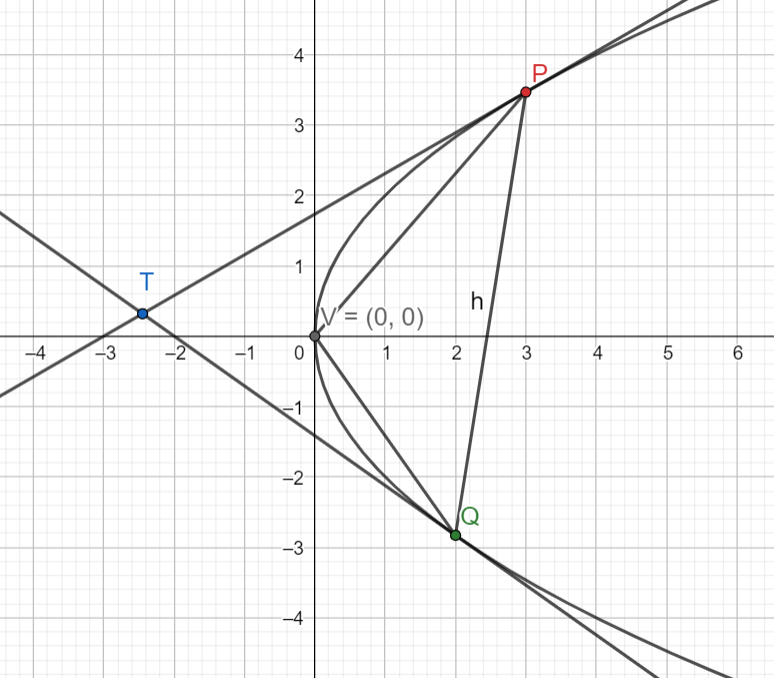
The equation of given parabola is ${{y}^{2}}=4x$
Generally, equation of tangent to a parabola ${{y}^{2}}=4ax$ at $({{x}_{1}},{{y}_{1}})$ is given by $y{{y}_{1}}-2a(x+{{x}_{1}})=0$ , so the equation of tangent to the parabola at point P (3,2$\sqrt{3}$ ) is given by $y(2\sqrt{3})-2(x+2)=0$ i.e. \[\sqrt{3}y-x-3=0\] .........(i)
and the equation of tangent to the parabola at Q (2, -2$\sqrt{2}$ ) is given by $y(-2\sqrt{2})-2(x+2)=0$ i.e. $\sqrt{2}y+x+2=0$ ...........(ii)
Adding equations (i) and (ii), we get
$\begin{align}
& y(\sqrt{2}+\sqrt{3})-1=0 \\
& \Rightarrow y=\dfrac{1}{\sqrt{2}+\sqrt{3}} \\
& \Rightarrow y=\dfrac{1}{\sqrt{2}+\sqrt{3}}\times \dfrac{\sqrt{2}-\sqrt{3}}{\sqrt{2}-\sqrt{3}} \\
& \Rightarrow y=\sqrt{2}-\sqrt{3} \\
\end{align}$
Putting ,the value of y in equation (i), we get
$\begin{align}
& \sqrt{3}(\sqrt{3}-\sqrt{2})-x-3=0 \\
& \Rightarrow x=-\sqrt{6} \\
\end{align}$
Therefore coordinate of T is $(-\sqrt{6},\sqrt{3}-\sqrt{2})$ .
Now, we have, P (3,2$\sqrt{3}$ ), Q (2, -2$\sqrt{2}$ ), T$(-\sqrt{6},\sqrt{3}-\sqrt{2})$,
$\therefore $ Area of $\Delta $ PQT =
$\dfrac{1}{2}\left| \begin{matrix}
3 & 2\sqrt{3} & 1 \\
2 & -2\sqrt{2} & 1 \\
-\sqrt{6} & \sqrt{3}-\sqrt{2} & 1 \\
\end{matrix} \right|$
Applying row transformations on ${{R}_{1}}\text{ and }{{R}_{2}}$ that is ${{R}_{1}}\to {{R}_{1}}-{{R}_{3}}\text{ and }{{R}_{2}}\to {{R}_{2}}-{{R}_{3}}$ , we have
Area of $\Delta $ PQT =
$\dfrac{1}{2}\left| \begin{matrix}
3+\sqrt{6} & \sqrt{3}+\sqrt{2} & 0 \\
2+\sqrt{6} & -\sqrt{3}-\sqrt{2} & 0 \\
-\sqrt{6} & \sqrt{3}-\sqrt{2} & 1 \\
\end{matrix} \right|$
Expanding the determinant along ${{C}_{3}}$ , we have
Area of $\Delta $ PQT
$\begin{align}
& =\dfrac{1}{2}\left[ -\sqrt{3}\left( \sqrt{3}+\sqrt{2} \right)\left( \sqrt{3}+\sqrt{2} \right)-\sqrt{2}\left( \sqrt{3}+\sqrt{2} \right)\left( \sqrt{3}+\sqrt{2} \right) \right] \\
& =\dfrac{1}{2}\left[ -{{\left( \sqrt{3}+\sqrt{2} \right)}^{2}}\left( \sqrt{3}+\sqrt{2} \right) \right] \\
& ={{\dfrac{-\left( \sqrt{3}+\sqrt{2} \right)}{2}}^{3}} \\
\end{align}$
But since area is always positive, so taking modulus of area, we have
$\text{Area of }\Delta \text{PQT}=\left| \dfrac{-{{\left( \sqrt{3}+\sqrt{2} \right)}^{3}}}{2} \right|=\dfrac{{{\left( \sqrt{3}+\sqrt{2} \right)}^{3}}}{2}$
Similarly, we have P (3,2$\sqrt{3}$ ), Q (2, -2$\sqrt{2}$ ), V (0,0) ,
$\therefore $ Area of $\Delta $ VPQ $=\dfrac{1}{2}\left| \begin{matrix}
0 & 0 & 1 \\
2 & 2\sqrt{3} & 1 \\
2 & -2\sqrt{2} & 1 \\
\end{matrix} \right|$
Expanding the determinant along ${{R}_{\,1}}$ , we have
Area of $\Delta $ VPQ
\[\begin{align}
& =\dfrac{1}{2}\left[ 1\left( -6\sqrt{2}-4\sqrt{3} \right) \right] \\
& =\dfrac{1}{2}\left[ -2\sqrt{6}\left( \sqrt{3}+\sqrt{2} \right) \right] \\
& =\dfrac{-2\sqrt{6}\left( \sqrt{3}+\sqrt{2} \right)}{2} \\
\end{align}\]
But since area is always positive taking modulus of area,we have
Area of $\Delta $ VPQ
\[=\left| \dfrac{-2\sqrt{6}\left( \sqrt{3}+\sqrt{2} \right)}{2} \right|=\dfrac{2\sqrt{6}\left( \sqrt{3}+\sqrt{2} \right)}{2}\]
Now, ar $\Delta $ PQT: ar $\Delta $ VPQ
$\begin{align}
& =\dfrac{\text{area of }\Delta \text{PQT}}{\text{area of }\Delta \text{VPQ}} \\
& =\dfrac{\dfrac{{{\left( \sqrt{3}+\sqrt{2} \right)}^{3}}}{2}}{\dfrac{2\sqrt{6}\left( \sqrt{3}+\sqrt{2} \right)}{2}} \\
& =\dfrac{{{\left( \sqrt{3}+\sqrt{2} \right)}^{2}}}{2\sqrt{6}} \\
& =\dfrac{3+2+2\sqrt{6}}{2\sqrt{6}} \\
& =\dfrac{5}{2\sqrt{6}}+1=\dfrac{5}{2\sqrt{6}}\times \dfrac{\sqrt{6}}{\sqrt{6}}+1=\dfrac{5\sqrt{6}}{12}+1 \\
\end{align}$
$\therefore $ ar $\Delta $ PQT: ar $\Delta $ VPQ = $5\sqrt{6}+12:12$
Note:
Here in this problem, while calculating the area of $\Delta $ PQT , direct expansion of the determinant becomes complex, so in order to avoid this try to use the property of determinant as used above in the solution to make calculations easier.
{{x}_{1}} & {{y}_{1}} & 1 \\
{{x}_{2}} & {{y}_{2}} & 1 \\
{{x}_{3}} & {{y}_{3}} & 1 \\
\end{matrix} \right|$. And then we will find the area of $\Delta $ VPQ using same determinant formula, where V is vertex of parabola. After that we will find the ratio of their areas and get the desired result.
Complete step by step answer:
The equation of given parabola is ${{y}^{2}}=4x$
Generally, equation of tangent to a parabola ${{y}^{2}}=4ax$ at $({{x}_{1}},{{y}_{1}})$ is given by $y{{y}_{1}}-2a(x+{{x}_{1}})=0$ , so the equation of tangent to the parabola at point P (3,2$\sqrt{3}$ ) is given by $y(2\sqrt{3})-2(x+2)=0$ i.e. \[\sqrt{3}y-x-3=0\] .........(i)
and the equation of tangent to the parabola at Q (2, -2$\sqrt{2}$ ) is given by $y(-2\sqrt{2})-2(x+2)=0$ i.e. $\sqrt{2}y+x+2=0$ ...........(ii)
Adding equations (i) and (ii), we get
$\begin{align}
& y(\sqrt{2}+\sqrt{3})-1=0 \\
& \Rightarrow y=\dfrac{1}{\sqrt{2}+\sqrt{3}} \\
& \Rightarrow y=\dfrac{1}{\sqrt{2}+\sqrt{3}}\times \dfrac{\sqrt{2}-\sqrt{3}}{\sqrt{2}-\sqrt{3}} \\
& \Rightarrow y=\sqrt{2}-\sqrt{3} \\
\end{align}$
Putting ,the value of y in equation (i), we get
$\begin{align}
& \sqrt{3}(\sqrt{3}-\sqrt{2})-x-3=0 \\
& \Rightarrow x=-\sqrt{6} \\
\end{align}$
Therefore coordinate of T is $(-\sqrt{6},\sqrt{3}-\sqrt{2})$ .
Now, we have, P (3,2$\sqrt{3}$ ), Q (2, -2$\sqrt{2}$ ), T$(-\sqrt{6},\sqrt{3}-\sqrt{2})$,
$\therefore $ Area of $\Delta $ PQT =
$\dfrac{1}{2}\left| \begin{matrix}
3 & 2\sqrt{3} & 1 \\
2 & -2\sqrt{2} & 1 \\
-\sqrt{6} & \sqrt{3}-\sqrt{2} & 1 \\
\end{matrix} \right|$
Applying row transformations on ${{R}_{1}}\text{ and }{{R}_{2}}$ that is ${{R}_{1}}\to {{R}_{1}}-{{R}_{3}}\text{ and }{{R}_{2}}\to {{R}_{2}}-{{R}_{3}}$ , we have
Area of $\Delta $ PQT =
$\dfrac{1}{2}\left| \begin{matrix}
3+\sqrt{6} & \sqrt{3}+\sqrt{2} & 0 \\
2+\sqrt{6} & -\sqrt{3}-\sqrt{2} & 0 \\
-\sqrt{6} & \sqrt{3}-\sqrt{2} & 1 \\
\end{matrix} \right|$
Expanding the determinant along ${{C}_{3}}$ , we have
Area of $\Delta $ PQT
$\begin{align}
& =\dfrac{1}{2}\left[ -\sqrt{3}\left( \sqrt{3}+\sqrt{2} \right)\left( \sqrt{3}+\sqrt{2} \right)-\sqrt{2}\left( \sqrt{3}+\sqrt{2} \right)\left( \sqrt{3}+\sqrt{2} \right) \right] \\
& =\dfrac{1}{2}\left[ -{{\left( \sqrt{3}+\sqrt{2} \right)}^{2}}\left( \sqrt{3}+\sqrt{2} \right) \right] \\
& ={{\dfrac{-\left( \sqrt{3}+\sqrt{2} \right)}{2}}^{3}} \\
\end{align}$
But since area is always positive, so taking modulus of area, we have
$\text{Area of }\Delta \text{PQT}=\left| \dfrac{-{{\left( \sqrt{3}+\sqrt{2} \right)}^{3}}}{2} \right|=\dfrac{{{\left( \sqrt{3}+\sqrt{2} \right)}^{3}}}{2}$
Similarly, we have P (3,2$\sqrt{3}$ ), Q (2, -2$\sqrt{2}$ ), V (0,0) ,
$\therefore $ Area of $\Delta $ VPQ $=\dfrac{1}{2}\left| \begin{matrix}
0 & 0 & 1 \\
2 & 2\sqrt{3} & 1 \\
2 & -2\sqrt{2} & 1 \\
\end{matrix} \right|$
Expanding the determinant along ${{R}_{\,1}}$ , we have
Area of $\Delta $ VPQ
\[\begin{align}
& =\dfrac{1}{2}\left[ 1\left( -6\sqrt{2}-4\sqrt{3} \right) \right] \\
& =\dfrac{1}{2}\left[ -2\sqrt{6}\left( \sqrt{3}+\sqrt{2} \right) \right] \\
& =\dfrac{-2\sqrt{6}\left( \sqrt{3}+\sqrt{2} \right)}{2} \\
\end{align}\]
But since area is always positive taking modulus of area,we have
Area of $\Delta $ VPQ
\[=\left| \dfrac{-2\sqrt{6}\left( \sqrt{3}+\sqrt{2} \right)}{2} \right|=\dfrac{2\sqrt{6}\left( \sqrt{3}+\sqrt{2} \right)}{2}\]
Now, ar $\Delta $ PQT: ar $\Delta $ VPQ
$\begin{align}
& =\dfrac{\text{area of }\Delta \text{PQT}}{\text{area of }\Delta \text{VPQ}} \\
& =\dfrac{\dfrac{{{\left( \sqrt{3}+\sqrt{2} \right)}^{3}}}{2}}{\dfrac{2\sqrt{6}\left( \sqrt{3}+\sqrt{2} \right)}{2}} \\
& =\dfrac{{{\left( \sqrt{3}+\sqrt{2} \right)}^{2}}}{2\sqrt{6}} \\
& =\dfrac{3+2+2\sqrt{6}}{2\sqrt{6}} \\
& =\dfrac{5}{2\sqrt{6}}+1=\dfrac{5}{2\sqrt{6}}\times \dfrac{\sqrt{6}}{\sqrt{6}}+1=\dfrac{5\sqrt{6}}{12}+1 \\
\end{align}$
$\therefore $ ar $\Delta $ PQT: ar $\Delta $ VPQ = $5\sqrt{6}+12:12$
Note:
Here in this problem, while calculating the area of $\Delta $ PQT , direct expansion of the determinant becomes complex, so in order to avoid this try to use the property of determinant as used above in the solution to make calculations easier.
Recently Updated Pages
Master Class 10 Social Science: Engaging Questions & Answers for Success

Master Class 10 Science: Engaging Questions & Answers for Success
Master Class 10 Maths: Engaging Questions & Answers for Success
Master Class 10 General Knowledge: Engaging Questions & Answers for Success
Master Class 10 Computer Science: Engaging Questions & Answers for Success
Class 10 Question and Answer - Your Ultimate Solutions Guide
Trending doubts
What is the full form of PNG A Petrol Natural Gas B class 10 chemistry CBSE
Why is there a time difference of about 5 hours between class 10 social science CBSE
Distinguish between the reserved forests and protected class 10 biology CBSE
Metals which do not react with dilute acids beginarray20l class 10 chemistry CBSE
If a trait A exists in 10 of a population of an asexually class 10 biology CBSE
Find the value of log sqrt 2 64 class 10 maths CBSE