




If the sides of a triangle are 5, 6, 10, then the length of the median of the biggest side is:
A. $ \sqrt{\dfrac{13}{2}} $
B. $ \sqrt{\dfrac{11}{2}} $
C. $ \sqrt{\dfrac{17}{2}} $
D. $ \sqrt{\dfrac{19}{2}} $
Answer
 Verified
589.5k+ views
Hint:The Apollonius theorem: states that "the sum of the squares of any two sides of any triangle equals twice the square on half the third side, together with twice the square on the median bisecting the third side". Specifically, in any triangle ABC, if AD is a median, then: $ A{{B}^{2}} $ + $ A{{C}^{2}} $ = $ 2\left(
A{{D}^{2}}+B{{D}^{2}} \right) $ .
If AD is the median to the longest side, what will be the values of AB, AC and BD in the above formula?
Complete step by step solution:
Let's say that the required median is AD, where D is the mid−point of the longest side BC opposite to
vertex A.
∴ BC = 10, AC = 6 and AB = 5.
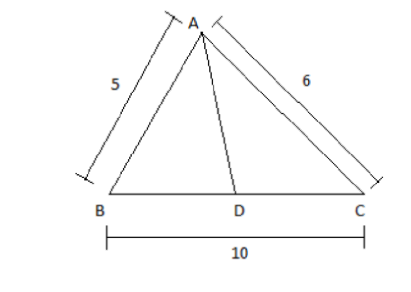
Since D is the mid−point of BC, BD = DC = $ \dfrac{10}{2} $ = 5.
Using the Apollonius theorem, we have:
$ A{{B}^{2}} $ + $ A{{C}^{2}} $ = $ 2\left( A{{D}^{2}}+B{{D}^{2}} \right) $
Substituting the values, we get:
⇒ $ {{5}^{2}} $ + $ {{6}^{2}} $ = $ 2\left( A{{D}^{2}}+{{5}^{2}} \right) $
⇒ 25 + 36 = $ 2A{{D}^{2}} $ + 50
Subtracting 50 from both sides, we get:
⇒ $ 2A{{D}^{2}} $ = 11
Divide by 2 on both sides and take square root:
⇒ AD = $ \sqrt{\dfrac{11}{2}} $ .
Therefore, the correct answer is B. $ \sqrt{\dfrac{11}{2}} $ .
Note:Median is the line joining the mid−point of a side to the opposite vertex. All medians of a triangle are concurrent. The point of intersection of the medians is called the centroid and it divides each of the medians in the ratio 2 : 1, from the vertex. We can also drop a perpendicular on the longest side and solve using Pythagoras theorem, if we don't remember the formula well.
A{{D}^{2}}+B{{D}^{2}} \right) $ .
If AD is the median to the longest side, what will be the values of AB, AC and BD in the above formula?
Complete step by step solution:
Let's say that the required median is AD, where D is the mid−point of the longest side BC opposite to
vertex A.
∴ BC = 10, AC = 6 and AB = 5.
Since D is the mid−point of BC, BD = DC = $ \dfrac{10}{2} $ = 5.
Using the Apollonius theorem, we have:
$ A{{B}^{2}} $ + $ A{{C}^{2}} $ = $ 2\left( A{{D}^{2}}+B{{D}^{2}} \right) $
Substituting the values, we get:
⇒ $ {{5}^{2}} $ + $ {{6}^{2}} $ = $ 2\left( A{{D}^{2}}+{{5}^{2}} \right) $
⇒ 25 + 36 = $ 2A{{D}^{2}} $ + 50
Subtracting 50 from both sides, we get:
⇒ $ 2A{{D}^{2}} $ = 11
Divide by 2 on both sides and take square root:
⇒ AD = $ \sqrt{\dfrac{11}{2}} $ .
Therefore, the correct answer is B. $ \sqrt{\dfrac{11}{2}} $ .
Note:Median is the line joining the mid−point of a side to the opposite vertex. All medians of a triangle are concurrent. The point of intersection of the medians is called the centroid and it divides each of the medians in the ratio 2 : 1, from the vertex. We can also drop a perpendicular on the longest side and solve using Pythagoras theorem, if we don't remember the formula well.
Recently Updated Pages
Master Class 12 Business Studies: Engaging Questions & Answers for Success

Master Class 12 Biology: Engaging Questions & Answers for Success
Master Class 12 Chemistry: Engaging Questions & Answers for Success
Class 12 Question and Answer - Your Ultimate Solutions Guide
Master Class 11 Social Science: Engaging Questions & Answers for Success
Master Class 11 English: Engaging Questions & Answers for Success
Trending doubts
Explain the Treaty of Vienna of 1815 class 10 social science CBSE
Who Won 36 Oscar Awards? Record Holder Revealed
What is the median of the first 10 natural numbers class 10 maths CBSE
Why is it 530 pm in india when it is 1200 afternoon class 10 social science CBSE
What is the full form of POSCO class 10 social science CBSE
The highest temperature in Karnataka is recorded in class 10 social science CBSE