




If the ratio of maximum and minimum intensities in an interference pattern is $36:1$ then What will be the ratio of amplitudes of two interfering waves?
A. $5:7$
B. $7:4$
C. $4:7$
D. $7:5$
Answer
 Verified
613.8k+ views
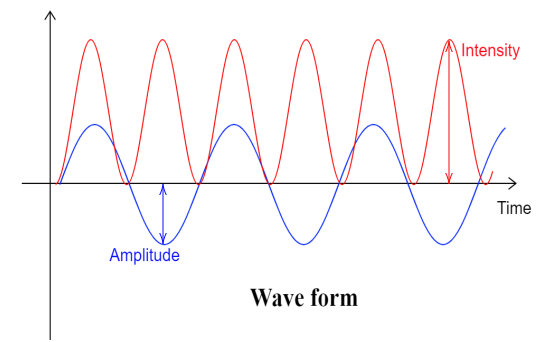
Hint: The wave interference pattern is formed when two waves intersect each other. While intersecting, the intensity will change according to the intensity of the two waves. Similarly, the amplitude also gets changed based on the amplitude of the two waves. Using the given ratio of intensity, the ratio of amplitude can be calculated.
Formula used:
In wave interference, the maximum intensity, ${I_{\max }} = {\left( {\sqrt {\dfrac{{{I_1}}}{{{I_2}}}} + 1} \right)^2}$
And the minimum intensity, ${I_{\min }} = {\left( {\sqrt {\dfrac{{{I_1}}}{{{I_2}}}} - 1} \right)^2}$
Also, the relation between intensity and amplitude,
$I \propto {A^2}$
Complete step by step answer:
Given, the ratio of maximum and minimum intensities in an interference pattern,
${I_{\max }}:{I_{\min }} = 36:1$
Thus, $\dfrac{{{I_{\max }}}}{{{I_{\min }}}} = \dfrac{{36}}{1}$
By substituting the values of ${I_{\max }}$ and ${I_{\min }}$ in above equation, we get
$\dfrac{{{{\left( {\sqrt {\dfrac{{{I_1}}}{{{I_2}}}} + 1} \right)}^2}}}{{{{\left( {\sqrt {\dfrac{{{I_1}}}{{{I_2}}}} - 1} \right)}^2}}} = \dfrac{{36}}{1}\;.....................................\left( 1 \right)$
Since, the relation between intensity and amplitude,
$I \propto {A^2}$
So, $A \propto \sqrt I $, used in equation (1).
$ \Rightarrow \dfrac{{{{\left( {\dfrac{{{A_1}}}{{{A_2}}} + 1} \right)}^2}}}{{{{\left( {\dfrac{{{A_1}}}{{{A_2}}} - 1} \right)}^2}}} = \dfrac{{36}}{1}\;$
Taking square root on both sides,
$ \Rightarrow \dfrac{{\left( {\dfrac{{{A_1}}}{{{A_2}}} + 1} \right)}}{{\left( {\dfrac{{{A_1}}}{{{A_2}}} - 1} \right)}} = \sqrt {36} \;$
By rearranging the terms, we get
$
\Rightarrow \left( {\dfrac{{{A_1}}}{{{A_2}}} + 1} \right) = 6 \times \left( {\dfrac{{{A_1}}}{{{A_2}}} - 1} \right)\; \\
\Rightarrow \left( {\dfrac{{{A_1} + {A_2}}}{{{A_2}}}} \right) = 6 \times \left( {\dfrac{{{A_1} - {A_2}}}{{{A_2}}}} \right)\; \\
$
Canceling common tern in both sides,
$
\Rightarrow \left( {{A_1} + {A_2}} \right) = 6\left( {{A_1} - {A_2}} \right) \\
\Rightarrow {A_1} + {A_2} = 6{A_1} - 6{A_2} \\
$
By performing arithmetic operations,
$
\Rightarrow {A_2} + 6{A_2} = 6{A_1} - {A_1} \\
\Rightarrow 7{A_2} = 5{A_1} \\
$
Hence, the final ratio $\dfrac{{{A_1}}}{{{A_2}}} = \dfrac{7}{5}$
$\therefore {A_1}:{A_2} = 7:5$
$\therefore $ The ratio of amplitudes of two interfering waves is$7:5$. Hence, the option (D) is correct.
Note:
The intensity of the wave is directly proportional to the amplitude of the wave. When the amplitude gets increased, then the intensity gets increased. Intensity is proportional to the square of the amplitude. It means the negative side of the wave gets multiplied to the positive side to get intensity. Thus, the sign doesn’t matter in intensity.
Formula used:
In wave interference, the maximum intensity, ${I_{\max }} = {\left( {\sqrt {\dfrac{{{I_1}}}{{{I_2}}}} + 1} \right)^2}$
And the minimum intensity, ${I_{\min }} = {\left( {\sqrt {\dfrac{{{I_1}}}{{{I_2}}}} - 1} \right)^2}$
Also, the relation between intensity and amplitude,
$I \propto {A^2}$
Complete step by step answer:
Given, the ratio of maximum and minimum intensities in an interference pattern,
${I_{\max }}:{I_{\min }} = 36:1$
Thus, $\dfrac{{{I_{\max }}}}{{{I_{\min }}}} = \dfrac{{36}}{1}$
By substituting the values of ${I_{\max }}$ and ${I_{\min }}$ in above equation, we get
$\dfrac{{{{\left( {\sqrt {\dfrac{{{I_1}}}{{{I_2}}}} + 1} \right)}^2}}}{{{{\left( {\sqrt {\dfrac{{{I_1}}}{{{I_2}}}} - 1} \right)}^2}}} = \dfrac{{36}}{1}\;.....................................\left( 1 \right)$
Since, the relation between intensity and amplitude,
$I \propto {A^2}$
So, $A \propto \sqrt I $, used in equation (1).
$ \Rightarrow \dfrac{{{{\left( {\dfrac{{{A_1}}}{{{A_2}}} + 1} \right)}^2}}}{{{{\left( {\dfrac{{{A_1}}}{{{A_2}}} - 1} \right)}^2}}} = \dfrac{{36}}{1}\;$
Taking square root on both sides,
$ \Rightarrow \dfrac{{\left( {\dfrac{{{A_1}}}{{{A_2}}} + 1} \right)}}{{\left( {\dfrac{{{A_1}}}{{{A_2}}} - 1} \right)}} = \sqrt {36} \;$
By rearranging the terms, we get
$
\Rightarrow \left( {\dfrac{{{A_1}}}{{{A_2}}} + 1} \right) = 6 \times \left( {\dfrac{{{A_1}}}{{{A_2}}} - 1} \right)\; \\
\Rightarrow \left( {\dfrac{{{A_1} + {A_2}}}{{{A_2}}}} \right) = 6 \times \left( {\dfrac{{{A_1} - {A_2}}}{{{A_2}}}} \right)\; \\
$
Canceling common tern in both sides,
$
\Rightarrow \left( {{A_1} + {A_2}} \right) = 6\left( {{A_1} - {A_2}} \right) \\
\Rightarrow {A_1} + {A_2} = 6{A_1} - 6{A_2} \\
$
By performing arithmetic operations,
$
\Rightarrow {A_2} + 6{A_2} = 6{A_1} - {A_1} \\
\Rightarrow 7{A_2} = 5{A_1} \\
$
Hence, the final ratio $\dfrac{{{A_1}}}{{{A_2}}} = \dfrac{7}{5}$
$\therefore {A_1}:{A_2} = 7:5$
$\therefore $ The ratio of amplitudes of two interfering waves is$7:5$. Hence, the option (D) is correct.
Note:
The intensity of the wave is directly proportional to the amplitude of the wave. When the amplitude gets increased, then the intensity gets increased. Intensity is proportional to the square of the amplitude. It means the negative side of the wave gets multiplied to the positive side to get intensity. Thus, the sign doesn’t matter in intensity.
Recently Updated Pages
Master Class 12 Business Studies: Engaging Questions & Answers for Success

Master Class 12 Biology: Engaging Questions & Answers for Success
Master Class 12 Chemistry: Engaging Questions & Answers for Success
Class 12 Question and Answer - Your Ultimate Solutions Guide
Master Class 11 Social Science: Engaging Questions & Answers for Success
Master Class 11 English: Engaging Questions & Answers for Success
Trending doubts
Which are the Top 10 Largest Countries of the World?
Draw a labelled sketch of the human eye class 12 physics CBSE
Name the crygenes that control cotton bollworm and class 12 biology CBSE
Differentiate between homogeneous and heterogeneous class 12 chemistry CBSE
Ribosomal RNA is actively synthesised in A Nucleoplasm class 12 biology CBSE
How many molecules of ATP and NADPH are required information class 12 biology CBSE