




If the points A(1,2), B(2,3), C(a,2) and D(4,3) form a parallelogram, find the value of a and the height of the parallelogram taking AB as base.
$
(a){\text{ a = 1,h = 2}} \\
(b){\text{ a = 1,h = 1}} \\
(c){\text{ a = 3,h = 1}} \\
(d){\text{ a = 2,h = 3}} \\
$
Answer
 Verified
624k+ views
Hint – In this question use the distance formula to calculate the length of base AB. Use the concept that opposite sides of a parallelogram are equal, thus the value of a can be calculated. To find height consider the fact that a diagonal of a parallelogram divides it into two equal triangles of equal areas.
Complete step-by-step answer:
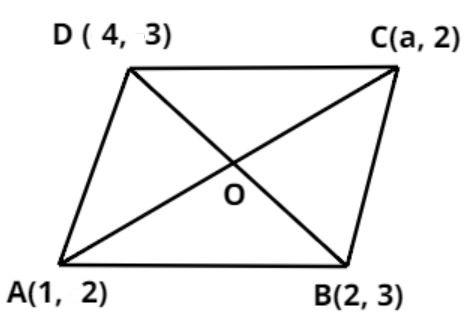
Let us consider the parallelogram ABCD as shown above.
Let A = (x1, y1) = (1, 2), B = (x2, y2) = (2, 3), C = (x3, y3) = (a, 2), D = (x4, y4) = (4, 3).
As we know that in parallelogram the length of opposite sides are equal.
Therefore length of AB = BC
Now as we know that the distance (d) between two points (x1, y1) , (x2, y2) is calculated as,
$d = \sqrt {{{\left( {{x_2} - {x_1}} \right)}^2} + {{\left( {{y_2} - {y_1}} \right)}^2}} $
Therefore AB = $\sqrt {{{\left( {{x_2} - {x_1}} \right)}^2} + {{\left( {{y_2} - {y_1}} \right)}^2}} = \sqrt {{{\left( {2 - 1} \right)}^2} + {{\left( {3 - 2} \right)}^2}} = \sqrt 2 $
Now distance CD = $\sqrt {{{\left( {{x_4} - {x_3}} \right)}^2} + {{\left( {{y_4} - {y_3}} \right)}^2}} = \sqrt {{{\left( {4 - a} \right)}^2} + {{\left( {3 - 2} \right)}^2}} = \sqrt {{{\left( {4 - a} \right)}^2} + 1} $
$ \Rightarrow \sqrt 2 = \sqrt {{{\left( {4 - a} \right)}^2} + 1} $
Now squaring on both sides we have,
$ \Rightarrow 2 = {\left( {4 - a} \right)^2} + 1$
$ \Rightarrow {\left( {4 - a} \right)^2} = 1$
$ \Rightarrow 4 - a = \sqrt 1 = 1$
$ \Rightarrow a = 4 - 1 = 3$
Now as we know that the area of the parallelogram (ABCD) = $2 \times $area of triangle ABD.
So first calculate area of triangle ABD
So area of triangle ABD = $\dfrac{1}{2}\left| {\begin{array}{*{20}{c}}
{{x_1}}&{{y_1}}&1 \\
{{x_2}}&{{y_2}}&1 \\
{{x_3}}&{{y_3}}&1
\end{array}} \right|$
Let A = (x1, y1) = (1, 2)
B = (x2, y2) = (2, 3)
D = (x3, y3) = (4, 3)
Therefore area (A) of triangle ABD = $\dfrac{1}{2}\left| {\begin{array}{*{20}{c}}
1&2&1 \\
2&3&1 \\
4&3&1
\end{array}} \right|$
Now expand the determinant we have,
A = $\dfrac{1}{2}\left[ {1\left| {\begin{array}{*{20}{c}}
3&1 \\
3&1
\end{array}} \right| - 2\left| {\begin{array}{*{20}{c}}
2&1 \\
4&1
\end{array}} \right| + 1\left| {\begin{array}{*{20}{c}}
2&3 \\
4&3
\end{array}} \right|} \right]$
Now simplify it we have,
A = $\dfrac{1}{2}\left[ {1\left( {3 - 3} \right) - 2\left( {2 - 4} \right) + 1\left( {6 - 12} \right)} \right]$
A = $\dfrac{1}{2}\left[ {0 + 4 - 6} \right] = \dfrac{{ - 2}}{2} = - 1$ sq. units.
Now as we know area cannot be negative so we calculate the absolute value,
$ \Rightarrow A = 1$ Sq. units.
So the area of parallelogram = $2 \times 1 = 2$ sq. units.
Now as we know that the area of the triangle is half multiplied by base (b) and height (h).
So area of parallelogram = $2 \times \dfrac{1}{2} \times h \times b$
$ \Rightarrow h = \dfrac{2}{b}$ unit.
Now it is given that AB is the base.
So the distance of AB is calculated as
$ \Rightarrow AB = \sqrt {{{\left( {{x_2} - {x_1}} \right)}^2} + {{\left( {{y_2} - {y_1}} \right)}^2}} $
A = (x1, y1) = (1, 2)
B = (x2, y2) = (2, 3)
So the distance AB is
$ \Rightarrow AB = b = \sqrt {{{\left( {2 - 1} \right)}^2} + {{\left( {3 - 2} \right)}^2}} = \sqrt {1 + 1} = \sqrt 2 $ unit.
So the height of the parallelogram is
$ \Rightarrow h = \dfrac{2}{{\sqrt 2 }} = \sqrt 2 $ unit.
So this is the required height of the parallelogram.
Note – Here we have used the direct determinant formula to compute the area of triangles when coordinates of its all three sides are given that is $\dfrac{1}{2}\left| {\begin{array}{*{20}{c}}
{{x_1}}&{{y_1}}&1 \\
{{x_2}}&{{y_2}}&1 \\
{{x_3}}&{{y_3}}&1
\end{array}} \right|$, it is advised to remember this short trick formula. Some properties of parallelogram are also helpful in solving problems of this kind like the opposite angles are congruent of a parallelogram, consecutive angles are supplementary and the diagonals of a parallelogram bisects each other.
Complete step-by-step answer:
Let us consider the parallelogram ABCD as shown above.
Let A = (x1, y1) = (1, 2), B = (x2, y2) = (2, 3), C = (x3, y3) = (a, 2), D = (x4, y4) = (4, 3).
As we know that in parallelogram the length of opposite sides are equal.
Therefore length of AB = BC
Now as we know that the distance (d) between two points (x1, y1) , (x2, y2) is calculated as,
$d = \sqrt {{{\left( {{x_2} - {x_1}} \right)}^2} + {{\left( {{y_2} - {y_1}} \right)}^2}} $
Therefore AB = $\sqrt {{{\left( {{x_2} - {x_1}} \right)}^2} + {{\left( {{y_2} - {y_1}} \right)}^2}} = \sqrt {{{\left( {2 - 1} \right)}^2} + {{\left( {3 - 2} \right)}^2}} = \sqrt 2 $
Now distance CD = $\sqrt {{{\left( {{x_4} - {x_3}} \right)}^2} + {{\left( {{y_4} - {y_3}} \right)}^2}} = \sqrt {{{\left( {4 - a} \right)}^2} + {{\left( {3 - 2} \right)}^2}} = \sqrt {{{\left( {4 - a} \right)}^2} + 1} $
$ \Rightarrow \sqrt 2 = \sqrt {{{\left( {4 - a} \right)}^2} + 1} $
Now squaring on both sides we have,
$ \Rightarrow 2 = {\left( {4 - a} \right)^2} + 1$
$ \Rightarrow {\left( {4 - a} \right)^2} = 1$
$ \Rightarrow 4 - a = \sqrt 1 = 1$
$ \Rightarrow a = 4 - 1 = 3$
Now as we know that the area of the parallelogram (ABCD) = $2 \times $area of triangle ABD.
So first calculate area of triangle ABD
So area of triangle ABD = $\dfrac{1}{2}\left| {\begin{array}{*{20}{c}}
{{x_1}}&{{y_1}}&1 \\
{{x_2}}&{{y_2}}&1 \\
{{x_3}}&{{y_3}}&1
\end{array}} \right|$
Let A = (x1, y1) = (1, 2)
B = (x2, y2) = (2, 3)
D = (x3, y3) = (4, 3)
Therefore area (A) of triangle ABD = $\dfrac{1}{2}\left| {\begin{array}{*{20}{c}}
1&2&1 \\
2&3&1 \\
4&3&1
\end{array}} \right|$
Now expand the determinant we have,
A = $\dfrac{1}{2}\left[ {1\left| {\begin{array}{*{20}{c}}
3&1 \\
3&1
\end{array}} \right| - 2\left| {\begin{array}{*{20}{c}}
2&1 \\
4&1
\end{array}} \right| + 1\left| {\begin{array}{*{20}{c}}
2&3 \\
4&3
\end{array}} \right|} \right]$
Now simplify it we have,
A = $\dfrac{1}{2}\left[ {1\left( {3 - 3} \right) - 2\left( {2 - 4} \right) + 1\left( {6 - 12} \right)} \right]$
A = $\dfrac{1}{2}\left[ {0 + 4 - 6} \right] = \dfrac{{ - 2}}{2} = - 1$ sq. units.
Now as we know area cannot be negative so we calculate the absolute value,
$ \Rightarrow A = 1$ Sq. units.
So the area of parallelogram = $2 \times 1 = 2$ sq. units.
Now as we know that the area of the triangle is half multiplied by base (b) and height (h).
So area of parallelogram = $2 \times \dfrac{1}{2} \times h \times b$
$ \Rightarrow h = \dfrac{2}{b}$ unit.
Now it is given that AB is the base.
So the distance of AB is calculated as
$ \Rightarrow AB = \sqrt {{{\left( {{x_2} - {x_1}} \right)}^2} + {{\left( {{y_2} - {y_1}} \right)}^2}} $
A = (x1, y1) = (1, 2)
B = (x2, y2) = (2, 3)
So the distance AB is
$ \Rightarrow AB = b = \sqrt {{{\left( {2 - 1} \right)}^2} + {{\left( {3 - 2} \right)}^2}} = \sqrt {1 + 1} = \sqrt 2 $ unit.
So the height of the parallelogram is
$ \Rightarrow h = \dfrac{2}{{\sqrt 2 }} = \sqrt 2 $ unit.
So this is the required height of the parallelogram.
Note – Here we have used the direct determinant formula to compute the area of triangles when coordinates of its all three sides are given that is $\dfrac{1}{2}\left| {\begin{array}{*{20}{c}}
{{x_1}}&{{y_1}}&1 \\
{{x_2}}&{{y_2}}&1 \\
{{x_3}}&{{y_3}}&1
\end{array}} \right|$, it is advised to remember this short trick formula. Some properties of parallelogram are also helpful in solving problems of this kind like the opposite angles are congruent of a parallelogram, consecutive angles are supplementary and the diagonals of a parallelogram bisects each other.
Recently Updated Pages
Basicity of sulphurous acid and sulphuric acid are

Master Class 10 English: Engaging Questions & Answers for Success
Master Class 10 Social Science: Engaging Questions & Answers for Success
Master Class 10 Computer Science: Engaging Questions & Answers for Success
Class 10 Question and Answer - Your Ultimate Solutions Guide
Master Class 10 General Knowledge: Engaging Questions & Answers for Success
Trending doubts
Who is known as the "Little Master" in Indian cricket history?
A boat goes 24 km upstream and 28 km downstream in class 10 maths CBSE
Who Won 36 Oscar Awards? Record Holder Revealed
Why is there a time difference of about 5 hours between class 10 social science CBSE
Explain the Treaty of Vienna of 1815 class 10 social science CBSE
What is the median of the first 10 natural numbers class 10 maths CBSE