




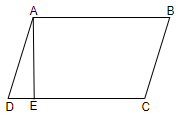
If the parallelogram ABCD’s base, $\overrightarrow{DC}=3\overrightarrow{DE}$, what is the ratio of the parallelogram ABCD and triangle ADE and prove the same.
Answer
 Verified
656.4k+ views
Hint: To find the ratio of the parallelogram ABCD and the triangle ADE, we will have to find the area of both of them first. We will use the formula for finding the area of the parallelogram as, $area=base\times height$ and for the area of the triangle as, $area=\dfrac{1}{2}\times base\times height$. The height of the parallelogram and the triangle are same, that is $\overrightarrow{AE}$, but the base is different. The base of the parallelogram is given as $\overrightarrow{DC}$ and that of the triangle is given as $\overrightarrow{DE}$. The relation between them is given as $\overrightarrow{DC}=3\overrightarrow{DE}$. So, we will assume the heights $\overrightarrow{AE}=x$ and $\overrightarrow{DE}=y$ and find the areas of the parallelogram and triangle. And finally, to find the ratio of the areas, we will use the formula, $\dfrac{\text{area of parallelogram}}{\text{area of triangle}}$.
Complete step-by-step answer:
The figure given to us in the question is as shown below.
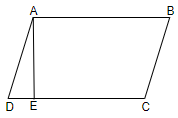
We have been asked to find the ratio of the parallelogram ABCD and the triangle ADE. So, for that, we have to first find the areas of both. We know that the area of parallelogram is given by, $area=base\times height$ and that of the triangle is, $area=\dfrac{1}{2}\times base\times height$. Now, we have the height $\overrightarrow{AE}$ as the same for both parallelogram and triangle and their bases as, $\overrightarrow{DC}$ and $\overrightarrow{DE}$ respectively. We have been given a relation between the bases as, $\overrightarrow{DC}=3\overrightarrow{DE}$. So, we will assume the heights, $\overrightarrow{AE}=x$ and $\overrightarrow{DE}=y$.
Now, in the parallelogram ABCD, we have the base as $\overrightarrow{DC}$ and the height as $\overrightarrow{AE}$. We know that area of the parallelogram is,
$\begin{align}
& area\left( ABCD \right)=base\times height \\
& \Rightarrow area\left( ABCD \right)=\overrightarrow{DC}\times \overrightarrow{AE} \\
\end{align}$
We know that $\overrightarrow{DC}=3\overrightarrow{DE}$, and $\overrightarrow{DE}=y$, so we will get $\overrightarrow{DC}=3y$. Now, we will substitute the values of $\overrightarrow{DC}$ and $\overrightarrow{AE}$. So, we will get,
$\begin{align}
& area\left( ABCD \right)=3y\times x \\
& \Rightarrow area\left( ABCD \right)=3xy\ldots \ldots \ldots \left( i \right) \\
\end{align}$
Similarly, in triangle ADE, we have the base as $\overrightarrow{DE}$ and height as $\overrightarrow{AE}$. We know that the area of the triangle is given as,
$\begin{align}
& area\left( ADE \right)=\dfrac{1}{2}\times base\times height \\
& \Rightarrow area\left( ADE \right)=\dfrac{1}{2}\times \overrightarrow{DE}\times \overrightarrow{AE} \\
\end{align}$
As we know that $\overrightarrow{AE}=x$ and $\overrightarrow{DE}=y$, we will substitute these values and get as,
$\begin{align}
& area\left( ADE \right)=\dfrac{1}{2}\times y\times x \\
& \Rightarrow area\left( ADE \right)=\dfrac{1}{2}xy\ldots \ldots \ldots \left( ii \right) \\
\end{align}$
Now, since we have obtained the areas of the parallelogram and the triangle, we will find their ratios using the formula, $\dfrac{\text{area}\left( \text{ABCD} \right)}{\text{area}\left( \text{ADE} \right)}=\dfrac{\text{area of parallelogram}}{\text{area of triangle}}$. We will take the values of the areas from equations (i) and (ii) and substitute in this formula. So, we get the ratio as,
$\begin{align}
& \dfrac{area\left( ABCD \right)}{area\left( ADE \right)}=\dfrac{3xy}{\dfrac{1}{2}xy} \\
& \Rightarrow \dfrac{area\left( ABCD \right)}{area\left( ADE \right)}=\dfrac{3}{\dfrac{1}{2}} \\
& \Rightarrow \dfrac{area\left( ABCD \right)}{area\left( ADE \right)}=\dfrac{3\times 2}{1} \\
& \Rightarrow \dfrac{area\left( ABCD \right)}{area\left( ADE \right)}=\dfrac{6}{1} \\
\end{align}$
Hence, we get the ratio of the area of the parallelogram ABCD to the triangle ADE as 6 : 1.
Note: There is a chance that the students make a mistake in the last step and find the ratio as the ratio of area of triangle ADE to area of parallelogram ABCD and end up with the wrong answer of 1 : 6, but it is clearly mentioned in the question that we have to find the ratio of the area of the parallelogram to triangle. So, the students should read the question and understand it before finding the answer.
Complete step-by-step answer:
The figure given to us in the question is as shown below.
We have been asked to find the ratio of the parallelogram ABCD and the triangle ADE. So, for that, we have to first find the areas of both. We know that the area of parallelogram is given by, $area=base\times height$ and that of the triangle is, $area=\dfrac{1}{2}\times base\times height$. Now, we have the height $\overrightarrow{AE}$ as the same for both parallelogram and triangle and their bases as, $\overrightarrow{DC}$ and $\overrightarrow{DE}$ respectively. We have been given a relation between the bases as, $\overrightarrow{DC}=3\overrightarrow{DE}$. So, we will assume the heights, $\overrightarrow{AE}=x$ and $\overrightarrow{DE}=y$.
Now, in the parallelogram ABCD, we have the base as $\overrightarrow{DC}$ and the height as $\overrightarrow{AE}$. We know that area of the parallelogram is,
$\begin{align}
& area\left( ABCD \right)=base\times height \\
& \Rightarrow area\left( ABCD \right)=\overrightarrow{DC}\times \overrightarrow{AE} \\
\end{align}$
We know that $\overrightarrow{DC}=3\overrightarrow{DE}$, and $\overrightarrow{DE}=y$, so we will get $\overrightarrow{DC}=3y$. Now, we will substitute the values of $\overrightarrow{DC}$ and $\overrightarrow{AE}$. So, we will get,
$\begin{align}
& area\left( ABCD \right)=3y\times x \\
& \Rightarrow area\left( ABCD \right)=3xy\ldots \ldots \ldots \left( i \right) \\
\end{align}$
Similarly, in triangle ADE, we have the base as $\overrightarrow{DE}$ and height as $\overrightarrow{AE}$. We know that the area of the triangle is given as,
$\begin{align}
& area\left( ADE \right)=\dfrac{1}{2}\times base\times height \\
& \Rightarrow area\left( ADE \right)=\dfrac{1}{2}\times \overrightarrow{DE}\times \overrightarrow{AE} \\
\end{align}$
As we know that $\overrightarrow{AE}=x$ and $\overrightarrow{DE}=y$, we will substitute these values and get as,
$\begin{align}
& area\left( ADE \right)=\dfrac{1}{2}\times y\times x \\
& \Rightarrow area\left( ADE \right)=\dfrac{1}{2}xy\ldots \ldots \ldots \left( ii \right) \\
\end{align}$
Now, since we have obtained the areas of the parallelogram and the triangle, we will find their ratios using the formula, $\dfrac{\text{area}\left( \text{ABCD} \right)}{\text{area}\left( \text{ADE} \right)}=\dfrac{\text{area of parallelogram}}{\text{area of triangle}}$. We will take the values of the areas from equations (i) and (ii) and substitute in this formula. So, we get the ratio as,
$\begin{align}
& \dfrac{area\left( ABCD \right)}{area\left( ADE \right)}=\dfrac{3xy}{\dfrac{1}{2}xy} \\
& \Rightarrow \dfrac{area\left( ABCD \right)}{area\left( ADE \right)}=\dfrac{3}{\dfrac{1}{2}} \\
& \Rightarrow \dfrac{area\left( ABCD \right)}{area\left( ADE \right)}=\dfrac{3\times 2}{1} \\
& \Rightarrow \dfrac{area\left( ABCD \right)}{area\left( ADE \right)}=\dfrac{6}{1} \\
\end{align}$
Hence, we get the ratio of the area of the parallelogram ABCD to the triangle ADE as 6 : 1.
Note: There is a chance that the students make a mistake in the last step and find the ratio as the ratio of area of triangle ADE to area of parallelogram ABCD and end up with the wrong answer of 1 : 6, but it is clearly mentioned in the question that we have to find the ratio of the area of the parallelogram to triangle. So, the students should read the question and understand it before finding the answer.
Recently Updated Pages
Class 10 Question and Answer - Your Ultimate Solutions Guide

Master Class 10 Computer Science: Engaging Questions & Answers for Success
Master Class 10 General Knowledge: Engaging Questions & Answers for Success
Master Class 12 Economics: Engaging Questions & Answers for Success
Master Class 12 Social Science: Engaging Questions & Answers for Success
Master Class 12 English: Engaging Questions & Answers for Success
Trending doubts
The slogan Jai Hind was given by A Lal Bahadur Shastri class 10 social science CBSE
Five things I will do to build a great India class 10 english CBSE
Identify the feminine form of noun nephew a shenephew class 10 english CBSE
CSIR full form?
State BPT theorem and prove it class 10 maths CBSE
Draw a diagram of the human eye as seen in a vertical class 10 biology CBSE