




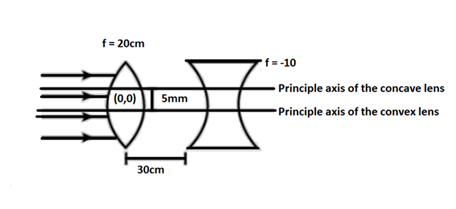
If the optical center of the convex and the concave lenses are separated by a distance 5mm as shown in the figure. Find the coordinate of the final image formed by the combination of if a parallel beam of light is incident on lenses. Origin is at the optical center of the convex lens.
A. 25cm, 0.5cm
B. 25cm, 0.25cm
C. 25cm, -0.5cm
D. 25cm, -0.25cm
Answer
 Verified
587.7k+ views
Hint: When a parallel beam of light is intent on a convex lens, it will form an image on the focal point of convex lens. And this image acts as an object for the concave lens and by applying formulas for the concave lens we get the image formed by the concave lens.
Formula used:
$\begin{align}
& \dfrac{1}{v}-\dfrac{1}{u}=\dfrac{1}{f} \\
& m=\dfrac{v}{u} \\
& m=\dfrac{h\text{ }image}{h\text{ }object} \\
\end{align}$
Complete step by step solution:
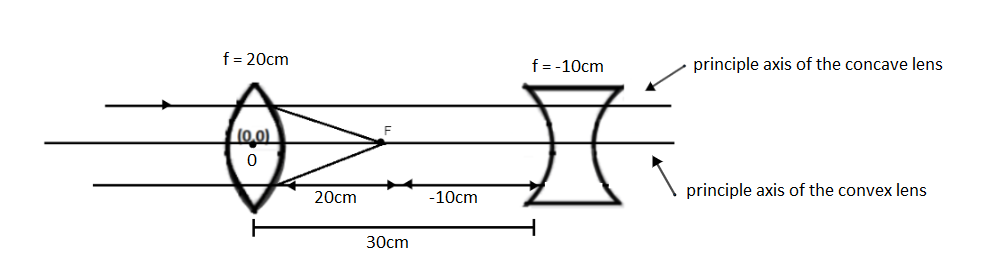
As we know that when a parallel beam of the light incident on the lens the image will form on the focal point of the convex lens.
Now the distance of the image from the origin 0 (0, 0) is
${{I}_{1}}=20cm$
And this image formed on the focal point will act as an object for the concave lens.
From the figure object distance from concave lens is,
$u=-10cm$
-ve sign denotes that the object is on the left side from the concave lens.
Focal point of the concave lens is given as,
f = -10cm
Now the formula for the concave lens.
$\dfrac{1}{v}-\dfrac{1}{u}=\dfrac{1}{f}....\left( 1 \right)$
Where, v = image distance
u = object distance
f = focal point of concave lens.
Now substitute all the values in the equation (1)
$\begin{align}
& \Rightarrow \dfrac{1}{v}-\dfrac{1}{(-10)}=\dfrac{1}{-10} \\
& \Rightarrow \dfrac{1}{v}=\dfrac{-1}{10}-\dfrac{1}{10} \\
& \Rightarrow \dfrac{1}{v}=\dfrac{-20}{100} \\
& \therefore v=-5cm \\
\end{align}$
Now we know that magnification of the concave lens,
$m=\dfrac{v}{u}....\left( 2 \right)$
Where, m = magnification
v = image distance
u = object distance
Now we also know that formula for the magnification is,
$\Rightarrow m=\dfrac{h\text{ }image}{h\text{ }object}...\left( 3 \right)$
Where, h image = height of the image
h object = height of the object
It is given in the question that the principal axis of the concave lens is 5mm upper than the convex lens, therefore we can say that height of the object is,
h object = 5mm = 0.5cm
From the equation (2) and equation (3)
$\dfrac{h\text{ image}}{h\text{ object}}=\dfrac{v}{u}...\left( 4 \right)$
Now substitute all the values in the equation (4)
$\begin{align}
& \dfrac{h\text{ }image}{0.5}=\dfrac{-5}{-10} \\
& h\text{ }image=0.5\times 0.5 \\
& \therefore h\text{ }image=0.25cm \\
\end{align}$
Here the value of v = -5cm which is 25cm from the 0 (0, 0) and height is 0.25cm
Therefore correct option (b) is correct 25cm, 0.25cm.
Note:
In this question the difference between both the parallel principal axes of convex and concave lenses is 5mm, so when we are calculating the height of an image doesn’t forget to convert the unit of mm into cm.
Formula used:
$\begin{align}
& \dfrac{1}{v}-\dfrac{1}{u}=\dfrac{1}{f} \\
& m=\dfrac{v}{u} \\
& m=\dfrac{h\text{ }image}{h\text{ }object} \\
\end{align}$
Complete step by step solution:
As we know that when a parallel beam of the light incident on the lens the image will form on the focal point of the convex lens.
Now the distance of the image from the origin 0 (0, 0) is
${{I}_{1}}=20cm$
And this image formed on the focal point will act as an object for the concave lens.
From the figure object distance from concave lens is,
$u=-10cm$
-ve sign denotes that the object is on the left side from the concave lens.
Focal point of the concave lens is given as,
f = -10cm
Now the formula for the concave lens.
$\dfrac{1}{v}-\dfrac{1}{u}=\dfrac{1}{f}....\left( 1 \right)$
Where, v = image distance
u = object distance
f = focal point of concave lens.
Now substitute all the values in the equation (1)
$\begin{align}
& \Rightarrow \dfrac{1}{v}-\dfrac{1}{(-10)}=\dfrac{1}{-10} \\
& \Rightarrow \dfrac{1}{v}=\dfrac{-1}{10}-\dfrac{1}{10} \\
& \Rightarrow \dfrac{1}{v}=\dfrac{-20}{100} \\
& \therefore v=-5cm \\
\end{align}$
Now we know that magnification of the concave lens,
$m=\dfrac{v}{u}....\left( 2 \right)$
Where, m = magnification
v = image distance
u = object distance
Now we also know that formula for the magnification is,
$\Rightarrow m=\dfrac{h\text{ }image}{h\text{ }object}...\left( 3 \right)$
Where, h image = height of the image
h object = height of the object
It is given in the question that the principal axis of the concave lens is 5mm upper than the convex lens, therefore we can say that height of the object is,
h object = 5mm = 0.5cm
From the equation (2) and equation (3)
$\dfrac{h\text{ image}}{h\text{ object}}=\dfrac{v}{u}...\left( 4 \right)$
Now substitute all the values in the equation (4)
$\begin{align}
& \dfrac{h\text{ }image}{0.5}=\dfrac{-5}{-10} \\
& h\text{ }image=0.5\times 0.5 \\
& \therefore h\text{ }image=0.25cm \\
\end{align}$
Here the value of v = -5cm which is 25cm from the 0 (0, 0) and height is 0.25cm
Therefore correct option (b) is correct 25cm, 0.25cm.
Note:
In this question the difference between both the parallel principal axes of convex and concave lenses is 5mm, so when we are calculating the height of an image doesn’t forget to convert the unit of mm into cm.
Recently Updated Pages
Master Class 12 Business Studies: Engaging Questions & Answers for Success

Master Class 12 Biology: Engaging Questions & Answers for Success
Master Class 12 Chemistry: Engaging Questions & Answers for Success
Class 12 Question and Answer - Your Ultimate Solutions Guide
Master Class 11 Social Science: Engaging Questions & Answers for Success
Master Class 11 English: Engaging Questions & Answers for Success
Trending doubts
Which are the Top 10 Largest Countries of the World?
Draw a labelled sketch of the human eye class 12 physics CBSE
Differentiate between homogeneous and heterogeneous class 12 chemistry CBSE
Sulphuric acid is known as the king of acids State class 12 chemistry CBSE
Why is the cell called the structural and functional class 12 biology CBSE
Which is the correct genotypic ratio of mendel dihybrid class 12 biology CBSE