




If the lengths of the sides of a triangle are in A.P and the greatest angle is double the smallest, then the ratio of the lengths of the sides of this triangle is:
(a) 5:9:13
(b) 5:6:7
(c) 4:5:6
(d) 3:4:5
Answer
 Verified
606.6k+ views
Hint: To solve this question, first, we will apply the condition of A.P for three consecutive numbers. After that, we will find the angle B. Then using the sine rule of the triangle we will get a quadratic equation in terms of cosine. Then we will solve the quadratic equation by splitting the middle term and get values of cos. After that, we will write values of sides a, b and c in ratio and by using solved values we will get the ratio in which sides are.
Complete step by step answer:
Let first us draw the figure.
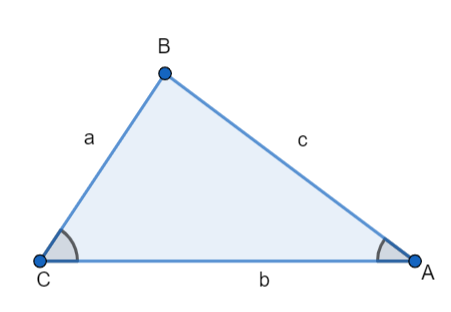
$\Rightarrow$ Let there be a triangle $\vartriangle ABC$ , with sides BC = a, AB = c and CA = b. and let angles be $\angle A,$ $\angle B,$and$\angle C$ and let $\angle C=2\angle A$.
Now, in question, it is given that sides of the triangle are in A.P
We know that if three numbers a, b, c are in A.P, then 2b = a + c
So, we have 2b = a + c
Also, it is given that a larger angle is twice the smaller angle. So let $\angle A$be a larger angle and $\angle C$ be a smaller angle, then $\angle C=2\angle A$.
So, if $\angle A=\theta $, then $\angle C=2\theta $.
We know that sum of the interior angle of the triangle equals to ${{180}^{{}^\circ }}.$
So, in $\vartriangle ABC$
$\Rightarrow$ $\angle A+\angle B+\angle C=180$
$\Rightarrow$ Then, $\theta +\angle B+2\theta =180$
$\Rightarrow$ $\angle B=180-3\theta $
Now for triangle we know that there is sine rule, which states that $\dfrac{a}{\sin A}=\dfrac{b}{\operatorname{sinB}}=\dfrac{c}{\operatorname{sinC}}=k$
$\Rightarrow$ So, for triangle $\vartriangle ABC$,
$\dfrac{a}{\sin \theta }=\dfrac{b}{\sin 3\theta }=\dfrac{c}{\sin 2\theta }=k$
Now, we can say that $\dfrac{b}{\sin 3\theta }=k$
$\Rightarrow$ $b=k\sin 3\theta $
Also, we know that 2b = a + c
$\Rightarrow$ So, $2k\sin 3\theta =a+c$
But from sine rule,
$a=k\sin \theta $ and $c=k\sin 2\theta $
So, we can say that
$2k\sin 3\theta =k\sin \theta +k\sin 2\theta $
$\Rightarrow$ $2sin3\theta =\sin \theta +\sin 2\theta $
$\Rightarrow$ We know that $sin3\theta =3\sin \theta -4{{\sin }^{3}}\theta $
So, we have
$\Rightarrow$ $2\left( 3\sin \theta -4{{\sin }^{3}}\theta \right)=\sin \theta +\sin 2\theta $
$\Rightarrow$ $6\sin \theta -8{{\sin }^{3}}\theta =\sin \theta +\sin 2\theta $
We know that \[\sin 2\theta =2\sin \theta \cos \theta \]
So, $6\sin \theta -8{{\sin }^{3}}\theta =\sin \theta +2\sin \theta \cos \theta $
$\Rightarrow$ $6-8{{\sin }^{2}}\theta =1+2\cos \theta $
We know that ${{\sin }^{2}}\theta =1-{{\cos }^{2}}\theta $
So, $6-8\left( 1-{{\cos }^{2}}\theta \right)=1+2\cos \theta $
On simplifying, we get
$\Rightarrow$ $8{{\cos }^{2}}\theta -2\cos \theta -3=0$
$\Rightarrow$ $8{{\cos }^{2}}\theta -6\cos \theta +4\cos \theta -3=0$
$\Rightarrow$ $2\cos \theta (4\cos \theta -3)+(4\cos \theta -3)=0$
$\Rightarrow$ So, we have $\cos \theta =\dfrac{3}{4}$ or $\cos \theta =-\dfrac{1}{2}$
So, case of $\cos \theta =-\dfrac{1}{2}$will be rejected as all angles lies in first quadrant.
Now, we have to find ratio of sides of triangle that is a:b:c
$\Rightarrow$ $k\sin \theta $:$k\sin 3\theta $:$k\sin 2\theta $
$\Rightarrow$ $\sin \theta $:$3\sin \theta -4{{\sin }^{3}}\theta $:$2\sin \theta \cos \theta $
$\Rightarrow$ 1:$3-4{{\sin }^{2}}\theta $:$2\cos \theta $
$\Rightarrow$ 1:$3-4(1-{{\cos }^{2}}\theta )$:$2\cos \theta $
$\Rightarrow$ 1:$4{{\cos }^{2}}\theta -1$:$2\cos \theta $
Putting, $\cos \theta =\dfrac{3}{4}$, we get
1:$4{{\left( \dfrac{3}{4} \right)}^{2}}-1$:$2.\dfrac{3}{4}$
$\Rightarrow$ 1:$\left( \dfrac{9}{4} \right)-1$:$\dfrac{3}{2}$
1:$\left( \dfrac{5}{4} \right)$:$\dfrac{3}{2}$
Multiplying by 4, we get
4:5:6
$\Rightarrow$ Hence, option ( c ) is correct.
Note:
To solve such questions one must know if three numbers a, b, c are in A.P, then 2b = a + c and sine rule for triangles which states $\dfrac{a}{\sin \theta }=\dfrac{b}{\sin 3\theta }=\dfrac{c}{\sin 2\theta }=k$. Also, remember some trigonometric formulas such as ${{\sin }^{2}}\theta =1-{{\cos }^{2}}\theta $, ${{\sin }^{2}}\theta =1-{{\cos }^{2}}\theta $, $sin3\theta =3\sin \theta -4{{\sin }^{3}}\theta $ etc. Try not to make any calculation mistake as this will make solution more complex.
Complete step by step answer:
Let first us draw the figure.
$\Rightarrow$ Let there be a triangle $\vartriangle ABC$ , with sides BC = a, AB = c and CA = b. and let angles be $\angle A,$ $\angle B,$and$\angle C$ and let $\angle C=2\angle A$.
Now, in question, it is given that sides of the triangle are in A.P
We know that if three numbers a, b, c are in A.P, then 2b = a + c
So, we have 2b = a + c
Also, it is given that a larger angle is twice the smaller angle. So let $\angle A$be a larger angle and $\angle C$ be a smaller angle, then $\angle C=2\angle A$.
So, if $\angle A=\theta $, then $\angle C=2\theta $.
We know that sum of the interior angle of the triangle equals to ${{180}^{{}^\circ }}.$
So, in $\vartriangle ABC$
$\Rightarrow$ $\angle A+\angle B+\angle C=180$
$\Rightarrow$ Then, $\theta +\angle B+2\theta =180$
$\Rightarrow$ $\angle B=180-3\theta $
Now for triangle we know that there is sine rule, which states that $\dfrac{a}{\sin A}=\dfrac{b}{\operatorname{sinB}}=\dfrac{c}{\operatorname{sinC}}=k$
$\Rightarrow$ So, for triangle $\vartriangle ABC$,
$\dfrac{a}{\sin \theta }=\dfrac{b}{\sin 3\theta }=\dfrac{c}{\sin 2\theta }=k$
Now, we can say that $\dfrac{b}{\sin 3\theta }=k$
$\Rightarrow$ $b=k\sin 3\theta $
Also, we know that 2b = a + c
$\Rightarrow$ So, $2k\sin 3\theta =a+c$
But from sine rule,
$a=k\sin \theta $ and $c=k\sin 2\theta $
So, we can say that
$2k\sin 3\theta =k\sin \theta +k\sin 2\theta $
$\Rightarrow$ $2sin3\theta =\sin \theta +\sin 2\theta $
$\Rightarrow$ We know that $sin3\theta =3\sin \theta -4{{\sin }^{3}}\theta $
So, we have
$\Rightarrow$ $2\left( 3\sin \theta -4{{\sin }^{3}}\theta \right)=\sin \theta +\sin 2\theta $
$\Rightarrow$ $6\sin \theta -8{{\sin }^{3}}\theta =\sin \theta +\sin 2\theta $
We know that \[\sin 2\theta =2\sin \theta \cos \theta \]
So, $6\sin \theta -8{{\sin }^{3}}\theta =\sin \theta +2\sin \theta \cos \theta $
$\Rightarrow$ $6-8{{\sin }^{2}}\theta =1+2\cos \theta $
We know that ${{\sin }^{2}}\theta =1-{{\cos }^{2}}\theta $
So, $6-8\left( 1-{{\cos }^{2}}\theta \right)=1+2\cos \theta $
On simplifying, we get
$\Rightarrow$ $8{{\cos }^{2}}\theta -2\cos \theta -3=0$
$\Rightarrow$ $8{{\cos }^{2}}\theta -6\cos \theta +4\cos \theta -3=0$
$\Rightarrow$ $2\cos \theta (4\cos \theta -3)+(4\cos \theta -3)=0$
$\Rightarrow$ So, we have $\cos \theta =\dfrac{3}{4}$ or $\cos \theta =-\dfrac{1}{2}$
So, case of $\cos \theta =-\dfrac{1}{2}$will be rejected as all angles lies in first quadrant.
Now, we have to find ratio of sides of triangle that is a:b:c
$\Rightarrow$ $k\sin \theta $:$k\sin 3\theta $:$k\sin 2\theta $
$\Rightarrow$ $\sin \theta $:$3\sin \theta -4{{\sin }^{3}}\theta $:$2\sin \theta \cos \theta $
$\Rightarrow$ 1:$3-4{{\sin }^{2}}\theta $:$2\cos \theta $
$\Rightarrow$ 1:$3-4(1-{{\cos }^{2}}\theta )$:$2\cos \theta $
$\Rightarrow$ 1:$4{{\cos }^{2}}\theta -1$:$2\cos \theta $
Putting, $\cos \theta =\dfrac{3}{4}$, we get
1:$4{{\left( \dfrac{3}{4} \right)}^{2}}-1$:$2.\dfrac{3}{4}$
$\Rightarrow$ 1:$\left( \dfrac{9}{4} \right)-1$:$\dfrac{3}{2}$
1:$\left( \dfrac{5}{4} \right)$:$\dfrac{3}{2}$
Multiplying by 4, we get
4:5:6
$\Rightarrow$ Hence, option ( c ) is correct.
Note:
To solve such questions one must know if three numbers a, b, c are in A.P, then 2b = a + c and sine rule for triangles which states $\dfrac{a}{\sin \theta }=\dfrac{b}{\sin 3\theta }=\dfrac{c}{\sin 2\theta }=k$. Also, remember some trigonometric formulas such as ${{\sin }^{2}}\theta =1-{{\cos }^{2}}\theta $, ${{\sin }^{2}}\theta =1-{{\cos }^{2}}\theta $, $sin3\theta =3\sin \theta -4{{\sin }^{3}}\theta $ etc. Try not to make any calculation mistake as this will make solution more complex.
Recently Updated Pages
Master Class 11 English: Engaging Questions & Answers for Success

Master Class 11 Maths: Engaging Questions & Answers for Success
Class 11 Question and Answer - Your Ultimate Solutions Guide
Master Class 11 Biology: Engaging Questions & Answers for Success
Master Class 11 Physics: Engaging Questions & Answers for Success
Master Class 11 Accountancy: Engaging Questions & Answers for Success
Trending doubts
Explain the Treaty of Vienna of 1815 class 10 social science CBSE
Who Won 36 Oscar Awards? Record Holder Revealed
What is the median of the first 10 natural numbers class 10 maths CBSE
Why is it 530 pm in india when it is 1200 afternoon class 10 social science CBSE
Why is there a time difference of about 5 hours between class 10 social science CBSE
What is the full form of POSCO class 10 social science CBSE