




If the incentre of an equilateral triangle is (1, 1) and the equation of its one side is 3x + 4y + 3 = 0, then find the equation of the circumcircle of this triangle.
(a) ${{x}^{2}}+{{y}^{2}}-2x-2y-2=0$
(b) ${{x}^{2}}+{{y}^{2}}-2x-2y-14=0$
(c) ${{x}^{2}}+{{y}^{2}}-2x-2y+2=0$
(d) ${{x}^{2}}+{{y}^{2}}-2x-2y+14=0$
Answer
 Verified
644.1k+ views
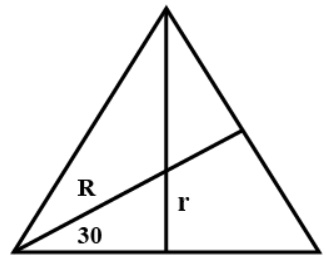
Hint:Note that for an equilateral triangle, circumcentre and incentre coincide. So, circumcentre is (1, 1). Find the inradius. Use this and the figure to get the expression $\sin 30{}^\circ =\dfrac{1}{2}=\dfrac{2}{R}$. This gives R = 4. Now, we have the centre and the radius of the circumcentre. Using these find the equation of the circumcircle of this triangle.
Complete Step-by-step answer:
In this question, we are given that the incentre of an equilateral triangle is (1, 1) and the equation of its one side is 3x + 4y + 3 = 0.
Using this information, we need to find the equation of the circumcircle of this triangle.
First, let us define the incentre and circumcentre.
The incentre of a triangle may be equivalently defined as the point where the internal angle bisectors of the triangle cross, as the point equidistant from the triangle's sides, and as the centre point of the inscribed circle of the triangle.
The circumcentre of a triangle is defined as the point where the perpendicular bisectors of the sides of that particular triangle intersect. In other words, the point of concurrency of the bisector of the sides of a triangle is called the circumcentre.
We know that, for an equilateral triangle, circumcentre and incentre coincide.
Using this property, the circumcentre of the given triangle is (1, 1). …(1)
In the shown figure, R is the circumradius of the triangle.
r is the inradius of the triangle.
The shown angle is $30{}^\circ $.
Now, the inradius, r is the distance of (1,1) from the line 3x + 4y + 3 = 0
So, inradius, r $=\dfrac{|3\cdot 1+4\cdot 1+3|}{\sqrt{{{3}^{2}}+{{4}^{2}}}}=2$
Now, $\sin 30{}^\circ =\dfrac{1}{2}=\dfrac{r}{R}$
$\sin 30{}^\circ =\dfrac{1}{2}=\dfrac{2}{R}$
R = 4
Hence, the circumradius, R = 4 units.
Now, we know that general equation of circle is: \[{{x}^{2}}+{{y}^{2}}+2gx+2fy+c=0\] with centre at $\left( -g,-f \right)$ and radius = $\sqrt{{{g}^{2}}+{{f}^{2}}-c}$.
Now the circumcircle has its centre at (1, 1) and has the radius R = 4 units. We will substitute these values in the general equation above. So, the equation of the circumcircle is:
${{x}^{2}}+{{y}^{2}}-2x-2y-14=0$
So, option (b) is correct.
Note:It is important to know the following: the incentre of a triangle may be equivalently defined as the point where the internal angle bisectors of the triangle cross and that for an equilateral triangle, circumcentre and incentre coincide.
Complete Step-by-step answer:
In this question, we are given that the incentre of an equilateral triangle is (1, 1) and the equation of its one side is 3x + 4y + 3 = 0.
Using this information, we need to find the equation of the circumcircle of this triangle.
First, let us define the incentre and circumcentre.
The incentre of a triangle may be equivalently defined as the point where the internal angle bisectors of the triangle cross, as the point equidistant from the triangle's sides, and as the centre point of the inscribed circle of the triangle.
The circumcentre of a triangle is defined as the point where the perpendicular bisectors of the sides of that particular triangle intersect. In other words, the point of concurrency of the bisector of the sides of a triangle is called the circumcentre.
We know that, for an equilateral triangle, circumcentre and incentre coincide.
Using this property, the circumcentre of the given triangle is (1, 1). …(1)
In the shown figure, R is the circumradius of the triangle.
r is the inradius of the triangle.
The shown angle is $30{}^\circ $.
Now, the inradius, r is the distance of (1,1) from the line 3x + 4y + 3 = 0
So, inradius, r $=\dfrac{|3\cdot 1+4\cdot 1+3|}{\sqrt{{{3}^{2}}+{{4}^{2}}}}=2$
Now, $\sin 30{}^\circ =\dfrac{1}{2}=\dfrac{r}{R}$
$\sin 30{}^\circ =\dfrac{1}{2}=\dfrac{2}{R}$
R = 4
Hence, the circumradius, R = 4 units.
Now, we know that general equation of circle is: \[{{x}^{2}}+{{y}^{2}}+2gx+2fy+c=0\] with centre at $\left( -g,-f \right)$ and radius = $\sqrt{{{g}^{2}}+{{f}^{2}}-c}$.
Now the circumcircle has its centre at (1, 1) and has the radius R = 4 units. We will substitute these values in the general equation above. So, the equation of the circumcircle is:
${{x}^{2}}+{{y}^{2}}-2x-2y-14=0$
So, option (b) is correct.
Note:It is important to know the following: the incentre of a triangle may be equivalently defined as the point where the internal angle bisectors of the triangle cross and that for an equilateral triangle, circumcentre and incentre coincide.
Recently Updated Pages
Master Class 12 Economics: Engaging Questions & Answers for Success

Master Class 12 English: Engaging Questions & Answers for Success
Master Class 12 Social Science: Engaging Questions & Answers for Success
Master Class 12 Maths: Engaging Questions & Answers for Success
Master Class 12 Physics: Engaging Questions & Answers for Success
Master Class 12 Business Studies: Engaging Questions & Answers for Success
Trending doubts
Which are the Top 10 Largest Countries of the World?
Draw a labelled sketch of the human eye class 12 physics CBSE
Differentiate between homogeneous and heterogeneous class 12 chemistry CBSE
Sulphuric acid is known as the king of acids State class 12 chemistry CBSE
Why is the cell called the structural and functional class 12 biology CBSE
Draw ray diagrams each showing i myopic eye and ii class 12 physics CBSE