




If the diameter of a circle contains A (1,3) and B (4,5) as opposite ends. Find the equation of the line perpendicular to the diameter.
Answer
 Verified
505.2k+ views
Hint: We will find the midpoint of the AB. then, the slope of the diameter. We will then find the slope of the line perpendicular to the line and using general form write its equation. As the center point will also satisfy the equation, we will find the value of constant.
Complete answer:
We have given the two endpoints of diameter of the circle as A(1,3) and B(4,5)
We have to find the line perpendicular to the given diameter
We will name the line as CD
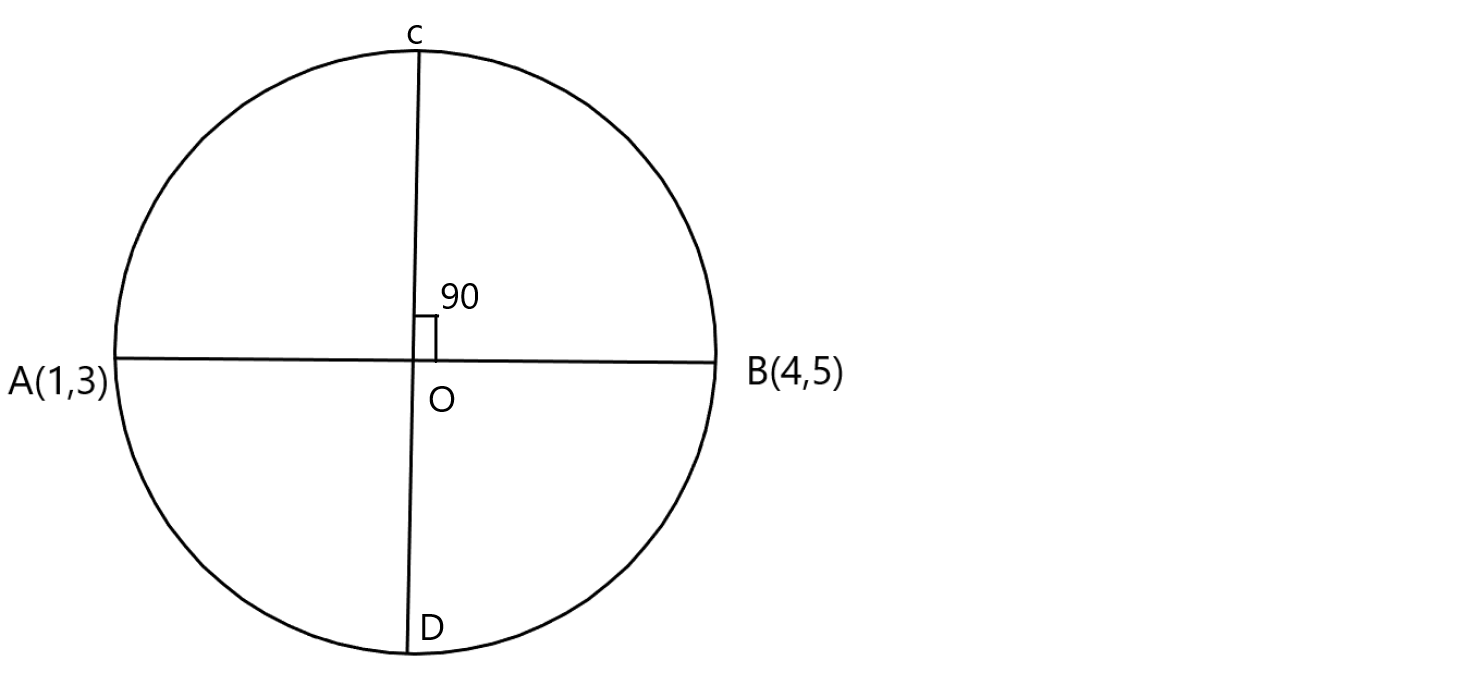
We will first find the midpoint or center of the circle.
We know that the midpoint of two point (a, b) and (c, d) is given by mid-point (M.D)
$ \Rightarrow M.D = \left( {\dfrac{{a + c}}{2},\dfrac{{b + d}}{2}} \right)$
The midpoint of the point A(1,3) and B(4,5)
$ \Rightarrow M.D = \left( {\dfrac{{1 + 4}}{2},\dfrac{{3 + 5}}{2}} \right)$
$ \Rightarrow M.D = \left( {\dfrac{5}{2},4} \right)$
We will now find the slope of the diameter
We know that the slope of line having of two point (a, b) and (c, d) is $m = \dfrac{{d - b}}{{c - a}}$
$ \Rightarrow m = \dfrac{{5 - 3}}{{4 - 1}}$
$ \Rightarrow m = \dfrac{2}{3}$
We know that the slope of line perpendicular to a line having slope m is $ - \dfrac{1}{m}$
So, the slope of line CD $ = - \dfrac{3}{2}$
We know that the general equation is $y = mx + c$
So, the equation of line CD
$ \Rightarrow y = - \dfrac{3}{2}x + c$
We will satisfy the centre with line CD as it will pass through the centre
$ \Rightarrow \dfrac{5}{2} = - \dfrac{3}{2} \times 4 + c$
$ \Rightarrow \dfrac{5}{2} + 6 = c$
$ \Rightarrow \dfrac{{5 + 12}}{2} = c$
$ \Rightarrow \dfrac{{17}}{2} = c$
So, the equation of the line CD is
$ \Rightarrow y = - \dfrac{3}{2}x + \dfrac{{17}}{2}$
$ \Rightarrow 2y + 3x - 17 = 0$
Hence, the equation of the line perpendicular to the line AB is $2y + 3x - 17 = 0$
Note: We should be familiar with the different formulas like how to find the midpoint of two points, to find the slope of the line. We should also be familiar with properties like the slope of a line perpendicular to a line having slope m is $ - \dfrac{1}{m}$ etc.
Complete answer:
We have given the two endpoints of diameter of the circle as A(1,3) and B(4,5)
We have to find the line perpendicular to the given diameter
We will name the line as CD
We will first find the midpoint or center of the circle.
We know that the midpoint of two point (a, b) and (c, d) is given by mid-point (M.D)
$ \Rightarrow M.D = \left( {\dfrac{{a + c}}{2},\dfrac{{b + d}}{2}} \right)$
The midpoint of the point A(1,3) and B(4,5)
$ \Rightarrow M.D = \left( {\dfrac{{1 + 4}}{2},\dfrac{{3 + 5}}{2}} \right)$
$ \Rightarrow M.D = \left( {\dfrac{5}{2},4} \right)$
We will now find the slope of the diameter
We know that the slope of line having of two point (a, b) and (c, d) is $m = \dfrac{{d - b}}{{c - a}}$
$ \Rightarrow m = \dfrac{{5 - 3}}{{4 - 1}}$
$ \Rightarrow m = \dfrac{2}{3}$
We know that the slope of line perpendicular to a line having slope m is $ - \dfrac{1}{m}$
So, the slope of line CD $ = - \dfrac{3}{2}$
We know that the general equation is $y = mx + c$
So, the equation of line CD
$ \Rightarrow y = - \dfrac{3}{2}x + c$
We will satisfy the centre with line CD as it will pass through the centre
$ \Rightarrow \dfrac{5}{2} = - \dfrac{3}{2} \times 4 + c$
$ \Rightarrow \dfrac{5}{2} + 6 = c$
$ \Rightarrow \dfrac{{5 + 12}}{2} = c$
$ \Rightarrow \dfrac{{17}}{2} = c$
So, the equation of the line CD is
$ \Rightarrow y = - \dfrac{3}{2}x + \dfrac{{17}}{2}$
$ \Rightarrow 2y + 3x - 17 = 0$
Hence, the equation of the line perpendicular to the line AB is $2y + 3x - 17 = 0$
Note: We should be familiar with the different formulas like how to find the midpoint of two points, to find the slope of the line. We should also be familiar with properties like the slope of a line perpendicular to a line having slope m is $ - \dfrac{1}{m}$ etc.
Recently Updated Pages
Master Class 11 Social Science: Engaging Questions & Answers for Success

Master Class 11 English: Engaging Questions & Answers for Success
Master Class 11 Maths: Engaging Questions & Answers for Success
Master Class 11 Chemistry: Engaging Questions & Answers for Success
Master Class 11 Biology: Engaging Questions & Answers for Success
Master Class 11 Physics: Engaging Questions & Answers for Success
Trending doubts
One Metric ton is equal to kg A 10000 B 1000 C 100 class 11 physics CBSE
Difference Between Prokaryotic Cells and Eukaryotic Cells
How many of the following diseases can be studied with class 11 biology CBSE
Which of the following enzymes is used for carboxylation class 11 biology CBSE
Two of the body parts which do not appear in MRI are class 11 biology CBSE
Draw a diagram of a plant cell and label at least eight class 11 biology CBSE