




If the diagonals of a parallelogram are equal, then show that it is a rectangle.
Answer
 Verified
653.7k+ views
Hint – To prove it is a rectangle, we draw its diagonals and then compare the triangles formed w.r.t the diagonals. We use properties of triangles to find the angles of the figure.
Complete step-by-step answer:
Given Data, in parallelogram ABCD, AC = BD.
To prove: Parallelogram ABCD is rectangle.
Proof: Let us consider ∆ACB and ∆BDA from the figure
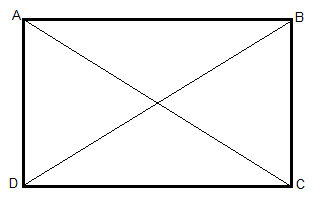
Let us compare their sides, AC = BD (given)
They have a common side, i.e. AB = BA
We know the opposite sides of a parallelogram are equal, hence BC = AD
The SSS rule states that: If three sides of one triangle are equal to three sides of another triangle, then the triangles are congruent.
⟹$\Delta {\text{ACB }} \cong {\text{ }}\Delta {\text{BDA - - - (sss rule)}}$
CPCT (corresponding parts of congruent triangle) theorem states that if two or more triangles which are congruent to each other are taken then the corresponding angles and the sides of the triangles are also congruent to each other.
Hence from congruent triangles ∆ACB and ∆BDA,
$\therefore \angle {\text{ABC = }}\angle {\text{BAD - - - (1)}}$.
As we know opposite sides of a parallelogram are equal, applying that to the figure we get,
Now AD ∥ BC.
AD ∥ BC and they are intersected by AB which is a traversal.
From the concept of traversal we know, the sum of consecutive interior angles on the same side of traversal is$180^\circ $.
$\therefore \angle {\text{BAD + }}\angle {\text{ABC = 180}}^\circ {\text{ - - - (2)}}$
Now, comparing equations (1) and (2), we get
$\angle {\text{BAD = }}\angle {\text{ABC = 90}}^\circ $
$\therefore $$\angle {\text{A = 90}}^\circ {\text{ and }}\angle {\text{C = 90}}^\circ $
Hence the angles in the figure are 90°, i.e. the given parallelogram is a rectangle.
Note – In order to solve this type of problem the key is to use the given data in the question and draw an appropriate figure. Upon drawing the figure we use the properties of diagonals and triangles formed to prove that the angles inside the figure are 90°, to prove it as a rectangle.
In geometry, a transversal is a line that passes through two lines in the same plane at two distinct points.
Complete step-by-step answer:
Given Data, in parallelogram ABCD, AC = BD.
To prove: Parallelogram ABCD is rectangle.
Proof: Let us consider ∆ACB and ∆BDA from the figure
Let us compare their sides, AC = BD (given)
They have a common side, i.e. AB = BA
We know the opposite sides of a parallelogram are equal, hence BC = AD
The SSS rule states that: If three sides of one triangle are equal to three sides of another triangle, then the triangles are congruent.
⟹$\Delta {\text{ACB }} \cong {\text{ }}\Delta {\text{BDA - - - (sss rule)}}$
CPCT (corresponding parts of congruent triangle) theorem states that if two or more triangles which are congruent to each other are taken then the corresponding angles and the sides of the triangles are also congruent to each other.
Hence from congruent triangles ∆ACB and ∆BDA,
$\therefore \angle {\text{ABC = }}\angle {\text{BAD - - - (1)}}$.
As we know opposite sides of a parallelogram are equal, applying that to the figure we get,
Now AD ∥ BC.
AD ∥ BC and they are intersected by AB which is a traversal.
From the concept of traversal we know, the sum of consecutive interior angles on the same side of traversal is$180^\circ $.
$\therefore \angle {\text{BAD + }}\angle {\text{ABC = 180}}^\circ {\text{ - - - (2)}}$
Now, comparing equations (1) and (2), we get
$\angle {\text{BAD = }}\angle {\text{ABC = 90}}^\circ $
$\therefore $$\angle {\text{A = 90}}^\circ {\text{ and }}\angle {\text{C = 90}}^\circ $
Hence the angles in the figure are 90°, i.e. the given parallelogram is a rectangle.
Note – In order to solve this type of problem the key is to use the given data in the question and draw an appropriate figure. Upon drawing the figure we use the properties of diagonals and triangles formed to prove that the angles inside the figure are 90°, to prove it as a rectangle.
In geometry, a transversal is a line that passes through two lines in the same plane at two distinct points.
Recently Updated Pages
Master Class 11 English: Engaging Questions & Answers for Success

Master Class 11 Social Science: Engaging Questions & Answers for Success
Master Class 11 Maths: Engaging Questions & Answers for Success
Master Class 11 Biology: Engaging Questions & Answers for Success
Master Class 11 Physics: Engaging Questions & Answers for Success
Master Class 11 Chemistry: Engaging Questions & Answers for Success
Trending doubts
Explain the Treaty of Vienna of 1815 class 10 social science CBSE
What is the full form of CNG A Complete Natural Gas class 10 social science CBSE
In cricket, what is a "Yorker" designed to do?
What is the full form of POSCO class 10 social science CBSE
Define Potential, Developed, Stock and Reserved resources
What were the majoritarian measures taken in Sri Lanka class 10 social science CBSE