




If the co-domain of ${{\cos }^{-1}}x$ is $\left( 2\pi ,3\pi \right)$ and $\left( {{\sin }^{-1}}x+{{\cos }^{-1}}x=\dfrac{9\pi }{2} \right)$, then the co-domain of ${{\sin }^{-1}}x=?$
\[\begin{align}
& A.\left( \dfrac{3\pi }{2},\dfrac{5\pi }{2} \right) \\
& B.\left( \dfrac{5\pi }{2},\dfrac{7\pi }{2} \right) \\
& C.\left( \dfrac{7\pi }{2},\dfrac{9\pi }{2} \right) \\
& D.\left( \dfrac{-\pi }{2},\dfrac{\pi }{2} \right) \\
\end{align}\]
Answer
 Verified
579.3k+ views
Hint: This question implemented the concept of inverse trigonometric functions. Co-domain is the concept that we have learned in functions. So, here one condition of inverse trigonometric function regarding ${{\cos }^{-1}}x$ has been provided. There, the simple approach is to use the first condition in the second condition $\left( {{\sin }^{-1}}x+{{\cos }^{-1}}x=\dfrac{9\pi }{2} \right)$, and by doing some manipulation and applying codomain concept, we will reach to the solution.
Complete step by step answer:
Here we have given condition as: the codomain of ${{\cos }^{-1}}x$ is $\left( 2\pi ,3\pi \right)$ and $\left( {{\sin }^{-1}}x+{{\cos }^{-1}}x=\dfrac{9\pi }{2} \right)$.
We have to find the codomain of ${{\sin }^{-1}}x=?$
Firstly we should know the difference between domain and codomain.
Let $f:A\to B$ then the set A is known as the domain of f. (i.e. domain of a function is the set of all possible inputs for the function).
Here, the set B is known as the co-domain of f. (i.e. the co-domain of a function is the set of its possible outputs).
Now, according to the given condition:
\[\begin{align}
& {{f}^{-1}}:\left( -1,1 \right)\to \left( 2\pi ,3\pi \right) \\
& {{f}^{-1}}\left( x \right)={{\cos }^{-1}}\left( x \right) \\
\end{align}\]
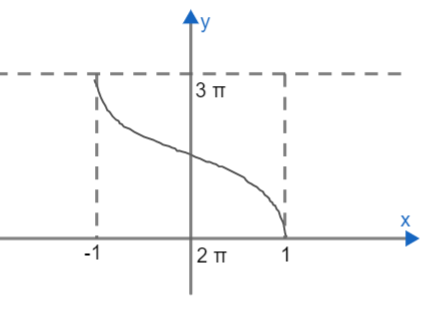
Now, we have \[\left( {{\sin }^{-1}}x+{{\cos }^{-1}}x=\dfrac{9\pi }{2} \right)\]
Therefore, \[\left( {{\sin }^{-1}}x=\dfrac{9\pi }{2}-{{\cos }^{-1}}x \right)\]
Now, we have to find the set of possible outputs for ${{\sin }^{-1}}x$.
Now, in $\left( {{\sin }^{-1}}x=\dfrac{9\pi }{2}-{{\cos }^{-1}}x \right)$ if we put the minimum value (lower bound) of co-domain of ${{\cos }^{-1}}x$, then, we will get maximum (upper bound) of co-domain of ${{\sin }^{-1}}x$. i.e. if ${{\cos }^{-1}}x=2\pi $.
\[\begin{align}
& \therefore {{\sin }^{-1}}x=\dfrac{9\pi }{2}-2\pi \\
& \Rightarrow {{\sin }^{-1}}x=\left( \dfrac{5\pi }{2} \right)\to \text{Upper value} \\
\end{align}\]
Similarly, if ${{\cos }^{-1}}x=3\pi $.
\[\begin{align}
& \therefore {{\sin }^{-1}}x=\dfrac{9\pi }{2}-3\pi \\
& \Rightarrow {{\sin }^{-1}}x=\left( \dfrac{3\pi }{2} \right)\to \text{Lower value} \\
\end{align}\]
Hence, overall we can say the set of possible outputs (or co-domain) of ${{\sin }^{-1}}x$ would be:
$\left( \dfrac{3\pi }{2},\dfrac{5\pi }{2} \right)$
So, the correct answer is “Option A”.
Note: Sometimes students do not focus on proper definitions of the basic terms in functions and inverse trigonometric functions and make silly mistakes in competitive examination. Like in this problem, we have $f:A\to B$ so most of the students think that A is domain and B is range. But actually, B is codomain i.e. range is a subset of codomain. Co-domain will be equal to the range in case of onto function (i.e. surjective function).
And also unlike normal trigonometric functions, inverse trigonometric functions have different graphs and they should be remembered by heart (at least for the fundamental inverse functions like ${{\sin }^{-1}}x,{{\cos }^{-1}}x\text{ and }{{\tan }^{-1}}x$) . These are one of the most commonly asked topics in various competitive exams.
Complete step by step answer:
Here we have given condition as: the codomain of ${{\cos }^{-1}}x$ is $\left( 2\pi ,3\pi \right)$ and $\left( {{\sin }^{-1}}x+{{\cos }^{-1}}x=\dfrac{9\pi }{2} \right)$.
We have to find the codomain of ${{\sin }^{-1}}x=?$
Firstly we should know the difference between domain and codomain.
Let $f:A\to B$ then the set A is known as the domain of f. (i.e. domain of a function is the set of all possible inputs for the function).
Here, the set B is known as the co-domain of f. (i.e. the co-domain of a function is the set of its possible outputs).
Now, according to the given condition:
\[\begin{align}
& {{f}^{-1}}:\left( -1,1 \right)\to \left( 2\pi ,3\pi \right) \\
& {{f}^{-1}}\left( x \right)={{\cos }^{-1}}\left( x \right) \\
\end{align}\]
Now, we have \[\left( {{\sin }^{-1}}x+{{\cos }^{-1}}x=\dfrac{9\pi }{2} \right)\]
Therefore, \[\left( {{\sin }^{-1}}x=\dfrac{9\pi }{2}-{{\cos }^{-1}}x \right)\]
Now, we have to find the set of possible outputs for ${{\sin }^{-1}}x$.
Now, in $\left( {{\sin }^{-1}}x=\dfrac{9\pi }{2}-{{\cos }^{-1}}x \right)$ if we put the minimum value (lower bound) of co-domain of ${{\cos }^{-1}}x$, then, we will get maximum (upper bound) of co-domain of ${{\sin }^{-1}}x$. i.e. if ${{\cos }^{-1}}x=2\pi $.
\[\begin{align}
& \therefore {{\sin }^{-1}}x=\dfrac{9\pi }{2}-2\pi \\
& \Rightarrow {{\sin }^{-1}}x=\left( \dfrac{5\pi }{2} \right)\to \text{Upper value} \\
\end{align}\]
Similarly, if ${{\cos }^{-1}}x=3\pi $.
\[\begin{align}
& \therefore {{\sin }^{-1}}x=\dfrac{9\pi }{2}-3\pi \\
& \Rightarrow {{\sin }^{-1}}x=\left( \dfrac{3\pi }{2} \right)\to \text{Lower value} \\
\end{align}\]
Hence, overall we can say the set of possible outputs (or co-domain) of ${{\sin }^{-1}}x$ would be:
$\left( \dfrac{3\pi }{2},\dfrac{5\pi }{2} \right)$
So, the correct answer is “Option A”.
Note: Sometimes students do not focus on proper definitions of the basic terms in functions and inverse trigonometric functions and make silly mistakes in competitive examination. Like in this problem, we have $f:A\to B$ so most of the students think that A is domain and B is range. But actually, B is codomain i.e. range is a subset of codomain. Co-domain will be equal to the range in case of onto function (i.e. surjective function).
And also unlike normal trigonometric functions, inverse trigonometric functions have different graphs and they should be remembered by heart (at least for the fundamental inverse functions like ${{\sin }^{-1}}x,{{\cos }^{-1}}x\text{ and }{{\tan }^{-1}}x$) . These are one of the most commonly asked topics in various competitive exams.
Recently Updated Pages
Master Class 12 Economics: Engaging Questions & Answers for Success

Master Class 12 Physics: Engaging Questions & Answers for Success
Master Class 12 English: Engaging Questions & Answers for Success
Master Class 12 Social Science: Engaging Questions & Answers for Success
Master Class 12 Maths: Engaging Questions & Answers for Success
Master Class 12 Business Studies: Engaging Questions & Answers for Success
Trending doubts
Why cannot DNA pass through cell membranes class 12 biology CBSE
Draw a neat and well labeled diagram of TS of ovary class 12 biology CBSE
In a human foetus the limbs and digits develop after class 12 biology CBSE
AABbCc genotype forms how many types of gametes a 4 class 12 biology CBSE
Differentiate between homogeneous and heterogeneous class 12 chemistry CBSE
The correct structure of ethylenediaminetetraacetic class 12 chemistry CBSE