




If the circumcentre of an acute-angled triangle lies at the origin and the centroid is the middle point of the line joining the point \[\left( {{a}^{2}}+1,{{a}^{2}}+1 \right)\] and $\left( 2a,-2a \right)$ , then find the line on which the orthocentre lies.
Answer
 Verified
603k+ views
Hint: First we will define every term given in the question that is acute angled triangle, the circumcenter, the centroid and the orthocentre. Then we will find the centroid by using the middle point formula that is for given points:$\left( {{x}_{1}},{{y}_{1}} \right)\text{ and }\left( {{x}_{2}},{{y}_{2}} \right)$, there middle point is $\left( \dfrac{{{x}_{1}}+{{x}_{2}}}{2},\dfrac{{{y}_{1}}+{{y}_{2}}}{2} \right)$ , and then we will find the line joining the circumcenter and the orthocenter and get the answer.
Complete step-by-step solution:
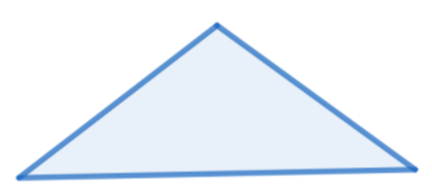
First, let’s understand what is an acute-angled triangle. So an acute-angled triangle is a triangle having all its angles less than ${{90}^{\circ }}$
Now let’s see the meaning of circumcenter. So, the circumcenter of a triangle is defined as the point where the perpendicular bisectors of the sides of that particular triangle intersect. In other words, the point of concurrency of the bisector of the sides of a triangle is called the circumcenter. It is denoted by $O\left( x,y \right)$ . The circumcenter is also the center of the circumcircle of that triangle and it can be either inside or outside the triangle.
Now we will see what is a centroid. So basically a centroid is the center point of the object. The point in which the three medians of the triangle intersect is known as the centroid of a triangle. It is also defined as the point of intersection of all the three medians where the median is a line that joins the midpoint of a side and the opposite vertex of the triangle. It is denoted by $G\left( x,y \right)$
Finally, we will understand the meaning of orthocentre. So the orthocenter is the point where all the three altitudes of the triangle cut or intersect each other. Here, the altitude is the line drawn from the vertex of the triangle and is perpendicular to the opposite side. Since the triangle has three vertices and three sides, therefore there are three altitudes. It is denoted by $H\left( x,y \right)$
Now according to the theorem of triangle properties, the orthocentre, centroid, and circumcentre of any triangle are collinear that means they lie on the same line and this line is called as Euler line of the triangle. The centroid divides the distance from the orthocentre to the circumcentre in the ratio of $2:1$.
Now, in the question, it is given that the circumcenter is at the origin that means \[O\left( 0,0 \right)\].
Now we know that the middle point of any line joining the points say $\left( {{x}_{1}},{{y}_{1}} \right)\text{ and }\left( {{x}_{2}},{{y}_{2}} \right)$ is:
$\left( \dfrac{{{x}_{1}}+{{x}_{2}}}{2},\dfrac{{{y}_{1}}+{{y}_{2}}}{2} \right)$ ,
It is given that the centroid is the middle point of the line joining $\left( {{a}^{2}}+1,{{a}^{2}}+1 \right)\text{ and }\left( 2a,-2a \right)$ .
So the centroid will be: $G\left( \dfrac{{{a}^{2}}+1+2a}{2},\dfrac{{{a}^{2}}+1-2a}{2} \right)\Rightarrow G\left( \dfrac{{{\left( {a}+1 \right)}^{2}}}{2},\dfrac{{{\left({a}-1 \right)}^{2}}}{2} \right)$
We will find the equation of line joining the circumcentre and the centroid will be:
\[\left( y-0 \right)=\dfrac{{{\left( a-1 \right)}^{2}}}{{{\left( a+1 \right)}^{2}}}\left( x-0 \right)\Rightarrow {{\left( a+1 \right)}^{2}}y-{{\left( a-1 \right)}^{2}}x=0\]
Now , we know according to the theorem that the orthocentre, centroid and circumcentre of any triangle are collinear that means they lie on the same line.
Therefore the orthocentre lies on the line: \[{{\left( a+1 \right)}^{2}}y-{{\left( a-1 \right)}^{2}}x=0\].
Note: Remember that in an acute-angled triangle, circumcenter lies inside the triangle whereas, in an obtuse-angled triangle, it lies outside of the triangle. While in the right-angled triangle circumcenter lies at the midpoint of the hypotenuse side of a right-angled triangle. Sometimes a student can get confused between the centroid and the circumcentre, mostly mistakes are made in confusion between the two terms.
Complete step-by-step solution:
First, let’s understand what is an acute-angled triangle. So an acute-angled triangle is a triangle having all its angles less than ${{90}^{\circ }}$
Now let’s see the meaning of circumcenter. So, the circumcenter of a triangle is defined as the point where the perpendicular bisectors of the sides of that particular triangle intersect. In other words, the point of concurrency of the bisector of the sides of a triangle is called the circumcenter. It is denoted by $O\left( x,y \right)$ . The circumcenter is also the center of the circumcircle of that triangle and it can be either inside or outside the triangle.
Now we will see what is a centroid. So basically a centroid is the center point of the object. The point in which the three medians of the triangle intersect is known as the centroid of a triangle. It is also defined as the point of intersection of all the three medians where the median is a line that joins the midpoint of a side and the opposite vertex of the triangle. It is denoted by $G\left( x,y \right)$
Finally, we will understand the meaning of orthocentre. So the orthocenter is the point where all the three altitudes of the triangle cut or intersect each other. Here, the altitude is the line drawn from the vertex of the triangle and is perpendicular to the opposite side. Since the triangle has three vertices and three sides, therefore there are three altitudes. It is denoted by $H\left( x,y \right)$
Now according to the theorem of triangle properties, the orthocentre, centroid, and circumcentre of any triangle are collinear that means they lie on the same line and this line is called as Euler line of the triangle. The centroid divides the distance from the orthocentre to the circumcentre in the ratio of $2:1$.
Now, in the question, it is given that the circumcenter is at the origin that means \[O\left( 0,0 \right)\].
Now we know that the middle point of any line joining the points say $\left( {{x}_{1}},{{y}_{1}} \right)\text{ and }\left( {{x}_{2}},{{y}_{2}} \right)$ is:
$\left( \dfrac{{{x}_{1}}+{{x}_{2}}}{2},\dfrac{{{y}_{1}}+{{y}_{2}}}{2} \right)$ ,
It is given that the centroid is the middle point of the line joining $\left( {{a}^{2}}+1,{{a}^{2}}+1 \right)\text{ and }\left( 2a,-2a \right)$ .
So the centroid will be: $G\left( \dfrac{{{a}^{2}}+1+2a}{2},\dfrac{{{a}^{2}}+1-2a}{2} \right)\Rightarrow G\left( \dfrac{{{\left( {a}+1 \right)}^{2}}}{2},\dfrac{{{\left({a}-1 \right)}^{2}}}{2} \right)$
We will find the equation of line joining the circumcentre and the centroid will be:
\[\left( y-0 \right)=\dfrac{{{\left( a-1 \right)}^{2}}}{{{\left( a+1 \right)}^{2}}}\left( x-0 \right)\Rightarrow {{\left( a+1 \right)}^{2}}y-{{\left( a-1 \right)}^{2}}x=0\]
Now , we know according to the theorem that the orthocentre, centroid and circumcentre of any triangle are collinear that means they lie on the same line.
Therefore the orthocentre lies on the line: \[{{\left( a+1 \right)}^{2}}y-{{\left( a-1 \right)}^{2}}x=0\].
Note: Remember that in an acute-angled triangle, circumcenter lies inside the triangle whereas, in an obtuse-angled triangle, it lies outside of the triangle. While in the right-angled triangle circumcenter lies at the midpoint of the hypotenuse side of a right-angled triangle. Sometimes a student can get confused between the centroid and the circumcentre, mostly mistakes are made in confusion between the two terms.
Recently Updated Pages
Master Class 11 Social Science: Engaging Questions & Answers for Success

Master Class 11 Physics: Engaging Questions & Answers for Success
Master Class 11 Maths: Engaging Questions & Answers for Success
Master Class 11 Economics: Engaging Questions & Answers for Success
Master Class 11 Computer Science: Engaging Questions & Answers for Success
Master Class 11 Chemistry: Engaging Questions & Answers for Success
Trending doubts
One Metric ton is equal to kg A 10000 B 1000 C 100 class 11 physics CBSE
There are 720 permutations of the digits 1 2 3 4 5 class 11 maths CBSE
1 Quintal is equal to a 110 kg b 10 kg c 100kg d 1000 class 11 physics CBSE
State and prove Bernoullis theorem class 11 physics CBSE
Difference Between Prokaryotic Cells and Eukaryotic Cells
Which among the following are examples of coming together class 11 social science CBSE