




If the area (in square units) bounded by the parabola ${{y}^{2}}=4\lambda x$ and the line $y=\lambda x,\lambda >0$, is $\dfrac{1}{9}$, then $\lambda $ is equal to \[\]
A.24\[\]
B.48\[\]
C.$4\sqrt{3}$\[\]
D. $2\sqrt{6}$\[\]
Answer
 Verified
588.6k+ views
Hint: Put the value of $y=\lambda x$ from the equation of the line in the equation of parabola ${{y}^{2}}=4\lambda x$ to find the points of intersection of the line and the parabola. Use definite integral with abscissas of the intersection of the point as limits to find the area under the parabola and line. Equate their difference to $\dfrac{1}{9}$ and find the only unknown $\lambda $ .\[\]
Complete step-by-step answer:
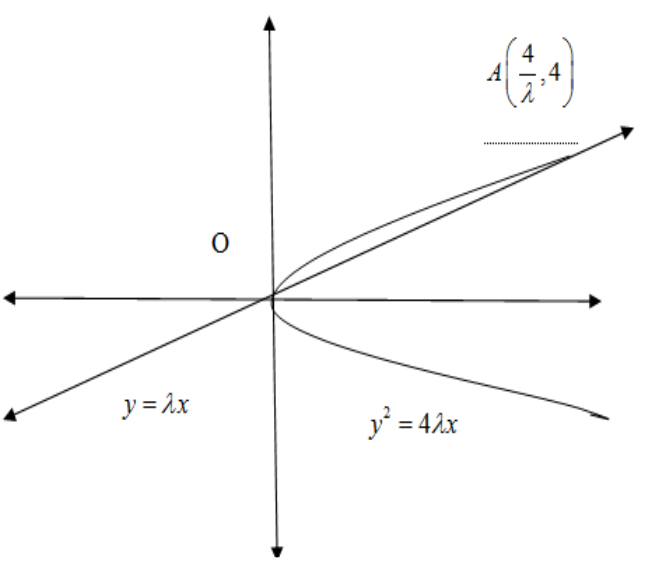
The given equation of parabola is
\[{{y}^{2}}=4\lambda x...(1)\]
Where $\lambda $ is a positive real number. The given equation of line
\[y=\lambda x...(2)\]
We solve the pair of equations by putting the values of $y$ in equation(1),
\[\begin{align}
& {{\left( \lambda x \right)}^{2}}=4\lambda x \\
& \Rightarrow {{\lambda }^{2}}{{x}^{2}}=4\lambda x \\
& \Rightarrow x\left( {{\lambda }^{2}}x-4\lambda \right)=0 \\
& \Rightarrow x=0,\dfrac{4}{\lambda } \\
\end{align}\]
When $x=0,y=0$ and one of the points of intersection of parabola and the line is origin. The other point of intersection is given by $x=\dfrac{4}{\lambda },y= \lambda \left( \dfrac{4}{\lambda } \right)=4$. Here, $\dfrac{4}{\lambda }$ exists as $\lambda $ is real and positive number. So the area bounded by the parabola and the line has points $\left( 0,0 \right)$ and $\left( \dfrac{4}{\lambda },4 \right)$ at the boundary. \[\]
We know from the theory of definite integral that the area under any curve $f\left( x \right)$ within enclosed by vertical lines $x=a,x=b$ is given by $\int\limits_{a}^{b}{f\left( x \right)}dx$. The area under parabola within the points of intersection $\left( 0,0 \right)$and $\left( \dfrac{4}{\lambda },4 \right)$ can be expressed as $\int\limits_{0}^{\dfrac{4}{\lambda }}{\sqrt{4\lambda x}}dx$ and similarly the area under the line can be expressed as $\int\limits_{0}^{\dfrac{4}{\lambda }}{\lambda xdx}$.\[\]
We observe that the area bounded by the parabola and the line is the difference between the area under parabola and the line which is given in the question as 9 square units. We also deduce $\sqrt{4\lambda }>\lambda $ as $\lambda $ is positive. So the line will lie under the parabola within the bounds defined by points of intersection. So
\[9=\int\limits_{0}^{\dfrac{4}{\lambda}}{\sqrt{4\lambda x}}dx-\int\limits_{0}^{\dfrac{4}{\lambda }}{\lambda xdx}\]
Using the integration formula $\int{{{x}^{n}}dx}=\dfrac{{{x}^{n}}+1}{n+1}$ we get,
\[\begin{align}
& \dfrac{1}{9}={{\left[ 2\sqrt{\lambda }\cdot \dfrac{2}{3}\cdot {{x}^{\dfrac{3}{2}}}-\lambda \dfrac{{{x}^{2}}}{2} \right]}_{0}}^{\dfrac{4}{\lambda }} \\
& \Rightarrow \dfrac{1}{9}=\dfrac{4\sqrt{\lambda }}{3}\cdot \dfrac{4}{\lambda }\cdot \dfrac{2}{\sqrt{\lambda }}-\dfrac{\lambda }{2}\cdot \dfrac{16}{{{\lambda }^{2}}} \\
& \Rightarrow \dfrac{1}{9}=\dfrac{32}{3\lambda }-\dfrac{8}{\lambda } \\
& \Rightarrow \lambda =24 \\
\end{align}\]
The correct choice is A.\[\]
Note: We need to take care that area is a positive quantity and we need to subtract the smaller area from the larger area. So we need to investigate under which curve more area is bounded. It is also to be noted that if some part of the curve if lies below $x-$axis and some above part above then the formula within interval $\left[ a,b \right]$ then the formula for area $\int\limits_{a}^{b}{f\left( x \right)}dx$ fails there. We have to find the sum of the area below and above the $x-$axis.
Complete step-by-step answer:
The given equation of parabola is
\[{{y}^{2}}=4\lambda x...(1)\]
Where $\lambda $ is a positive real number. The given equation of line
\[y=\lambda x...(2)\]
We solve the pair of equations by putting the values of $y$ in equation(1),
\[\begin{align}
& {{\left( \lambda x \right)}^{2}}=4\lambda x \\
& \Rightarrow {{\lambda }^{2}}{{x}^{2}}=4\lambda x \\
& \Rightarrow x\left( {{\lambda }^{2}}x-4\lambda \right)=0 \\
& \Rightarrow x=0,\dfrac{4}{\lambda } \\
\end{align}\]
When $x=0,y=0$ and one of the points of intersection of parabola and the line is origin. The other point of intersection is given by $x=\dfrac{4}{\lambda },y= \lambda \left( \dfrac{4}{\lambda } \right)=4$. Here, $\dfrac{4}{\lambda }$ exists as $\lambda $ is real and positive number. So the area bounded by the parabola and the line has points $\left( 0,0 \right)$ and $\left( \dfrac{4}{\lambda },4 \right)$ at the boundary. \[\]
We know from the theory of definite integral that the area under any curve $f\left( x \right)$ within enclosed by vertical lines $x=a,x=b$ is given by $\int\limits_{a}^{b}{f\left( x \right)}dx$. The area under parabola within the points of intersection $\left( 0,0 \right)$and $\left( \dfrac{4}{\lambda },4 \right)$ can be expressed as $\int\limits_{0}^{\dfrac{4}{\lambda }}{\sqrt{4\lambda x}}dx$ and similarly the area under the line can be expressed as $\int\limits_{0}^{\dfrac{4}{\lambda }}{\lambda xdx}$.\[\]
We observe that the area bounded by the parabola and the line is the difference between the area under parabola and the line which is given in the question as 9 square units. We also deduce $\sqrt{4\lambda }>\lambda $ as $\lambda $ is positive. So the line will lie under the parabola within the bounds defined by points of intersection. So
\[9=\int\limits_{0}^{\dfrac{4}{\lambda}}{\sqrt{4\lambda x}}dx-\int\limits_{0}^{\dfrac{4}{\lambda }}{\lambda xdx}\]
Using the integration formula $\int{{{x}^{n}}dx}=\dfrac{{{x}^{n}}+1}{n+1}$ we get,
\[\begin{align}
& \dfrac{1}{9}={{\left[ 2\sqrt{\lambda }\cdot \dfrac{2}{3}\cdot {{x}^{\dfrac{3}{2}}}-\lambda \dfrac{{{x}^{2}}}{2} \right]}_{0}}^{\dfrac{4}{\lambda }} \\
& \Rightarrow \dfrac{1}{9}=\dfrac{4\sqrt{\lambda }}{3}\cdot \dfrac{4}{\lambda }\cdot \dfrac{2}{\sqrt{\lambda }}-\dfrac{\lambda }{2}\cdot \dfrac{16}{{{\lambda }^{2}}} \\
& \Rightarrow \dfrac{1}{9}=\dfrac{32}{3\lambda }-\dfrac{8}{\lambda } \\
& \Rightarrow \lambda =24 \\
\end{align}\]
The correct choice is A.\[\]
Note: We need to take care that area is a positive quantity and we need to subtract the smaller area from the larger area. So we need to investigate under which curve more area is bounded. It is also to be noted that if some part of the curve if lies below $x-$axis and some above part above then the formula within interval $\left[ a,b \right]$ then the formula for area $\int\limits_{a}^{b}{f\left( x \right)}dx$ fails there. We have to find the sum of the area below and above the $x-$axis.
Recently Updated Pages
Basicity of sulphurous acid and sulphuric acid are

Master Class 12 English: Engaging Questions & Answers for Success
Master Class 12 Social Science: Engaging Questions & Answers for Success
Master Class 12 Maths: Engaging Questions & Answers for Success
Master Class 12 Economics: Engaging Questions & Answers for Success
Master Class 12 Physics: Engaging Questions & Answers for Success
Trending doubts
Which are the Top 10 Largest Countries of the World?
Draw a labelled sketch of the human eye class 12 physics CBSE
Draw ray diagrams each showing i myopic eye and ii class 12 physics CBSE
Give 10 examples of unisexual and bisexual flowers
Coming together federation is practiced in A India class 12 social science CBSE
How was the Civil Disobedience Movement different from class 12 social science CBSE