




If the angle of incident is ${50^o}$, then calculate the angle between the incident ray and the reflected ray.
A. ${50^o}$
B. ${260^o}$
C. ${100^o}$
D. ${80^o}$
Answer
 Verified
598.8k+ views
Hint: In this question, we need to determine the angle between the incident ray and the reflected ray. A normal line divides the angle between the incident ray and the reflected ray. These are divided into two equal angles. This implies that both the angles formed are equal.
Complete step by step answer:
According to the law of reflection,the angle of incidence is equal to the angle of reflection.the given example, the angle of incidence is ${50^o}$.Therefore, the angle of reflection will also be ${50^o}$.We can write this as,
The angle of incidence $ = $ the angle of reflection $ = $ ${50^o}$.
Now, we need to find out the angle between the incident ray and the reflected ray.Let \[\theta \] be the angle between the incident ray and the reflected ray.By observing the figure below, we can conclude that the sum of the angle of incidence and the angle of reflection equal to the measure of the angle between the incident ray and the reflected ray.
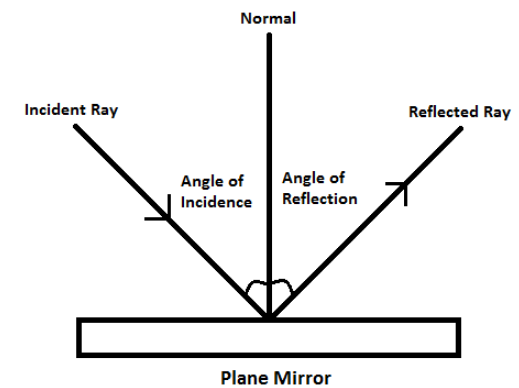
The angle between the incident ray and the reflected ray $ = $ the angle of incidence $ + $ the angle of reflection.
$
\theta = {50^o} + {50^o} \\
\therefore\theta = {100^o} $
Therefore, the angle between the incident ray and the reflected ray is ${100^o}$.
So, option C is the correct answer.
Note:Students get confused instead of calculating the angle between the incident ray and the reflected ray, they calculate the answer for the angle between the reflected ray and the normal. The angle between normal and the incident ray is called the angle of incidence. Similarly, the angle between the normal and the reflected ray is called the angle of reflection.
Complete step by step answer:
According to the law of reflection,the angle of incidence is equal to the angle of reflection.the given example, the angle of incidence is ${50^o}$.Therefore, the angle of reflection will also be ${50^o}$.We can write this as,
The angle of incidence $ = $ the angle of reflection $ = $ ${50^o}$.
Now, we need to find out the angle between the incident ray and the reflected ray.Let \[\theta \] be the angle between the incident ray and the reflected ray.By observing the figure below, we can conclude that the sum of the angle of incidence and the angle of reflection equal to the measure of the angle between the incident ray and the reflected ray.
The angle between the incident ray and the reflected ray $ = $ the angle of incidence $ + $ the angle of reflection.
$
\theta = {50^o} + {50^o} \\
\therefore\theta = {100^o} $
Therefore, the angle between the incident ray and the reflected ray is ${100^o}$.
So, option C is the correct answer.
Note:Students get confused instead of calculating the angle between the incident ray and the reflected ray, they calculate the answer for the angle between the reflected ray and the normal. The angle between normal and the incident ray is called the angle of incidence. Similarly, the angle between the normal and the reflected ray is called the angle of reflection.
Recently Updated Pages
Master Class 11 English: Engaging Questions & Answers for Success

Master Class 11 Social Science: Engaging Questions & Answers for Success
Master Class 11 Maths: Engaging Questions & Answers for Success
Master Class 11 Biology: Engaging Questions & Answers for Success
Master Class 11 Physics: Engaging Questions & Answers for Success
Master Class 11 Chemistry: Engaging Questions & Answers for Success
Trending doubts
Explain the Treaty of Vienna of 1815 class 10 social science CBSE
What is the full form of POSCO class 10 social science CBSE
Define Potential, Developed, Stock and Reserved resources
The diagonals of a rhombus are 10cm and 24cm Find the class 10 maths CBSE
One number is chosen from numbers 1 to 200 Find the class 10 maths CBSE
Why is Venus called Earths sister planet class 10 physics CBSE