




If the angle of elevation of the cloud from a point h meter above a lake has a measure \[\alpha \] and the angle of depression of its reflection of the lake has a measure \[\beta \] .
Prove that the height of the cloud is \[\dfrac{h\left( \tan \beta +\tan \alpha \right)}{\left( \tan \beta -\tan \alpha \right)}\] .
Answer
 Verified
616.5k+ views
Hint: We will find the values of \[\tan \alpha \] and \[\tan \beta \] as ratios of sides of the triangle. Then we will solve the two equations to get a combined equation which would be our final answer.
Complete step-by-step answer:
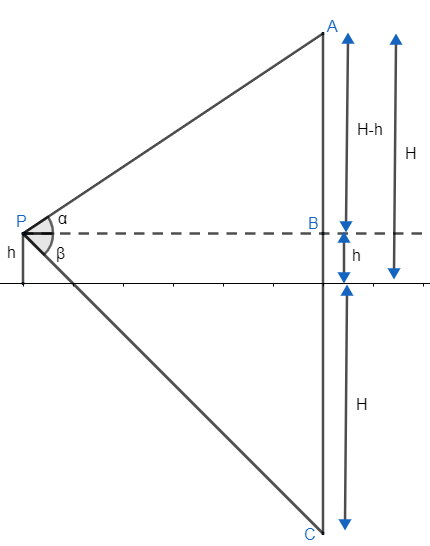
Now as we can see in the figure, let us assume that the point P is h above the lake.
Now let the cloud be at point A at a height of H. Let the line PB be the line of sight.
Also the reflection is at a depth of H below the lake since the height of the object and the depth of its reflection is equal.
Therefore, AB = H-h and BC = H+h.
Thus the angle \[\angle APB=\alpha \] .
Thus \[\tan \alpha =\dfrac{H-h}{PB}..........\left( i \right)\] .
Now, \[\angle BPC=\beta \] .
Therefore, \[\tan \beta =\dfrac{H+h}{PB}..........\left( ii \right)\]
Now dividing (i) by (ii) we get,
\[\dfrac{\tan \alpha }{\tan \beta }=\dfrac{\dfrac{H-h}{PB}}{\dfrac{H+h}{PB}}\]
Cancelling the common term PB, we get,
\[\dfrac{\tan \alpha }{\tan \beta }=\dfrac{H-h}{H+h}\]
Now cross multiplying we get,
\[\begin{align}
& \left( H+h \right)\tan \alpha =\left( H-h \right)\tan \beta \\
& H\tan \alpha +h\tan \alpha =H\tan \beta -h\tan \beta \\
\end{align}\]
Taking all the H terms on one side and all the h terms on the other we get,
\[\begin{align}
& H\tan \alpha -H\tan \beta =h\tan \alpha +h\tan \beta \\
& H\left( \tan \alpha -\tan \beta \right)=h\left( \tan \alpha +\tan \beta \right) \\
\end{align}\]
Cross multiplying we get,
\[H=\dfrac{h\left( \tan \alpha +\tan \beta \right)}{\left( \tan \alpha -\tan \beta \right)}\] .
Thus proved.
Note: Please remember that the height of the object and depth of its reflection is always equal from the ground point and not from the line of sight. You can commit a mistake there by taking the height and depth to be equal from the line of sight and mess up with the solution.
Complete step-by-step answer:
Now as we can see in the figure, let us assume that the point P is h above the lake.
Now let the cloud be at point A at a height of H. Let the line PB be the line of sight.
Also the reflection is at a depth of H below the lake since the height of the object and the depth of its reflection is equal.
Therefore, AB = H-h and BC = H+h.
Thus the angle \[\angle APB=\alpha \] .
Thus \[\tan \alpha =\dfrac{H-h}{PB}..........\left( i \right)\] .
Now, \[\angle BPC=\beta \] .
Therefore, \[\tan \beta =\dfrac{H+h}{PB}..........\left( ii \right)\]
Now dividing (i) by (ii) we get,
\[\dfrac{\tan \alpha }{\tan \beta }=\dfrac{\dfrac{H-h}{PB}}{\dfrac{H+h}{PB}}\]
Cancelling the common term PB, we get,
\[\dfrac{\tan \alpha }{\tan \beta }=\dfrac{H-h}{H+h}\]
Now cross multiplying we get,
\[\begin{align}
& \left( H+h \right)\tan \alpha =\left( H-h \right)\tan \beta \\
& H\tan \alpha +h\tan \alpha =H\tan \beta -h\tan \beta \\
\end{align}\]
Taking all the H terms on one side and all the h terms on the other we get,
\[\begin{align}
& H\tan \alpha -H\tan \beta =h\tan \alpha +h\tan \beta \\
& H\left( \tan \alpha -\tan \beta \right)=h\left( \tan \alpha +\tan \beta \right) \\
\end{align}\]
Cross multiplying we get,
\[H=\dfrac{h\left( \tan \alpha +\tan \beta \right)}{\left( \tan \alpha -\tan \beta \right)}\] .
Thus proved.
Note: Please remember that the height of the object and depth of its reflection is always equal from the ground point and not from the line of sight. You can commit a mistake there by taking the height and depth to be equal from the line of sight and mess up with the solution.
Recently Updated Pages
Basicity of sulphurous acid and sulphuric acid are

Master Class 10 English: Engaging Questions & Answers for Success
Master Class 10 Social Science: Engaging Questions & Answers for Success
Master Class 10 Computer Science: Engaging Questions & Answers for Success
Class 10 Question and Answer - Your Ultimate Solutions Guide
Master Class 10 General Knowledge: Engaging Questions & Answers for Success
Trending doubts
Which country won the ICC Men's ODI World Cup in 2023?
What is the full form of PNG A Petrol Natural Gas B class 10 chemistry CBSE
In cricket, how many legal balls are there in a standard over?
Explain the Treaty of Vienna of 1815 class 10 social science CBSE
What does "powerplay" mean in limited-overs cricket?
What is the "Powerplay" in T20 cricket?