




If tangents TA and TB from a point T to a circle with center O are inclined to each other at an angle of \[{{70}^{\circ }}\], then find \[\angle AOB\] (in degrees).
Answer
 Verified
651.3k+ views
Hint: Draw the figure as mentioned. The tangents and normal are at a point on a circle as perpendicular to each other. Apply angle sum property of quadrilaterals and get \[\angle AOB\].
Complete step-by-step answer:
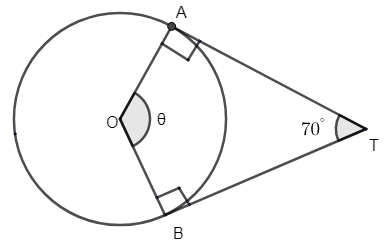
From the figure you can find a circle with center O. Let T be the point where the tangent starts. Thus TA and TB are tangents from the point T to the point A and B of the circle respectively.
It is said that they are inclined at an angle of \[{{70}^{\circ }}\]. Thus from the figure we can say that, \[\angle ATB={{70}^{\circ }}\].
The tangent to a circle is a line that touches the circle at one point, to the circle is always perpendicular to the radius.
Thus we can say that tangents and normal at a point on a circle are perpendicular to the radius.
Thus we can say that tangents and normal at a point on a circle are perpendicular to each other. Thus we can say that the circles are perpendicular to each other. Thus we can say that, \[\angle A={{90}^{\circ }}\] and \[\angle B={{90}^{\circ }}\] [from the figure].
We know that in a quadrilateral, the sum of all angles is \[{{360}^{\circ }}\].
Similarly by looking in the figure, we can say that,
\[\angle A+\angle B+\angle O+\angle T={{360}^{\circ }}\]
We know, \[\angle A={{90}^{\circ }}\], \[\angle B={{90}^{\circ }}\] and \[\angle T={{70}^{\circ }}\]. Thus substitute these values and get \[\angle O\].
\[\begin{align}
& \angle A+\angle B+\angle O+\angle T={{360}^{\circ }} \\
& {{90}^{\circ }}+{{90}^{\circ }}+\angle O+{{90}^{\circ }}={{360}^{\circ }} \\
& \angle O={{360}^{\circ }}-{{90}^{\circ }}-{{90}^{\circ }}-{{70}^{\circ }} \\
& \angle O={{360}^{\circ }}-{{180}^{\circ }}-{{70}^{\circ }} \\
& \angle O={{360}^{\circ }}-{{250}^{\circ }} \\
& \angle O={{110}^{\circ }} \\
\end{align}\]
Thus we got, \[\angle AOB={{110}^{\circ }}\].
\[\therefore \] We got the required angle AOB as \[{{110}^{\circ }}\] (in degrees).
Note: We know the angle sum property of a quadrilateral corresponds to \[{{360}^{\circ }}\]. You may sometimes take it as \[{{180}^{\circ }}\], which is the total angle sum in a triangle. Don’t mix between the angle’s sum of triangles and quadrilaterals.
Complete step-by-step answer:
From the figure you can find a circle with center O. Let T be the point where the tangent starts. Thus TA and TB are tangents from the point T to the point A and B of the circle respectively.
It is said that they are inclined at an angle of \[{{70}^{\circ }}\]. Thus from the figure we can say that, \[\angle ATB={{70}^{\circ }}\].
The tangent to a circle is a line that touches the circle at one point, to the circle is always perpendicular to the radius.
Thus we can say that tangents and normal at a point on a circle are perpendicular to the radius.
Thus we can say that tangents and normal at a point on a circle are perpendicular to each other. Thus we can say that the circles are perpendicular to each other. Thus we can say that, \[\angle A={{90}^{\circ }}\] and \[\angle B={{90}^{\circ }}\] [from the figure].
We know that in a quadrilateral, the sum of all angles is \[{{360}^{\circ }}\].
Similarly by looking in the figure, we can say that,
\[\angle A+\angle B+\angle O+\angle T={{360}^{\circ }}\]
We know, \[\angle A={{90}^{\circ }}\], \[\angle B={{90}^{\circ }}\] and \[\angle T={{70}^{\circ }}\]. Thus substitute these values and get \[\angle O\].
\[\begin{align}
& \angle A+\angle B+\angle O+\angle T={{360}^{\circ }} \\
& {{90}^{\circ }}+{{90}^{\circ }}+\angle O+{{90}^{\circ }}={{360}^{\circ }} \\
& \angle O={{360}^{\circ }}-{{90}^{\circ }}-{{90}^{\circ }}-{{70}^{\circ }} \\
& \angle O={{360}^{\circ }}-{{180}^{\circ }}-{{70}^{\circ }} \\
& \angle O={{360}^{\circ }}-{{250}^{\circ }} \\
& \angle O={{110}^{\circ }} \\
\end{align}\]
Thus we got, \[\angle AOB={{110}^{\circ }}\].
\[\therefore \] We got the required angle AOB as \[{{110}^{\circ }}\] (in degrees).
Note: We know the angle sum property of a quadrilateral corresponds to \[{{360}^{\circ }}\]. You may sometimes take it as \[{{180}^{\circ }}\], which is the total angle sum in a triangle. Don’t mix between the angle’s sum of triangles and quadrilaterals.
Recently Updated Pages
Master Class 11 English: Engaging Questions & Answers for Success

Master Class 11 Social Science: Engaging Questions & Answers for Success
Master Class 11 Maths: Engaging Questions & Answers for Success
Master Class 11 Biology: Engaging Questions & Answers for Success
Master Class 11 Physics: Engaging Questions & Answers for Success
Master Class 11 Chemistry: Engaging Questions & Answers for Success
Trending doubts
Explain the Treaty of Vienna of 1815 class 10 social science CBSE
What is the full form of CNG A Complete Natural Gas class 10 social science CBSE
In cricket, what is a "Yorker" designed to do?
What is the full form of POSCO class 10 social science CBSE
Define Potential, Developed, Stock and Reserved resources
What were the majoritarian measures taken in Sri Lanka class 10 social science CBSE