




If $\tan x=\dfrac{3}{4},0< x< {{90}^{\circ }}$, then what is the value of $\sin x$?
A. $\dfrac{3}{5}$
B. $\dfrac{4}{5}$
C. $\dfrac{12}{25}$
D. $\dfrac{13}{25}$
Answer
 Verified
511.8k+ views
Hint: We explain the function $\arctan \left( m \right)$. We express the inverse function of tan in the form of $\arctan \left( m \right)={{\tan }^{-1}}m$. We find the angle which gives $\tan x=\dfrac{3}{4}$. Thereafter we take the sin ratio of that angle to find the solution. We also use the representation of a right-angle triangle with height and base ratio being $\dfrac{3}{4}$.
Complete step-by-step solution:
This given ratio is $\tan x=\dfrac{3}{4}$. We know \[\tan \theta =\dfrac{\text{height}}{\text{base}}\]. This gives $x={{\tan }^{-1}}\left( \dfrac{3}{4} \right)$.
We can take the representation of a right-angle triangle with height and base ratio being $\dfrac{3}{4}$ and the angle being $x$. The height and base were considered with respect to that particular angle $x$.
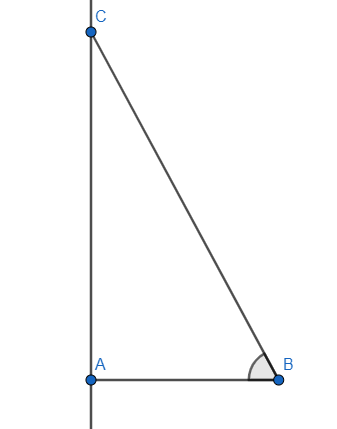
In this case we take $AB=4p$ and keeping the ratio in mind we have $AC=3p$ as the ratio has to be $\dfrac{3}{4}$.
Now we apply the Pythagoras’ theorem to find the length of BC. $B{{C}^{2}}=A{{B}^{2}}+A{{C}^{2}}$.
So, $B{{C}^{2}}={{\left( 4p \right)}^{2}}+{{\left( 3p \right)}^{2}}=25{{p}^{2}}$ which gives $BC=5p$. Length can’t be negative.
We need to find \[\sin \left( {{\tan }^{-1}}\left( \dfrac{3}{4} \right) \right)\] which is equal to \[\sin x\].
This ratio gives \[\sin x=\dfrac{\text{height}}{\text{hypotenuse}}\]. So, \[\sin x=\dfrac{AC}{BC}=\dfrac{3p}{5p}=\dfrac{3}{5}\].
Therefore, \[\sin x\] is equal to \[\dfrac{3}{5}\]. The correct option is A.
Note: We can also apply the trigonometric image form to get the value of \[\sin x\]. It’s given that $\tan x=\dfrac{3}{4}$ and we try to find \[\sin x\]. We know $\cot x=\dfrac{1}{\tan x}=\dfrac{4}{3}$. We also have $\csc \theta =\sqrt{1+{{\cot }^{2}}\theta }=\sqrt{1+\left( \dfrac{4}{3} \right)}=\dfrac{5}{3}$. Putting the values, we get $\sin x=\dfrac{1}{\csc x}=\dfrac{3}{5}$.
Complete step-by-step solution:
This given ratio is $\tan x=\dfrac{3}{4}$. We know \[\tan \theta =\dfrac{\text{height}}{\text{base}}\]. This gives $x={{\tan }^{-1}}\left( \dfrac{3}{4} \right)$.
We can take the representation of a right-angle triangle with height and base ratio being $\dfrac{3}{4}$ and the angle being $x$. The height and base were considered with respect to that particular angle $x$.
In this case we take $AB=4p$ and keeping the ratio in mind we have $AC=3p$ as the ratio has to be $\dfrac{3}{4}$.
Now we apply the Pythagoras’ theorem to find the length of BC. $B{{C}^{2}}=A{{B}^{2}}+A{{C}^{2}}$.
So, $B{{C}^{2}}={{\left( 4p \right)}^{2}}+{{\left( 3p \right)}^{2}}=25{{p}^{2}}$ which gives $BC=5p$. Length can’t be negative.
We need to find \[\sin \left( {{\tan }^{-1}}\left( \dfrac{3}{4} \right) \right)\] which is equal to \[\sin x\].
This ratio gives \[\sin x=\dfrac{\text{height}}{\text{hypotenuse}}\]. So, \[\sin x=\dfrac{AC}{BC}=\dfrac{3p}{5p}=\dfrac{3}{5}\].
Therefore, \[\sin x\] is equal to \[\dfrac{3}{5}\]. The correct option is A.
Note: We can also apply the trigonometric image form to get the value of \[\sin x\]. It’s given that $\tan x=\dfrac{3}{4}$ and we try to find \[\sin x\]. We know $\cot x=\dfrac{1}{\tan x}=\dfrac{4}{3}$. We also have $\csc \theta =\sqrt{1+{{\cot }^{2}}\theta }=\sqrt{1+\left( \dfrac{4}{3} \right)}=\dfrac{5}{3}$. Putting the values, we get $\sin x=\dfrac{1}{\csc x}=\dfrac{3}{5}$.
Recently Updated Pages
Basicity of sulphurous acid and sulphuric acid are

Master Class 11 Business Studies: Engaging Questions & Answers for Success
Master Class 11 Computer Science: Engaging Questions & Answers for Success
Master Class 11 Economics: Engaging Questions & Answers for Success
Master Class 11 Social Science: Engaging Questions & Answers for Success
Master Class 11 English: Engaging Questions & Answers for Success
Trending doubts
Draw a diagram of nephron and explain its structur class 11 biology CBSE
Explain zero factorial class 11 maths CBSE
Chemical formula of Bleaching powder is A Ca2OCl2 B class 11 chemistry CBSE
Name the part of the brain responsible for the precision class 11 biology CBSE
The growth of tendril in pea plants is due to AEffect class 11 biology CBSE
One Metric ton is equal to kg A 10000 B 1000 C 100 class 11 physics CBSE