




If Q(0,1) is equidistant from P(5,-3) and R(x,6), find the values of x. Also find the distance QR and PR.
Answer
 Verified
638.4k+ views
Hint: In this question it is given that the point Q(0,1) is equidistant from P(5,-3) and R(x,6), then we have to find the values of x. Also have to find QR and PR. So for this we have to know the distance formula between two points, which states that, the distance between the points A(a,b) to B(c,d) is $\mathbf{d} =\sqrt{\left( a-c\right)^{2} +\left( b-d\right)^{2} }$ ............(1)
Complete step-by-step solution:
Now by the above formula we can find the distance between Q(0,1) and P(5,-3),
QP$$=\sqrt{\left( 0-5\right)^{2} +\left( 1-\left( -3\right) \right)^{2} }$$
$$=\sqrt{\left( -5\right)^{2} +\left( 1+3\right)^{2} }$$
$$=\sqrt{25+4^{2}}$$
$$=\sqrt{25+16}$$
$$=\sqrt{41}$$
And the distance between Q(0,1) and R(x,6),
QR$$=\sqrt{\left( 0-x\right)^{2} +\left( 1-6\right)^{2} }$$
$$=\sqrt{x^{2}+\left( -5\right)^{2} }$$
$$=\sqrt{x^{2}+25}$$
Now since, the distance between the QP and QR are equal, then we can write,
QP = QR
$$\Rightarrow \sqrt{41} =\sqrt{x^{2}+25}$$
$$\Rightarrow \sqrt{x^{2}+25} =\sqrt{41}$$
$$\Rightarrow \left( \sqrt{x^{2}+25} \right) =\left( \sqrt{41} \right)^{2}$$ [squaring both side]
$$\Rightarrow x^{2}+25=41$$
$$\Rightarrow x^{2}=41-25$$
$$\Rightarrow x^{2}=16$$
$$\Rightarrow x=\pm \sqrt{16}$$
$$\Rightarrow x=\pm 4$$
Therefore, the coordinate of R is either (4,6) or (-4,6)
Now, when R=(4,6)
QR=$$\sqrt{\left( 0-4\right)^{2} +\left( 1-6\right)^{2} }$$
=$$\sqrt{16+25} =\sqrt{41}$$
Similarly when R=(-4,6) then
QR=$$\sqrt{\left( 0+4\right)^{2} +\left( 1-6\right)^{2} }$$
=$$\sqrt{16+25} =\sqrt{41}$$
Now when R=(4,6)
$$PR=\sqrt{\left( 5-4\right)^{2} +\left( -3-6\right)^{2} }$$
$$=\sqrt{1+\left( -9\right)^{2} } =\sqrt{1+81} =\sqrt{82}$$
And when R=(-4,6) then
PR$$=\sqrt{\left( 5-\left( -4\right) \right)^{2} +\left( -3-6\right)^{2} } =\sqrt{9^{2}+9^{2}}$$
=$$\sqrt{81+81}$$=$$\sqrt{162}$$
Therefore we can say that the coordinate of R is (4,6) or (-4,6) and QR=$\sqrt{41}$ and PR=$\sqrt{82}$ or $\sqrt{162}$ .
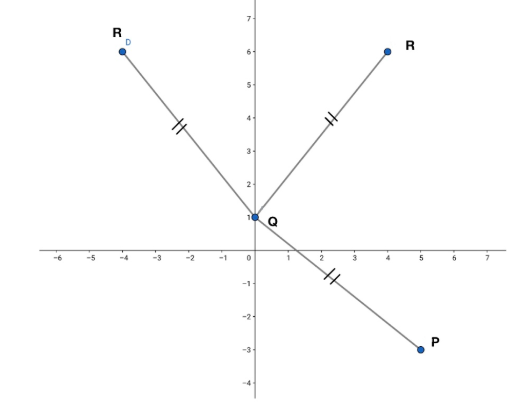
Note: While solving we got two coordinates for R, so why do we get two points? It is because in the first condition it is given that from point Q the distance of P and R are the same so there might be more than one point(point R) whose distance is equal to QP.
So you can understand it by a simple diagram,
Complete step-by-step solution:
Now by the above formula we can find the distance between Q(0,1) and P(5,-3),
QP$$=\sqrt{\left( 0-5\right)^{2} +\left( 1-\left( -3\right) \right)^{2} }$$
$$=\sqrt{\left( -5\right)^{2} +\left( 1+3\right)^{2} }$$
$$=\sqrt{25+4^{2}}$$
$$=\sqrt{25+16}$$
$$=\sqrt{41}$$
And the distance between Q(0,1) and R(x,6),
QR$$=\sqrt{\left( 0-x\right)^{2} +\left( 1-6\right)^{2} }$$
$$=\sqrt{x^{2}+\left( -5\right)^{2} }$$
$$=\sqrt{x^{2}+25}$$
Now since, the distance between the QP and QR are equal, then we can write,
QP = QR
$$\Rightarrow \sqrt{41} =\sqrt{x^{2}+25}$$
$$\Rightarrow \sqrt{x^{2}+25} =\sqrt{41}$$
$$\Rightarrow \left( \sqrt{x^{2}+25} \right) =\left( \sqrt{41} \right)^{2}$$ [squaring both side]
$$\Rightarrow x^{2}+25=41$$
$$\Rightarrow x^{2}=41-25$$
$$\Rightarrow x^{2}=16$$
$$\Rightarrow x=\pm \sqrt{16}$$
$$\Rightarrow x=\pm 4$$
Therefore, the coordinate of R is either (4,6) or (-4,6)
Now, when R=(4,6)
QR=$$\sqrt{\left( 0-4\right)^{2} +\left( 1-6\right)^{2} }$$
=$$\sqrt{16+25} =\sqrt{41}$$
Similarly when R=(-4,6) then
QR=$$\sqrt{\left( 0+4\right)^{2} +\left( 1-6\right)^{2} }$$
=$$\sqrt{16+25} =\sqrt{41}$$
Now when R=(4,6)
$$PR=\sqrt{\left( 5-4\right)^{2} +\left( -3-6\right)^{2} }$$
$$=\sqrt{1+\left( -9\right)^{2} } =\sqrt{1+81} =\sqrt{82}$$
And when R=(-4,6) then
PR$$=\sqrt{\left( 5-\left( -4\right) \right)^{2} +\left( -3-6\right)^{2} } =\sqrt{9^{2}+9^{2}}$$
=$$\sqrt{81+81}$$=$$\sqrt{162}$$
Therefore we can say that the coordinate of R is (4,6) or (-4,6) and QR=$\sqrt{41}$ and PR=$\sqrt{82}$ or $\sqrt{162}$ .
Note: While solving we got two coordinates for R, so why do we get two points? It is because in the first condition it is given that from point Q the distance of P and R are the same so there might be more than one point(point R) whose distance is equal to QP.
So you can understand it by a simple diagram,
Recently Updated Pages
Master Class 12 Economics: Engaging Questions & Answers for Success

Master Class 12 English: Engaging Questions & Answers for Success
Master Class 12 Social Science: Engaging Questions & Answers for Success
Master Class 12 Maths: Engaging Questions & Answers for Success
Master Class 12 Physics: Engaging Questions & Answers for Success
Master Class 11 Social Science: Engaging Questions & Answers for Success
Trending doubts
1 ton equals to A 100 kg B 1000 kg C 10 kg D 10000 class 11 physics CBSE
Draw a diagram of nephron and explain its structur class 11 biology CBSE
DNA is not present in A Nucleus B Mitochondria C Chloroplast class 11 biology CBSE
Proton was discovered by A Thomson B Rutherford C Chadwick class 11 chemistry CBSE
Mention the important general characters of Urocho class 11 biology CBSE
Define pneumatic bones class 11 biology CBSE