




If orthocentre and circumcentre of triangle are respectively (1, 1) and (3, 2), then the co – ordinates of its centroid are: -
(a) \[\left( \dfrac{7}{3},\dfrac{5}{3} \right)\]
(b) \[\left( \dfrac{5}{3},\dfrac{7}{3} \right)\]
(c) (7, 5)
(d) None of these
Answer
 Verified
589.5k+ views
Hint: Assume the co-ordinates of centroid of the triangle as (x, y). Apply the theorem that “centroid of a triangle divides the line joining its orthocentre and circumcentre in the ratio 2 : 1” and calculate the values of x and y using the section formula. Section formula is given as: - if a point (x, y) divides a line segment joining two points in the ratio m : n then, \[x=\dfrac{m{{x}_{2}}+n{{x}_{1}}}{m+n}\] and \[y=\dfrac{m{{y}_{2}}+n{{y}_{1}}}{m+n}\], where \[\left( {{x}_{1}},{{y}_{1}} \right)\] and \[\left( {{x}_{2}},{{y}_{2}} \right)\] are the co – ordinates of two given points.
Complete step-by-step solution
Here, we have been provided with the coordinates of the orthocentre and circumcentre of the triangle and we have to find the coordinates of its centroid.
Now, we know that the centroid of a triangle divides its line joining the orthocentre and circumcentre into the ratio 2: 1. So, we have,
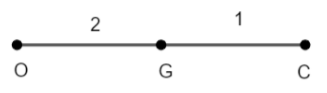
In the above figure we have denoted orthocentre with O, centroid with G and circumcentre with C. Therefore, we have according to the theorem,
\[\Rightarrow OG:GC=2:1=m:n\]
Now, we know that if a point (x, y) divides a line segment joining two points \[\left( {{x}_{1}},{{y}_{1}} \right)\] and \[\left( {{x}_{2}},{{y}_{2}} \right)\] in the ratio m : n then the co – ordinates x and y are given by the section formula: -
\[\Rightarrow x=\dfrac{m{{x}_{2}}+n{{x}_{1}}}{m+n}\]
\[\Rightarrow y=\dfrac{m{{y}_{2}}+n{{y}_{1}}}{m+n}\]
Therefore, here in the above figure we have, co – ordinates of: -
(i) G = (x, y)
(ii) O = \[\left( {{x}_{1}},{{y}_{1}} \right)\] = (1, 1)
(iii) C = \[\left( {{x}_{2}},{{y}_{2}} \right)\] = (3, 2)
So, applying section formula, we get,
\[\begin{align}
& \Rightarrow x=\dfrac{2\times 3+1\times 1}{2+1} \\
& \Rightarrow x=\dfrac{7}{3} \\
\end{align}\]
And, \[y=\dfrac{2\times 2+1\times 1}{2+1}\]
\[\Rightarrow y=\dfrac{5}{3}\]
Hence, co – ordinates of centroid, G = \[\left( \dfrac{7}{3},\dfrac{5}{3} \right)\].
Therefore, option (a) is the correct answer.
Note: One may note that we cannot interchange the points of orthocentre and circumcentre. If we will do so then we have to change the ratio to 1: 2 from 2: 1. So, you must remember the order of the points. Remember the section formula so that the question can be easily solved. Here, we have assumed the points as O, G, and C, you may use different letters to denote them but the only important thing is their order and the ratio.
Complete step-by-step solution
Here, we have been provided with the coordinates of the orthocentre and circumcentre of the triangle and we have to find the coordinates of its centroid.
Now, we know that the centroid of a triangle divides its line joining the orthocentre and circumcentre into the ratio 2: 1. So, we have,
In the above figure we have denoted orthocentre with O, centroid with G and circumcentre with C. Therefore, we have according to the theorem,
\[\Rightarrow OG:GC=2:1=m:n\]
Now, we know that if a point (x, y) divides a line segment joining two points \[\left( {{x}_{1}},{{y}_{1}} \right)\] and \[\left( {{x}_{2}},{{y}_{2}} \right)\] in the ratio m : n then the co – ordinates x and y are given by the section formula: -
\[\Rightarrow x=\dfrac{m{{x}_{2}}+n{{x}_{1}}}{m+n}\]
\[\Rightarrow y=\dfrac{m{{y}_{2}}+n{{y}_{1}}}{m+n}\]
Therefore, here in the above figure we have, co – ordinates of: -
(i) G = (x, y)
(ii) O = \[\left( {{x}_{1}},{{y}_{1}} \right)\] = (1, 1)
(iii) C = \[\left( {{x}_{2}},{{y}_{2}} \right)\] = (3, 2)
So, applying section formula, we get,
\[\begin{align}
& \Rightarrow x=\dfrac{2\times 3+1\times 1}{2+1} \\
& \Rightarrow x=\dfrac{7}{3} \\
\end{align}\]
And, \[y=\dfrac{2\times 2+1\times 1}{2+1}\]
\[\Rightarrow y=\dfrac{5}{3}\]
Hence, co – ordinates of centroid, G = \[\left( \dfrac{7}{3},\dfrac{5}{3} \right)\].
Therefore, option (a) is the correct answer.
Note: One may note that we cannot interchange the points of orthocentre and circumcentre. If we will do so then we have to change the ratio to 1: 2 from 2: 1. So, you must remember the order of the points. Remember the section formula so that the question can be easily solved. Here, we have assumed the points as O, G, and C, you may use different letters to denote them but the only important thing is their order and the ratio.
Recently Updated Pages
Master Class 11 Social Science: Engaging Questions & Answers for Success

Master Class 11 Physics: Engaging Questions & Answers for Success
Master Class 11 Maths: Engaging Questions & Answers for Success
Master Class 11 Economics: Engaging Questions & Answers for Success
Master Class 11 Computer Science: Engaging Questions & Answers for Success
Master Class 11 Chemistry: Engaging Questions & Answers for Success
Trending doubts
One Metric ton is equal to kg A 10000 B 1000 C 100 class 11 physics CBSE
There are 720 permutations of the digits 1 2 3 4 5 class 11 maths CBSE
1 Quintal is equal to a 110 kg b 10 kg c 100kg d 1000 class 11 physics CBSE
State and prove Bernoullis theorem class 11 physics CBSE
Difference Between Prokaryotic Cells and Eukaryotic Cells
Which among the following are examples of coming together class 11 social science CBSE