




If normal at the point $P\left( \theta \right)$ to the ellipse $\dfrac{{{x^2}}}{{14}} + \dfrac{{{y^2}}}{5} = 1$ , intersects it again at the point $Q\left( {2\theta } \right)$ , then $\cos \theta = $ ?
Answer
 Verified
588k+ views
Hint:
We can write the parametric equation of points on the ellipse using the given angle. Then we can find their slope. Then we can find the equation of the normal in the parametric form. Then we can equate the two slopes. Then we can simplify the equation using trigonometric identities and find the required trigonometric ratio.
Complete step by step solution:
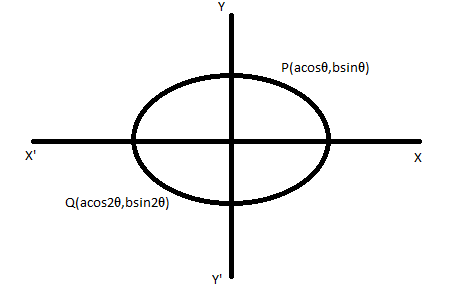
We are given the equation of the ellipse as $\dfrac{{{x^2}}}{{14}} + \dfrac{{{y^2}}}{5} = 1$ . On comparing with the standard equation of ellipse $\dfrac{{{x^2}}}{{{a^2}}} + \dfrac{{{y^2}}}{{{b^2}}} = 1$ , we can get the value of a and b.
$ \Rightarrow {a^2} = 14$ and ${b^2} = 5$
We know that the point on an ellipse in the parametric form is given by $\left( {a\cos t,b\sin t} \right)$ .
So, we can write the given points P and Q in its parametric form as,
$ \Rightarrow P\left( \theta \right) = \left( {a\cos \theta ,b\sin \theta } \right)$
$ \Rightarrow Q\left( {2\theta } \right) = \left( {a\cos 2\theta ,b\sin 2\theta } \right)$
Now we can find the slope of the line joining the points P and Q.
We know that slope of the line joining 2 points is given by,
$m = \dfrac{{{y_1} - {y_2}}}{{{x_1} - {x_2}}}$
On substituting the coordinates of the point, we get,
$ \Rightarrow {m_1} = \dfrac{{b\sin 2\theta - b\sin \theta }}{{a\cos 2\theta - a\cos \theta }}$
We know that the slope of the normal is given by $\dfrac{a}{b}\tan \theta $
As the normal passes through the points P and Q, we can equate the slope.
$ \Rightarrow \dfrac{{b\sin 2\theta - b\sin \theta }}{{a\cos 2\theta - a\cos \theta }} = \dfrac{a}{b}\tan \theta $
We know that $\tan \theta = \dfrac{{\sin \theta }}{{\cos \theta }}$ . On applying this and taking the common factors, we get.
$ \Rightarrow \dfrac{{b\left( {\sin 2\theta - \sin \theta } \right)}}{{a\left( {\cos 2\theta - \cos \theta } \right)}} = \dfrac{a}{b}\dfrac{{\sin \theta }}{{\cos \theta }}$
We know that $\sin 2A = 2\sin A\cos A$ and $\cos 2A = 2{\cos ^2}A - 1$
$ \Rightarrow \dfrac{{b\left( {2\sin \theta \cos \theta - \sin \theta } \right)}}{{a\left( {2{{\cos }^2}\theta - 1 - \cos \theta } \right)}} = \dfrac{a}{b}\dfrac{{\sin \theta }}{{\cos \theta }}$
We can take sine outside the bracket and bring $\dfrac{a}{b}$ to the LHS. So, we get,
$ \Rightarrow \dfrac{{{b^2}}}{{{a^2}}} \times \dfrac{{\sin \theta \left( {2\cos \theta - 1} \right)}}{{\left( {2{{\cos }^2}\theta - 1 - \cos \theta } \right)}} = \dfrac{{\sin \theta }}{{\cos \theta }}$
Now we can substitute the value of a and b and cancel the sin terms on both sides of the equation.
$ \Rightarrow \dfrac{5}{{14}} \times \dfrac{{\left( {2\cos \theta - 1} \right)}}{{\left( {2{{\cos }^2}\theta - 1 - \cos \theta } \right)}} = \dfrac{1}{{\cos \theta }}$
On rearranging, we get,
$ \Rightarrow \dfrac{5}{{14}} = \dfrac{{\left( {2{{\cos }^2}\theta - 1 - \cos \theta } \right)}}{{\cos \theta \left( {2\cos \theta - 1} \right)}}$
On cross- multiplying, we get,
$ \Rightarrow 5\cos \theta \left( {2\cos \theta - 1} \right) = 14\left( {2{{\cos }^2}\theta - 1 - \cos \theta } \right)$
On opening the brackets, we get,
$ \Rightarrow 10{\cos ^2}\theta - 5\cos \theta = 28{\cos ^2}\theta - 14 - 14\cos \theta $
On rearranging, we get,
$ \Rightarrow 28{\cos ^2}\theta - 10{\cos ^2}\theta - 14\cos \theta + 5\cos \theta - 14 = 0$
On adding like terms, we get,
$ \Rightarrow 18{\cos ^2}\theta - 9\cos \theta - 14 = 0$
Now we can split the middle term
$ \Rightarrow 18{\cos ^2}\theta - 21\cos \theta + 12\cos \theta - 14 = 0$
On taking the common factors, we get,
$ \Rightarrow 3\cos \theta \left( {6\cos \theta - 7} \right) + 2\left( {6\cos \theta - 7} \right) = 0$
Again, on taking the common terms, we get,
$ \Rightarrow \left( {3\cos \theta + 2} \right)\left( {6\cos \theta - 7} \right) = 0$
When $\left( {6\cos \theta - 7} \right) = 0$ ,
$ \Rightarrow 6\cos \theta = 7$
On dividing throughout with 6, we get,
$ \Rightarrow \cos \theta = \dfrac{7}{6}$ This value of cos is not possible as its value cannot be greater than 1.
When $\left( {3\cos \theta + 2} \right) = 0$
On rearranging, we get,
$ \Rightarrow 3\cos \theta = - 2$
On dividing throughout with 3, we get,
$ \Rightarrow \cos \theta = \dfrac{{ - 2}}{3}$
So, the required value of $\cos \theta $ is equal to $\dfrac{{ - 2}}{3}$.
Note:
Alternate solution to this problem is given by,
We are given the equation of the ellipse as $\dfrac{{{x^2}}}{{14}} + \dfrac{{{y^2}}}{5} = 1$ . On comparing with the standard equation of ellipse $\dfrac{{{x^2}}}{{{a^2}}} + \dfrac{{{y^2}}}{{{b^2}}} = 1$ , we can get the value of a and b.
$ \Rightarrow {a^2} = 14$ and ${b^2} = 5$
We know that the point on an ellipse in the parametric form is given by $\left( {a\cos t,b\sin t} \right)$ .
So, we can write the given points P and Q in its parametric form as,
$ \Rightarrow P\left( \theta \right) = \left( {a\cos \theta ,b\sin \theta } \right)$
$ \Rightarrow Q\left( {2\theta } \right) = \left( {a\cos 2\theta ,b\sin 2\theta } \right)$
We know that equation of the normal to the point $\left( {{x_0},{y_0}} \right)$ is given by \[\dfrac{{{a^2}x}}{{{x_0}}} - \dfrac{{{b^2}y}}{{{y_0}}} = {a^2} - {b^2}\] .
On substituting the coordinates of the point P, we get,
\[ \Rightarrow \dfrac{{{a^2}x}}{{a\cos \theta }} - \dfrac{{{b^2}y}}{{b\sin \theta }} = {a^2} - {b^2}\]
On simplification, we get,
\[ \Rightarrow \dfrac{{ax}}{{\cos \theta }} - \dfrac{{by}}{{\sin \theta }} = {a^2} - {b^2}\]
It is given that point Q lines on the normal. So, its coordinates satisfy the equations on the normal.
\[ \Rightarrow \dfrac{{a \times a\cos 2\theta }}{{\cos \theta }} - \dfrac{{b \times b\sin 2\theta }}{{\sin \theta }} = {a^2} - {b^2}\]
We know that $\sin 2A = 2\sin A\cos A$ and $\cos 2A = 2{\cos ^2}A - 1$
\[ \Rightarrow \dfrac{{{a^2} \times \left( {2{{\cos }^2}\theta - 1} \right)}}{{\cos \theta }} - \dfrac{{{b^2} \times 2\sin \theta \cos \theta }}{{\sin \theta }} = {a^2} - {b^2}\]
Now we can substitute the value of a and b and cancel the common terms
\[ \Rightarrow \dfrac{{14\left( {2{{\cos }^2}\theta - 1} \right)}}{{\cos \theta }} - 5 \times 2\cos \theta = 14 - 5\]
On multiplying throughout with \[\cos \theta \] , we get,
\[ \Rightarrow 28{\cos ^2}\theta - 14 - 10{\cos ^2}\theta = 9\cos \theta \]
On rearranging, we get,
$ \Rightarrow 18{\cos ^2}\theta - 9\cos \theta - 14 = 0$
Now we can split the middle term
$ \Rightarrow 18{\cos ^2}\theta - 21\cos \theta + 12\cos \theta - 14 = 0$
On taking the common factors, we get,
$ \Rightarrow 3\cos \theta \left( {6\cos \theta - 7} \right) + 2\left( {6\cos \theta - 7} \right) = 0$
Again, on taking the common terms, we get,
$ \Rightarrow \left( {3\cos \theta + 2} \right)\left( {6\cos \theta - 7} \right) = 0$
When $\left( {6\cos \theta - 7} \right) = 0$ ,
$ \Rightarrow 6\cos \theta = 7$
On dividing throughout with 6, we get,
$ \Rightarrow \cos \theta = \dfrac{7}{6}$ This value of cos is not possible as its value cannot be greater than 1.
When $\left( {3\cos \theta + 2} \right) = 0$
On rearranging, we get,
$ \Rightarrow 3\cos \theta = - 2$
On dividing throughout with 3, we get,
$ \Rightarrow \cos \theta = \dfrac{{ - 2}}{3}$
So, the required value of $\cos \theta $ is equal to $\dfrac{{ - 2}}{3}$ .
We can write the parametric equation of points on the ellipse using the given angle. Then we can find their slope. Then we can find the equation of the normal in the parametric form. Then we can equate the two slopes. Then we can simplify the equation using trigonometric identities and find the required trigonometric ratio.
Complete step by step solution:
We are given the equation of the ellipse as $\dfrac{{{x^2}}}{{14}} + \dfrac{{{y^2}}}{5} = 1$ . On comparing with the standard equation of ellipse $\dfrac{{{x^2}}}{{{a^2}}} + \dfrac{{{y^2}}}{{{b^2}}} = 1$ , we can get the value of a and b.
$ \Rightarrow {a^2} = 14$ and ${b^2} = 5$
We know that the point on an ellipse in the parametric form is given by $\left( {a\cos t,b\sin t} \right)$ .
So, we can write the given points P and Q in its parametric form as,
$ \Rightarrow P\left( \theta \right) = \left( {a\cos \theta ,b\sin \theta } \right)$
$ \Rightarrow Q\left( {2\theta } \right) = \left( {a\cos 2\theta ,b\sin 2\theta } \right)$
Now we can find the slope of the line joining the points P and Q.
We know that slope of the line joining 2 points is given by,
$m = \dfrac{{{y_1} - {y_2}}}{{{x_1} - {x_2}}}$
On substituting the coordinates of the point, we get,
$ \Rightarrow {m_1} = \dfrac{{b\sin 2\theta - b\sin \theta }}{{a\cos 2\theta - a\cos \theta }}$
We know that the slope of the normal is given by $\dfrac{a}{b}\tan \theta $
As the normal passes through the points P and Q, we can equate the slope.
$ \Rightarrow \dfrac{{b\sin 2\theta - b\sin \theta }}{{a\cos 2\theta - a\cos \theta }} = \dfrac{a}{b}\tan \theta $
We know that $\tan \theta = \dfrac{{\sin \theta }}{{\cos \theta }}$ . On applying this and taking the common factors, we get.
$ \Rightarrow \dfrac{{b\left( {\sin 2\theta - \sin \theta } \right)}}{{a\left( {\cos 2\theta - \cos \theta } \right)}} = \dfrac{a}{b}\dfrac{{\sin \theta }}{{\cos \theta }}$
We know that $\sin 2A = 2\sin A\cos A$ and $\cos 2A = 2{\cos ^2}A - 1$
$ \Rightarrow \dfrac{{b\left( {2\sin \theta \cos \theta - \sin \theta } \right)}}{{a\left( {2{{\cos }^2}\theta - 1 - \cos \theta } \right)}} = \dfrac{a}{b}\dfrac{{\sin \theta }}{{\cos \theta }}$
We can take sine outside the bracket and bring $\dfrac{a}{b}$ to the LHS. So, we get,
$ \Rightarrow \dfrac{{{b^2}}}{{{a^2}}} \times \dfrac{{\sin \theta \left( {2\cos \theta - 1} \right)}}{{\left( {2{{\cos }^2}\theta - 1 - \cos \theta } \right)}} = \dfrac{{\sin \theta }}{{\cos \theta }}$
Now we can substitute the value of a and b and cancel the sin terms on both sides of the equation.
$ \Rightarrow \dfrac{5}{{14}} \times \dfrac{{\left( {2\cos \theta - 1} \right)}}{{\left( {2{{\cos }^2}\theta - 1 - \cos \theta } \right)}} = \dfrac{1}{{\cos \theta }}$
On rearranging, we get,
$ \Rightarrow \dfrac{5}{{14}} = \dfrac{{\left( {2{{\cos }^2}\theta - 1 - \cos \theta } \right)}}{{\cos \theta \left( {2\cos \theta - 1} \right)}}$
On cross- multiplying, we get,
$ \Rightarrow 5\cos \theta \left( {2\cos \theta - 1} \right) = 14\left( {2{{\cos }^2}\theta - 1 - \cos \theta } \right)$
On opening the brackets, we get,
$ \Rightarrow 10{\cos ^2}\theta - 5\cos \theta = 28{\cos ^2}\theta - 14 - 14\cos \theta $
On rearranging, we get,
$ \Rightarrow 28{\cos ^2}\theta - 10{\cos ^2}\theta - 14\cos \theta + 5\cos \theta - 14 = 0$
On adding like terms, we get,
$ \Rightarrow 18{\cos ^2}\theta - 9\cos \theta - 14 = 0$
Now we can split the middle term
$ \Rightarrow 18{\cos ^2}\theta - 21\cos \theta + 12\cos \theta - 14 = 0$
On taking the common factors, we get,
$ \Rightarrow 3\cos \theta \left( {6\cos \theta - 7} \right) + 2\left( {6\cos \theta - 7} \right) = 0$
Again, on taking the common terms, we get,
$ \Rightarrow \left( {3\cos \theta + 2} \right)\left( {6\cos \theta - 7} \right) = 0$
When $\left( {6\cos \theta - 7} \right) = 0$ ,
$ \Rightarrow 6\cos \theta = 7$
On dividing throughout with 6, we get,
$ \Rightarrow \cos \theta = \dfrac{7}{6}$ This value of cos is not possible as its value cannot be greater than 1.
When $\left( {3\cos \theta + 2} \right) = 0$
On rearranging, we get,
$ \Rightarrow 3\cos \theta = - 2$
On dividing throughout with 3, we get,
$ \Rightarrow \cos \theta = \dfrac{{ - 2}}{3}$
So, the required value of $\cos \theta $ is equal to $\dfrac{{ - 2}}{3}$.
Note:
Alternate solution to this problem is given by,
We are given the equation of the ellipse as $\dfrac{{{x^2}}}{{14}} + \dfrac{{{y^2}}}{5} = 1$ . On comparing with the standard equation of ellipse $\dfrac{{{x^2}}}{{{a^2}}} + \dfrac{{{y^2}}}{{{b^2}}} = 1$ , we can get the value of a and b.
$ \Rightarrow {a^2} = 14$ and ${b^2} = 5$
We know that the point on an ellipse in the parametric form is given by $\left( {a\cos t,b\sin t} \right)$ .
So, we can write the given points P and Q in its parametric form as,
$ \Rightarrow P\left( \theta \right) = \left( {a\cos \theta ,b\sin \theta } \right)$
$ \Rightarrow Q\left( {2\theta } \right) = \left( {a\cos 2\theta ,b\sin 2\theta } \right)$
We know that equation of the normal to the point $\left( {{x_0},{y_0}} \right)$ is given by \[\dfrac{{{a^2}x}}{{{x_0}}} - \dfrac{{{b^2}y}}{{{y_0}}} = {a^2} - {b^2}\] .
On substituting the coordinates of the point P, we get,
\[ \Rightarrow \dfrac{{{a^2}x}}{{a\cos \theta }} - \dfrac{{{b^2}y}}{{b\sin \theta }} = {a^2} - {b^2}\]
On simplification, we get,
\[ \Rightarrow \dfrac{{ax}}{{\cos \theta }} - \dfrac{{by}}{{\sin \theta }} = {a^2} - {b^2}\]
It is given that point Q lines on the normal. So, its coordinates satisfy the equations on the normal.
\[ \Rightarrow \dfrac{{a \times a\cos 2\theta }}{{\cos \theta }} - \dfrac{{b \times b\sin 2\theta }}{{\sin \theta }} = {a^2} - {b^2}\]
We know that $\sin 2A = 2\sin A\cos A$ and $\cos 2A = 2{\cos ^2}A - 1$
\[ \Rightarrow \dfrac{{{a^2} \times \left( {2{{\cos }^2}\theta - 1} \right)}}{{\cos \theta }} - \dfrac{{{b^2} \times 2\sin \theta \cos \theta }}{{\sin \theta }} = {a^2} - {b^2}\]
Now we can substitute the value of a and b and cancel the common terms
\[ \Rightarrow \dfrac{{14\left( {2{{\cos }^2}\theta - 1} \right)}}{{\cos \theta }} - 5 \times 2\cos \theta = 14 - 5\]
On multiplying throughout with \[\cos \theta \] , we get,
\[ \Rightarrow 28{\cos ^2}\theta - 14 - 10{\cos ^2}\theta = 9\cos \theta \]
On rearranging, we get,
$ \Rightarrow 18{\cos ^2}\theta - 9\cos \theta - 14 = 0$
Now we can split the middle term
$ \Rightarrow 18{\cos ^2}\theta - 21\cos \theta + 12\cos \theta - 14 = 0$
On taking the common factors, we get,
$ \Rightarrow 3\cos \theta \left( {6\cos \theta - 7} \right) + 2\left( {6\cos \theta - 7} \right) = 0$
Again, on taking the common terms, we get,
$ \Rightarrow \left( {3\cos \theta + 2} \right)\left( {6\cos \theta - 7} \right) = 0$
When $\left( {6\cos \theta - 7} \right) = 0$ ,
$ \Rightarrow 6\cos \theta = 7$
On dividing throughout with 6, we get,
$ \Rightarrow \cos \theta = \dfrac{7}{6}$ This value of cos is not possible as its value cannot be greater than 1.
When $\left( {3\cos \theta + 2} \right) = 0$
On rearranging, we get,
$ \Rightarrow 3\cos \theta = - 2$
On dividing throughout with 3, we get,
$ \Rightarrow \cos \theta = \dfrac{{ - 2}}{3}$
So, the required value of $\cos \theta $ is equal to $\dfrac{{ - 2}}{3}$ .
Recently Updated Pages
Basicity of sulphurous acid and sulphuric acid are

Master Class 12 English: Engaging Questions & Answers for Success
Master Class 12 Social Science: Engaging Questions & Answers for Success
Master Class 12 Maths: Engaging Questions & Answers for Success
Master Class 12 Economics: Engaging Questions & Answers for Success
Master Class 12 Physics: Engaging Questions & Answers for Success
Trending doubts
Which are the Top 10 Largest Countries of the World?
Draw a labelled sketch of the human eye class 12 physics CBSE
Draw ray diagrams each showing i myopic eye and ii class 12 physics CBSE
Giving reasons state the signs positive or negative class 12 physics CBSE
Explain esterification reaction with the help of a class 12 chemistry CBSE
What is defined as a solenoid Depict a diagram with class 12 physics CBSE