




If in triangle ∆PQR, sin P, sin Q, sin R are in Arithmetic Progression (AP). Then,
\[
{\text{A}}{\text{. The altitudes are in AP}} \\
{\text{B}}{\text{. The altitudes are in HP}} \\
{\text{C}}{\text{. The medians are in GP}} \\
{\text{D}}{\text{. The medians are in AP}} \\
\]
Answer
 Verified
634.8k+ views
Hint – To determine the answer we write the area of the triangle in terms of sides and altitudes. Then we use Sine rule on them.
Complete Step-by-Step solution:
Let a, b, c be the sides of the triangle PQR respectively.
Let $p_1, p_2, p_3$ be the altitudes of the respective sides of the triangle.
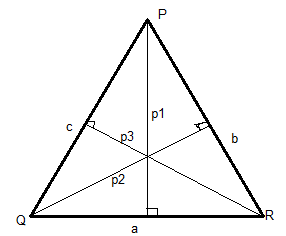
We know, the sine rule in a triangle states,
$\dfrac{{\text{a}}}{{{\text{SinP}}}}$ = $\dfrac{{\text{b}}}{{{\text{SinQ}}}}$ = $\dfrac{{\text{c}}}{{{\text{SinR}}}}$ = k (constant) -- (1)
We know that,
Area of the triangle (A)= $\dfrac{1}{2}$ x length of side x length of altitude = $\dfrac{1}{2}$bh
= $\dfrac{1}{2}.a.p_1$
= $\dfrac{1}{2}.b.p_2$
= $\dfrac{1}{2}.c.p_3$
⟹2 (Area of triangle) = 2A =a × $p_1$
⟹$p_1$ = $\dfrac{{2{\text{A}}}}{{\text{a}}} = \dfrac{{{\text{2A}}}}{{{\text{k SinP}}}}$ --- from (1)
Similarly, $p_2$ = $\dfrac{{{\text{2A}}}}{{{\text{k SinQ}}}}$and p3 = $\dfrac{{{\text{2A}}}}{{{\text{k SinR}}}}$
Given Data: sin P, sin Q, sin R are in AP
We know that if the elements of a series are in AP, then their reciprocals are in HP.
Therefore,$\dfrac{1}{{{\text{SinP}}}}$, $\dfrac{1}{{{\text{SinQ}}}}$and $\dfrac{1}{{{\text{SinR}}}}$are in HP.
We multiply it with 2A,
⟹$\dfrac{{{\text{2A}}}}{{{\text{SinP}}}}$, $\dfrac{{{\text{2A}}}}{{{\text{SinQ}}}}$and $\dfrac{{{\text{2A}}}}{{{\text{SinR}}}}$are in HP.
As Area of the triangle is directly proportional to the altitude, we can say
$p_1, p_2$ and $p_3$ are in HP.
Hence, all the altitudes are in HP. Option B is the correct answer.
Note: In order to solve such types of problems the key is to write the area of the triangle in terms of sides and altitudes and using the Sine rule. We should know the relation between AP and HP. HP stands for Harmonic mean which is one of several kinds of average, and in particular, one of the Pythagorean means and is the inverse of AP.
Complete Step-by-Step solution:
Let a, b, c be the sides of the triangle PQR respectively.
Let $p_1, p_2, p_3$ be the altitudes of the respective sides of the triangle.
We know, the sine rule in a triangle states,
$\dfrac{{\text{a}}}{{{\text{SinP}}}}$ = $\dfrac{{\text{b}}}{{{\text{SinQ}}}}$ = $\dfrac{{\text{c}}}{{{\text{SinR}}}}$ = k (constant) -- (1)
We know that,
Area of the triangle (A)= $\dfrac{1}{2}$ x length of side x length of altitude = $\dfrac{1}{2}$bh
= $\dfrac{1}{2}.a.p_1$
= $\dfrac{1}{2}.b.p_2$
= $\dfrac{1}{2}.c.p_3$
⟹2 (Area of triangle) = 2A =a × $p_1$
⟹$p_1$ = $\dfrac{{2{\text{A}}}}{{\text{a}}} = \dfrac{{{\text{2A}}}}{{{\text{k SinP}}}}$ --- from (1)
Similarly, $p_2$ = $\dfrac{{{\text{2A}}}}{{{\text{k SinQ}}}}$and p3 = $\dfrac{{{\text{2A}}}}{{{\text{k SinR}}}}$
Given Data: sin P, sin Q, sin R are in AP
We know that if the elements of a series are in AP, then their reciprocals are in HP.
Therefore,$\dfrac{1}{{{\text{SinP}}}}$, $\dfrac{1}{{{\text{SinQ}}}}$and $\dfrac{1}{{{\text{SinR}}}}$are in HP.
We multiply it with 2A,
⟹$\dfrac{{{\text{2A}}}}{{{\text{SinP}}}}$, $\dfrac{{{\text{2A}}}}{{{\text{SinQ}}}}$and $\dfrac{{{\text{2A}}}}{{{\text{SinR}}}}$are in HP.
As Area of the triangle is directly proportional to the altitude, we can say
$p_1, p_2$ and $p_3$ are in HP.
Hence, all the altitudes are in HP. Option B is the correct answer.
Note: In order to solve such types of problems the key is to write the area of the triangle in terms of sides and altitudes and using the Sine rule. We should know the relation between AP and HP. HP stands for Harmonic mean which is one of several kinds of average, and in particular, one of the Pythagorean means and is the inverse of AP.
Recently Updated Pages
Three beakers labelled as A B and C each containing 25 mL of water were taken A small amount of NaOH anhydrous CuSO4 and NaCl were added to the beakers A B and C respectively It was observed that there was an increase in the temperature of the solutions contained in beakers A and B whereas in case of beaker C the temperature of the solution falls Which one of the following statements isarecorrect i In beakers A and B exothermic process has occurred ii In beakers A and B endothermic process has occurred iii In beaker C exothermic process has occurred iv In beaker C endothermic process has occurred

Master Class 10 Social Science: Engaging Questions & Answers for Success
Master Class 10 Science: Engaging Questions & Answers for Success
Master Class 10 Maths: Engaging Questions & Answers for Success
Master Class 10 General Knowledge: Engaging Questions & Answers for Success
Master Class 10 Computer Science: Engaging Questions & Answers for Success
Three beakers labelled as A B and C each containing 25 mL of water were taken A small amount of NaOH anhydrous CuSO4 and NaCl were added to the beakers A B and C respectively It was observed that there was an increase in the temperature of the solutions contained in beakers A and B whereas in case of beaker C the temperature of the solution falls Which one of the following statements isarecorrect i In beakers A and B exothermic process has occurred ii In beakers A and B endothermic process has occurred iii In beaker C exothermic process has occurred iv In beaker C endothermic process has occurred
Master Class 10 Social Science: Engaging Questions & Answers for Success
Master Class 10 Science: Engaging Questions & Answers for Success
Trending doubts
In cricket, what is the term for a bowler taking five wickets in an innings?
What is deficiency disease class 10 biology CBSE
Why is there a time difference of about 5 hours between class 10 social science CBSE
Select the word that is correctly spelled a Twelveth class 10 english CBSE
Bharatiya Janata Party was founded in the year A 1979 class 10 social science CBSE
Define the 4R principle in brief class 10 physics CBSE