




If in a $\vartriangle ABC$,$\cos A\sin B = sinC$, then the value of $4\tan \left( {\dfrac{A}{2}} \right)$ if $3b - 5c = 0$
Answer
 Verified
586.5k+ views
Hint: Here we use the given relation of sine and cosine of the angle of triangle ABC to find the value of \[\cos A\]. Substitute the value in terms of side b and c using the sine rule. Convert the given linear equation in b and c into a fraction and substitute the value back to get the value of\[\cos A\]. Use the formula for \[\cos 2A\] to open the value in term of \[\tan \dfrac{A}{2}\].
* Sine Rule states that sides of a triangle are proportional to the sine values of the opposite angles. Therefore, In$\vartriangle ABC$ if side a is opposite to \[\angle A\], side b is opposite to \[\angle B\] and side c is opposite to \[\angle C\], then
$\dfrac{a}{{\sin A}} = \dfrac{b}{{\operatorname{Sin} B}} = \dfrac{c}{{\operatorname{Sin} C}}$
* $\cos 2A = \dfrac{{1 - {{\tan }^2}A}}{{1 + {{\tan }^2}A}}$
Complete step by step answer:
We draw a diagram for a triangle ABC having sides a, b and c.
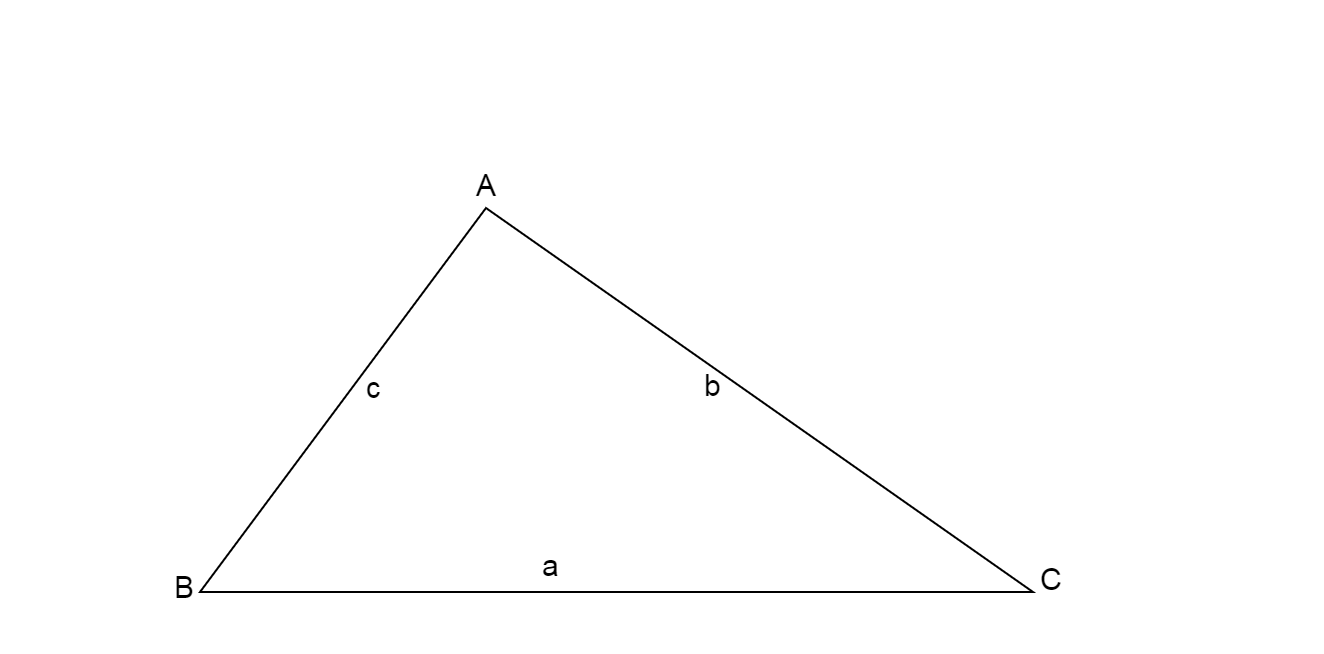
Side $a$ is opposite to \[\angle A\], side $b$ is opposite to \[\angle B\]and side $c$ is opposite to \[\angle C\].
Then we have from sine rule $\dfrac{a}{{\sin A}} = \dfrac{b}{{\sin B}} = \dfrac{c}{{\sin C}}$
We are given in the statement of the question $\cos A\sin B = sinC$
Dividing both sides of the equation by $\sin B$
$ \Rightarrow \dfrac{{\sin B\cos A}}{{\sin B}} = \dfrac{{\sin C}}{{\sin B}}$
Canceling the same terms from numerator and denominator.
$ \Rightarrow \cos A = \dfrac{{\sin C}}{{\sin B}}$
Now we know from the sine rule that $\dfrac{a}{{\sin A}} = \dfrac{b}{{\sin B}} = \dfrac{c}{{\sin C}}$
Take the equality $\dfrac{b}{{\sin B}} = \dfrac{c}{{\sin C}}$
Cross multiply the denominator in RHS to numerator in LHS
$ \Rightarrow \dfrac{{\sin C}}{{\sin B}} = \dfrac{c}{b}$
Substitute the value of $\dfrac{{\sin C}}{{\sin B}} = \dfrac{c}{b}$in$\cos A = \dfrac{{\sin C}}{{\sin B}}$
$ \Rightarrow \cos A = \dfrac{{\sin C}}{{\sin B}} = \dfrac{c}{b}$ …………………..… (1)
We are given the equation $3b - 5c = 0$
Shifting one value to RHS of the equation
$ \Rightarrow 3b = 5c$
Dividing both sides by 5b
$ \Rightarrow \dfrac{{3b}}{{5b}} = \dfrac{{5c}}{{5b}}$
Canceling the same terms from numerator and denominator.
$ \Rightarrow \dfrac{3}{5} = \dfrac{c}{b}$ ……………………………...(2)
Substituting the value of $\dfrac{3}{5} = \dfrac{c}{b}$from equation (2) in equation (1)
$ \Rightarrow \cos A = \dfrac{3}{5}$
We know that $\cos 2A = \dfrac{{1 - {{\tan }^2}A}}{{1 + {{\tan }^2}A}}$
Dividing the angle in the equation by 2
$ \Rightarrow \cos A = \dfrac{{1 - {{\tan }^2}\left( {\dfrac{A}{2}} \right)}}{{1 + {{\tan }^2}\left( {\dfrac{A}{2}} \right)}}$
Substituting the value of $\cos A = \dfrac{3}{5}$
$ \Rightarrow \dfrac{{1 - {{\tan }^2}\left( {\dfrac{A}{2}} \right)}}{{1 + {{\tan }^2}\left( {\dfrac{A}{2}} \right)}} = \dfrac{3}{5}$
Cross multiplying both sides of the equations.
$ \Rightarrow 5\left[ {1 - {{\tan }^2}\dfrac{A}{2}} \right] = 3\left[ {1 + {{\tan }^2}\dfrac{A}{2}} \right]$
Multiplying the values 5 & 3 inside the bracket
$ \Rightarrow 5 - 5{\tan ^2}\dfrac{A}{2} = 3 + 3{\tan ^2}\dfrac{A}{2}$
Shifting the constant values to one side of the equation.
$ \Rightarrow 5 - 3 = 3{\tan ^2}\dfrac{A}{2} + 5{\tan ^2}\dfrac{A}{2}$
Taking ${\tan ^2}\dfrac{A}{2}$ common in RHS of the equation
$ \Rightarrow 5 - 3 = {\tan ^2}\dfrac{A}{2}(3 + 5)$
$ \Rightarrow 2 = 8{\tan ^2}\dfrac{A}{2}$
Dividing both sides of the equation by 8
$ \Rightarrow \dfrac{2}{8} = \dfrac{8}{8}{\tan ^2}\dfrac{A}{2}$
Canceling the same terms from numerator and denominator.
$ \Rightarrow \dfrac{1}{4} = {\tan ^2}\dfrac{A}{2}$
Taking the square root on both sides of the equation.
$ \Rightarrow \sqrt {\dfrac{1}{4}} = \sqrt {{{\tan }^2}\dfrac{A}{2}} $
Writing the terms inside the square root as the square of some value.
$ \Rightarrow \sqrt {{{\left( {\dfrac{1}{2}} \right)}^2}} = \sqrt {{{\left( {\tan \dfrac{A}{2}} \right)}^2}} $
Cancelling square root by square power.
$ \Rightarrow \dfrac{1}{2} = \tan \dfrac{A}{2}$
Now we will multiply both sides by 4
$ \Rightarrow \dfrac{4}{2} = 4\tan \dfrac{A}{2}$
Cancel same terms from numerator and denominator in LHS.
$ \Rightarrow 2 = 4\tan \dfrac{A}{2}$
Therefore, value of $4\tan \dfrac{A}{2} = 2$
Note:
Many students make mistake when applying the formula $\cos 2A = \dfrac{{1 - {{\tan }^2}A}}{{1 + {{\tan }^2}A}}$ in the solution, keep in mind the value that formula gives is of angle 2A and we have the value for angle A so we change the angle by dividing all angles in the formula by 2.
Students get confused while writing the sine formula, keep in mind we take the opposite side to the angle in the numerator and the sine of the angle in the denominator. Also, many books state that sine rule can be written as \[\dfrac{{\sin A}}{a} = \dfrac{{\sin B}}{b} = \dfrac{{\sin C}}{c}\] which is one and the same thing.
* Sine Rule states that sides of a triangle are proportional to the sine values of the opposite angles. Therefore, In$\vartriangle ABC$ if side a is opposite to \[\angle A\], side b is opposite to \[\angle B\] and side c is opposite to \[\angle C\], then
$\dfrac{a}{{\sin A}} = \dfrac{b}{{\operatorname{Sin} B}} = \dfrac{c}{{\operatorname{Sin} C}}$
* $\cos 2A = \dfrac{{1 - {{\tan }^2}A}}{{1 + {{\tan }^2}A}}$
Complete step by step answer:
We draw a diagram for a triangle ABC having sides a, b and c.
Side $a$ is opposite to \[\angle A\], side $b$ is opposite to \[\angle B\]and side $c$ is opposite to \[\angle C\].
Then we have from sine rule $\dfrac{a}{{\sin A}} = \dfrac{b}{{\sin B}} = \dfrac{c}{{\sin C}}$
We are given in the statement of the question $\cos A\sin B = sinC$
Dividing both sides of the equation by $\sin B$
$ \Rightarrow \dfrac{{\sin B\cos A}}{{\sin B}} = \dfrac{{\sin C}}{{\sin B}}$
Canceling the same terms from numerator and denominator.
$ \Rightarrow \cos A = \dfrac{{\sin C}}{{\sin B}}$
Now we know from the sine rule that $\dfrac{a}{{\sin A}} = \dfrac{b}{{\sin B}} = \dfrac{c}{{\sin C}}$
Take the equality $\dfrac{b}{{\sin B}} = \dfrac{c}{{\sin C}}$
Cross multiply the denominator in RHS to numerator in LHS
$ \Rightarrow \dfrac{{\sin C}}{{\sin B}} = \dfrac{c}{b}$
Substitute the value of $\dfrac{{\sin C}}{{\sin B}} = \dfrac{c}{b}$in$\cos A = \dfrac{{\sin C}}{{\sin B}}$
$ \Rightarrow \cos A = \dfrac{{\sin C}}{{\sin B}} = \dfrac{c}{b}$ …………………..… (1)
We are given the equation $3b - 5c = 0$
Shifting one value to RHS of the equation
$ \Rightarrow 3b = 5c$
Dividing both sides by 5b
$ \Rightarrow \dfrac{{3b}}{{5b}} = \dfrac{{5c}}{{5b}}$
Canceling the same terms from numerator and denominator.
$ \Rightarrow \dfrac{3}{5} = \dfrac{c}{b}$ ……………………………...(2)
Substituting the value of $\dfrac{3}{5} = \dfrac{c}{b}$from equation (2) in equation (1)
$ \Rightarrow \cos A = \dfrac{3}{5}$
We know that $\cos 2A = \dfrac{{1 - {{\tan }^2}A}}{{1 + {{\tan }^2}A}}$
Dividing the angle in the equation by 2
$ \Rightarrow \cos A = \dfrac{{1 - {{\tan }^2}\left( {\dfrac{A}{2}} \right)}}{{1 + {{\tan }^2}\left( {\dfrac{A}{2}} \right)}}$
Substituting the value of $\cos A = \dfrac{3}{5}$
$ \Rightarrow \dfrac{{1 - {{\tan }^2}\left( {\dfrac{A}{2}} \right)}}{{1 + {{\tan }^2}\left( {\dfrac{A}{2}} \right)}} = \dfrac{3}{5}$
Cross multiplying both sides of the equations.
$ \Rightarrow 5\left[ {1 - {{\tan }^2}\dfrac{A}{2}} \right] = 3\left[ {1 + {{\tan }^2}\dfrac{A}{2}} \right]$
Multiplying the values 5 & 3 inside the bracket
$ \Rightarrow 5 - 5{\tan ^2}\dfrac{A}{2} = 3 + 3{\tan ^2}\dfrac{A}{2}$
Shifting the constant values to one side of the equation.
$ \Rightarrow 5 - 3 = 3{\tan ^2}\dfrac{A}{2} + 5{\tan ^2}\dfrac{A}{2}$
Taking ${\tan ^2}\dfrac{A}{2}$ common in RHS of the equation
$ \Rightarrow 5 - 3 = {\tan ^2}\dfrac{A}{2}(3 + 5)$
$ \Rightarrow 2 = 8{\tan ^2}\dfrac{A}{2}$
Dividing both sides of the equation by 8
$ \Rightarrow \dfrac{2}{8} = \dfrac{8}{8}{\tan ^2}\dfrac{A}{2}$
Canceling the same terms from numerator and denominator.
$ \Rightarrow \dfrac{1}{4} = {\tan ^2}\dfrac{A}{2}$
Taking the square root on both sides of the equation.
$ \Rightarrow \sqrt {\dfrac{1}{4}} = \sqrt {{{\tan }^2}\dfrac{A}{2}} $
Writing the terms inside the square root as the square of some value.
$ \Rightarrow \sqrt {{{\left( {\dfrac{1}{2}} \right)}^2}} = \sqrt {{{\left( {\tan \dfrac{A}{2}} \right)}^2}} $
Cancelling square root by square power.
$ \Rightarrow \dfrac{1}{2} = \tan \dfrac{A}{2}$
Now we will multiply both sides by 4
$ \Rightarrow \dfrac{4}{2} = 4\tan \dfrac{A}{2}$
Cancel same terms from numerator and denominator in LHS.
$ \Rightarrow 2 = 4\tan \dfrac{A}{2}$
Therefore, value of $4\tan \dfrac{A}{2} = 2$
Note:
Many students make mistake when applying the formula $\cos 2A = \dfrac{{1 - {{\tan }^2}A}}{{1 + {{\tan }^2}A}}$ in the solution, keep in mind the value that formula gives is of angle 2A and we have the value for angle A so we change the angle by dividing all angles in the formula by 2.
Students get confused while writing the sine formula, keep in mind we take the opposite side to the angle in the numerator and the sine of the angle in the denominator. Also, many books state that sine rule can be written as \[\dfrac{{\sin A}}{a} = \dfrac{{\sin B}}{b} = \dfrac{{\sin C}}{c}\] which is one and the same thing.
Recently Updated Pages
Master Class 10 Computer Science: Engaging Questions & Answers for Success

Master Class 10 General Knowledge: Engaging Questions & Answers for Success
Master Class 10 English: Engaging Questions & Answers for Success
Master Class 10 Social Science: Engaging Questions & Answers for Success
Master Class 10 Maths: Engaging Questions & Answers for Success
Master Class 10 Science: Engaging Questions & Answers for Success
Trending doubts
What is the median of the first 10 natural numbers class 10 maths CBSE
Which women's tennis player has 24 Grand Slam singles titles?
Who is the Brand Ambassador of Incredible India?
Why is there a time difference of about 5 hours between class 10 social science CBSE
Write a letter to the principal requesting him to grant class 10 english CBSE
State and prove converse of BPT Basic Proportionality class 10 maths CBSE