




If in a rectangle, the length is increased and breadth reduced each by 2 units, the area reduces by 28 square units. If, however, the length is reduced by 1 unit and the breadth increased by 2 units, the area increases by 33 square units. Find the area of the rectangle.
Answer
 Verified
555.8k+ views
Hint – We will start solving this question by making two different equations by using the given information and after solving those equations we will find the area of the rectangle by using the formula of the area of the rectangle, i.e., Length $ \times $ Breadth.
Complete step-by-step answer:
It is given that in a rectangle, when the length is increased and breadth is reduced each by 2 units, the area reduces by 28 square units and when the length is reduced by 1 unit and the breadth increased by 2 units, the area increases by 33 square units, so by using this we can make two different equations.
For which, let the length of the rectangle be $x$ units and the breadth be $y$ units.
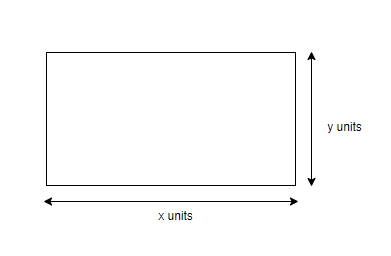
We know that,
Area of the rectangle = Length $ \times $ Breadth
$ = x \times y$
$ = xy$ sq. units
Now, we will make equations from the given information.
$\left( {x + 2} \right) \times \left( {y - 2} \right) = xy - 28$……… (1)
and, $\left( {x - 1} \right) \times \left( {y + 2} \right) = xy + 33$……... (2)
Taking equation (1),
$\left( {x + 2} \right) \times \left( {y - 2} \right) = xy - 28$
$
\Rightarrow xy - 2x + 2y - 4 = xy - 28 \\
\Rightarrow - 2x + 2y = - 28 + 4 \\
\Rightarrow - 2x + 2y = - 24 \\
\Rightarrow 2\left( { - x + y} \right) = - 24 \\
\Rightarrow - x + y = \dfrac{{ - 24}}{2} \\
\Rightarrow - x + y = - 12 \\
$
$ \Rightarrow x = y + 12$ ………… (i)
Now, taking equation (2),
$\left( {x - 1} \right) \times \left( {y + 2} \right) = xy + 33$
$
\Rightarrow xy + 2x - y - 2 = xy + 33 \\
\Rightarrow 2x - y - 2 = 33 \\
\Rightarrow 2x - y = 33 + 2 \\
$
$ \Rightarrow 2x - y = 35$ ………… (ii)
Substituting equation (i) in equation (ii), we get,
$
2\left( {y + 12} \right) - y = 35 \\
\Rightarrow 2y + 24 - y = 35 \\
\Rightarrow y + 24 = 35 \\
\Rightarrow y = 35 - 24 \\
\Rightarrow y = 11 \\
$
Now, substituting $y = 11$ in equation (i), we obtain
$
x = 11 + 12 \\
\Rightarrow x = 23 \\
$
Therefore, length of the rectangle $ = x = 23$units
and breadth of the rectangle $ = y = 11$units
Hence, area of the rectangle $ = $Length $ \times $Breadth
$
= x \times y \\
= 23 \times 11 \\
= 253{\text{ square units.}} \\
$
$\therefore$ Area of the rectangle is 253 square units.
Note – A rectangle is a quadrilateral with four straight sides and four right angles. It has unequal adjacent sides, in contrast to a square. These kinds of questions are very simple and easy to solve if one understands the question properly and knows all the basic formulas.
Complete step-by-step answer:
It is given that in a rectangle, when the length is increased and breadth is reduced each by 2 units, the area reduces by 28 square units and when the length is reduced by 1 unit and the breadth increased by 2 units, the area increases by 33 square units, so by using this we can make two different equations.
For which, let the length of the rectangle be $x$ units and the breadth be $y$ units.
We know that,
Area of the rectangle = Length $ \times $ Breadth
$ = x \times y$
$ = xy$ sq. units
Now, we will make equations from the given information.
$\left( {x + 2} \right) \times \left( {y - 2} \right) = xy - 28$……… (1)
and, $\left( {x - 1} \right) \times \left( {y + 2} \right) = xy + 33$……... (2)
Taking equation (1),
$\left( {x + 2} \right) \times \left( {y - 2} \right) = xy - 28$
$
\Rightarrow xy - 2x + 2y - 4 = xy - 28 \\
\Rightarrow - 2x + 2y = - 28 + 4 \\
\Rightarrow - 2x + 2y = - 24 \\
\Rightarrow 2\left( { - x + y} \right) = - 24 \\
\Rightarrow - x + y = \dfrac{{ - 24}}{2} \\
\Rightarrow - x + y = - 12 \\
$
$ \Rightarrow x = y + 12$ ………… (i)
Now, taking equation (2),
$\left( {x - 1} \right) \times \left( {y + 2} \right) = xy + 33$
$
\Rightarrow xy + 2x - y - 2 = xy + 33 \\
\Rightarrow 2x - y - 2 = 33 \\
\Rightarrow 2x - y = 33 + 2 \\
$
$ \Rightarrow 2x - y = 35$ ………… (ii)
Substituting equation (i) in equation (ii), we get,
$
2\left( {y + 12} \right) - y = 35 \\
\Rightarrow 2y + 24 - y = 35 \\
\Rightarrow y + 24 = 35 \\
\Rightarrow y = 35 - 24 \\
\Rightarrow y = 11 \\
$
Now, substituting $y = 11$ in equation (i), we obtain
$
x = 11 + 12 \\
\Rightarrow x = 23 \\
$
Therefore, length of the rectangle $ = x = 23$units
and breadth of the rectangle $ = y = 11$units
Hence, area of the rectangle $ = $Length $ \times $Breadth
$
= x \times y \\
= 23 \times 11 \\
= 253{\text{ square units.}} \\
$
$\therefore$ Area of the rectangle is 253 square units.
Note – A rectangle is a quadrilateral with four straight sides and four right angles. It has unequal adjacent sides, in contrast to a square. These kinds of questions are very simple and easy to solve if one understands the question properly and knows all the basic formulas.
Recently Updated Pages
Master Class 12 Economics: Engaging Questions & Answers for Success

Master Class 12 English: Engaging Questions & Answers for Success
Master Class 12 Social Science: Engaging Questions & Answers for Success
Master Class 12 Maths: Engaging Questions & Answers for Success
Master Class 12 Physics: Engaging Questions & Answers for Success
Master Class 10 English: Engaging Questions & Answers for Success
Trending doubts
Explain the Treaty of Vienna of 1815 class 10 social science CBSE
Why is it 530 pm in india when it is 1200 afternoon class 10 social science CBSE
What is the full form of POSCO class 10 social science CBSE
Define Potential, Developed, Stock and Reserved resources
Which Country Has the Largest Border with India?
Complete the sentence with the most appropriate word class 10 english CBSE