




If four distinct points (2k,3k),(2,0),(0,3),(0,0) lie on a circle, then
A. k<0
B. 0C. k=1
D. k>1
D. k>1
Answer
 Verified
639.6k+ views
Hint – In order to solve this problem we have to use the concept that the endpoints of diameter subtends right angle at the circle and the circle whose endpoints of diameter are given as (a,b) and (c,d) then its equation will be (x - a)(x - c)+(y - b)(y - d) = 0. Using these concepts you can find the location of k.
Complete step-by-step solution -
The diagram of the circle can be drawn as :-
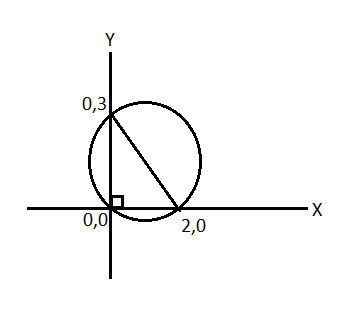
Since, join of (2,0) and (0,3) subtends right angle at (0,0)
So, it is a diameter.
∴ Equation is (x−2)(x−0)+(y−0)(y−3)=0
${{\text{x}}^{\text{2}}}{\text{ - 2x + }}{{\text{y}}^{\text{2}}}{\text{ - 3y = 0}}$
It is given that (2k,3k) lies on the circle so we put (2k,3k) in the equation of circle we get the equation as:
$ \Rightarrow $${{\text{(2k)}}^{\text{2}}}{\text{ - 2(2k) + 3}}{{\text{k}}^{\text{2}}}{\text{ - 3(3k) = 0}}$
$ \Rightarrow $${\text{4}}{{\text{k}}^{\text{2}}}{\text{ + 9}}{{\text{k}}^{\text{2}}}{\text{ - 4k - 9k = 0 }}$
$ \Rightarrow $${\text{13}}{{\text{k}}^{\text{2}}}{\text{ - 13k = 0}}$
$ \Rightarrow $${\text{k(k - 1) = 0}}$
$ \Rightarrow $k=1, k=0
Since, ${\text{k}} \ne {\text{0}}$ otherwise (2k,3k) will be (0,0).
Therefore, the value of k is 1.
So, the correct option is C.
Note – Whenever you face such a type of circle you have to use the concept of circles. Here we have used the concepts that ends of diameter subtends right angle on the circle and the equation of circle whose endpoints of one of the diameter is given [say (a,b) and (c,d)] can be written as (x-a)(x-b)+(y-c)(y-d)=0. Using these concepts will take you to the right answer.
Complete step-by-step solution -
The diagram of the circle can be drawn as :-
Since, join of (2,0) and (0,3) subtends right angle at (0,0)
So, it is a diameter.
∴ Equation is (x−2)(x−0)+(y−0)(y−3)=0
${{\text{x}}^{\text{2}}}{\text{ - 2x + }}{{\text{y}}^{\text{2}}}{\text{ - 3y = 0}}$
It is given that (2k,3k) lies on the circle so we put (2k,3k) in the equation of circle we get the equation as:
$ \Rightarrow $${{\text{(2k)}}^{\text{2}}}{\text{ - 2(2k) + 3}}{{\text{k}}^{\text{2}}}{\text{ - 3(3k) = 0}}$
$ \Rightarrow $${\text{4}}{{\text{k}}^{\text{2}}}{\text{ + 9}}{{\text{k}}^{\text{2}}}{\text{ - 4k - 9k = 0 }}$
$ \Rightarrow $${\text{13}}{{\text{k}}^{\text{2}}}{\text{ - 13k = 0}}$
$ \Rightarrow $${\text{k(k - 1) = 0}}$
$ \Rightarrow $k=1, k=0
Since, ${\text{k}} \ne {\text{0}}$ otherwise (2k,3k) will be (0,0).
Therefore, the value of k is 1.
So, the correct option is C.
Note – Whenever you face such a type of circle you have to use the concept of circles. Here we have used the concepts that ends of diameter subtends right angle on the circle and the equation of circle whose endpoints of one of the diameter is given [say (a,b) and (c,d)] can be written as (x-a)(x-b)+(y-c)(y-d)=0. Using these concepts will take you to the right answer.
Recently Updated Pages
Master Class 12 Business Studies: Engaging Questions & Answers for Success

Master Class 12 Biology: Engaging Questions & Answers for Success
Master Class 12 Chemistry: Engaging Questions & Answers for Success
Class 12 Question and Answer - Your Ultimate Solutions Guide
Master Class 11 Social Science: Engaging Questions & Answers for Success
Master Class 11 English: Engaging Questions & Answers for Success
Trending doubts
What is the full form of POSCO class 10 social science CBSE
Fill the blanks with proper collective nouns 1 A of class 10 english CBSE
Distinguish between the reserved forests and protected class 10 biology CBSE
Check weather 6n can end with the digit 0 for any natural class 10 maths CBSE
Who hosted the Congress of Vienna in 1815 A Duke Metternich class 10 social science CBSE
Find the mode of 10 12 11 10 15 20 19 21 11 9 10 class 10 maths CBSE