




If $ f\left( x \right) = \dfrac{1}{{1 - x}},x \ne 0,1 $ , then the graph of the function $ y = f\left\{ {f\left( {f\left( x \right)} \right)} \right\},x > 1 $ is ?
(A) a circle
(B) an ellipse
(C) a straight line
(D) a pair of straight line
Answer
 Verified
509.7k+ views
Hint: In the given question, we are required to find the nature of the graph of a composite function. We are given a function in the problem itself and we have to first calculate a composite function using the original function and then find out what the graph of the composite function represents. This question requires us to have the knowledge of basic and simple algebraic rules and operations such as substitution, addition, multiplication, subtraction and many more like these. A thorough understanding of functions, conic sections, coordinate geometry and its applications can be of great significance.
Complete step-by-step answer:
In the given question, we are given a function $ f\left( x \right) = \dfrac{1}{{1 - x}},x \ne 0,1 $ .
Now, we have to find a composite function using the given original function.
The composite function to be calculated is $ y = f\left\{ {f\left( {f\left( x \right)} \right)} \right\} $ .
So, we have to change the value of variable in the original function in order to find the composite function.
Now, we know that $ f\left( x \right) = \dfrac{1}{{1 - x}} $ .
So, to evaluate the composite function $ y = f\left\{ {f\left( {f\left( x \right)} \right)} \right\} $ , we substitute the value of $ f\left( x \right) $ as $ \dfrac{1}{{1 - x}} $ . Hence, we get,
$ \Rightarrow y = f\left\{ {f\left( {\dfrac{1}{{1 - x}}} \right)} \right\} $
Now, to carry on the method of evaluating the composite function, we have to change the variable in the function $ f\left( x \right) = \dfrac{1}{{1 - x}} $ from x to $ \dfrac{1}{{1 - x}} $ .
So, we get,
$ \Rightarrow y = f\left\{ {\dfrac{1}{{1 - \dfrac{1}{{1 - x}}}}} \right\} $
Taking the LCM and simplifying the expression, we get,
$ \Rightarrow y = f\left\{ {\dfrac{1}{{\dfrac{{1 - x - 1}}{{1 - x}}}}} \right\} $
Cancelling the like terms with opposite signs, we get,
$ \Rightarrow y = f\left\{ {\dfrac{{x - 1}}{x}} \right\} $
Now, we have to change the variable in the function $ f\left( x \right) = \dfrac{1}{{1 - x}} $ from x to $ \dfrac{{x - 1}}{x} $ . So, we get,
$ \Rightarrow y = \left( {\dfrac{1}{{1 - \left( {\dfrac{{x - 1}}{x}} \right)}}} \right) $
Simplifying the expression further, we get,
$ \Rightarrow y = \left( {\dfrac{1}{{\dfrac{{x - x + 1}}{x}}}} \right) $
Cancelling the like terms with opposite signs, we get,
$ \Rightarrow y = x $
So, the composite function $ y = f\left\{ {f\left( {f\left( x \right)} \right)} \right\},x > 1 $ is equivalent to $ y = x $ .
Now, we know that the equation $ y = x $ actually represents a straight line on the Cartesian plane as the equation is a linear equation in two variables.
The graph of the composite function $ y = f\left\{ {f\left( {f\left( x \right)} \right)} \right\} $ can thus be plotted easily as $ y = x $ .
If $ x = 2 $ , $ y = x = 2 $ .
If $ x = 3 $ , $ y = x = 3 $ .
If $ x = 4 $ , $ y = x = 4 $ .
So, the graph of the function $ y = f\left\{ {f\left( {f\left( x \right)} \right)} \right\},x > 1 $ is as below:
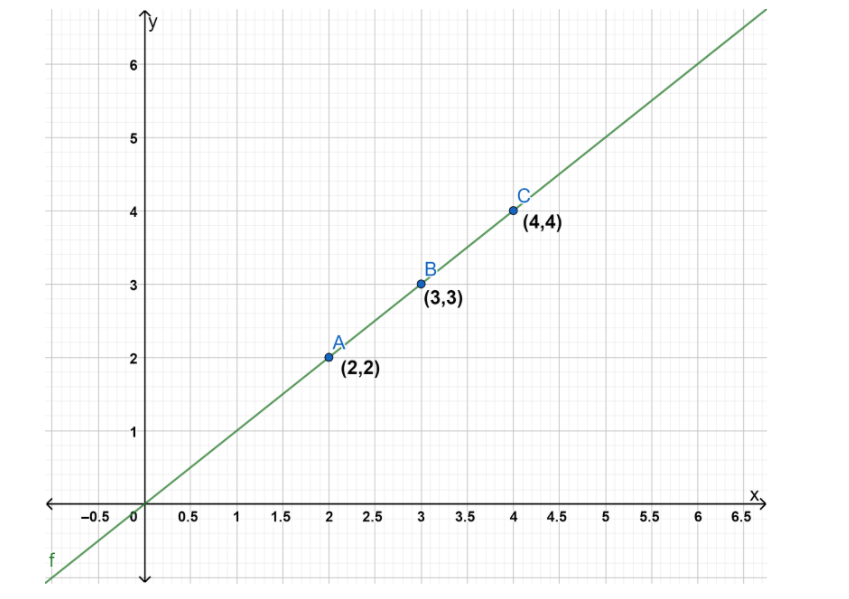
So, the graph of the function $ y = f\left\{ {f\left( {f\left( x \right)} \right)} \right\},x > 1 $ represents a straight line.
Hence, option (C) is correct.
Note: Such questions that require just simple change of variable can be solved easily by keeping in mind the algebraic rules such as substitution and transposition. Substitution of a variable involves putting a certain value in place of the variable. That specified value may be a certain number or even any other variable.
Complete step-by-step answer:
In the given question, we are given a function $ f\left( x \right) = \dfrac{1}{{1 - x}},x \ne 0,1 $ .
Now, we have to find a composite function using the given original function.
The composite function to be calculated is $ y = f\left\{ {f\left( {f\left( x \right)} \right)} \right\} $ .
So, we have to change the value of variable in the original function in order to find the composite function.
Now, we know that $ f\left( x \right) = \dfrac{1}{{1 - x}} $ .
So, to evaluate the composite function $ y = f\left\{ {f\left( {f\left( x \right)} \right)} \right\} $ , we substitute the value of $ f\left( x \right) $ as $ \dfrac{1}{{1 - x}} $ . Hence, we get,
$ \Rightarrow y = f\left\{ {f\left( {\dfrac{1}{{1 - x}}} \right)} \right\} $
Now, to carry on the method of evaluating the composite function, we have to change the variable in the function $ f\left( x \right) = \dfrac{1}{{1 - x}} $ from x to $ \dfrac{1}{{1 - x}} $ .
So, we get,
$ \Rightarrow y = f\left\{ {\dfrac{1}{{1 - \dfrac{1}{{1 - x}}}}} \right\} $
Taking the LCM and simplifying the expression, we get,
$ \Rightarrow y = f\left\{ {\dfrac{1}{{\dfrac{{1 - x - 1}}{{1 - x}}}}} \right\} $
Cancelling the like terms with opposite signs, we get,
$ \Rightarrow y = f\left\{ {\dfrac{{x - 1}}{x}} \right\} $
Now, we have to change the variable in the function $ f\left( x \right) = \dfrac{1}{{1 - x}} $ from x to $ \dfrac{{x - 1}}{x} $ . So, we get,
$ \Rightarrow y = \left( {\dfrac{1}{{1 - \left( {\dfrac{{x - 1}}{x}} \right)}}} \right) $
Simplifying the expression further, we get,
$ \Rightarrow y = \left( {\dfrac{1}{{\dfrac{{x - x + 1}}{x}}}} \right) $
Cancelling the like terms with opposite signs, we get,
$ \Rightarrow y = x $
So, the composite function $ y = f\left\{ {f\left( {f\left( x \right)} \right)} \right\},x > 1 $ is equivalent to $ y = x $ .
Now, we know that the equation $ y = x $ actually represents a straight line on the Cartesian plane as the equation is a linear equation in two variables.
The graph of the composite function $ y = f\left\{ {f\left( {f\left( x \right)} \right)} \right\} $ can thus be plotted easily as $ y = x $ .
If $ x = 2 $ , $ y = x = 2 $ .
If $ x = 3 $ , $ y = x = 3 $ .
If $ x = 4 $ , $ y = x = 4 $ .
So, the graph of the function $ y = f\left\{ {f\left( {f\left( x \right)} \right)} \right\},x > 1 $ is as below:
So, the graph of the function $ y = f\left\{ {f\left( {f\left( x \right)} \right)} \right\},x > 1 $ represents a straight line.
Hence, option (C) is correct.
Note: Such questions that require just simple change of variable can be solved easily by keeping in mind the algebraic rules such as substitution and transposition. Substitution of a variable involves putting a certain value in place of the variable. That specified value may be a certain number or even any other variable.
Recently Updated Pages
Master Class 10 Computer Science: Engaging Questions & Answers for Success

Master Class 10 General Knowledge: Engaging Questions & Answers for Success
Master Class 10 English: Engaging Questions & Answers for Success
Master Class 10 Social Science: Engaging Questions & Answers for Success
Master Class 10 Maths: Engaging Questions & Answers for Success
Master Class 10 Science: Engaging Questions & Answers for Success
Trending doubts
Which women's tennis player has 24 Grand Slam singles titles?
Who is the Brand Ambassador of Incredible India?
Why is there a time difference of about 5 hours between class 10 social science CBSE
The Equation xxx + 2 is Satisfied when x is Equal to Class 10 Maths
Which Country is Called "The Land of Festivals"?
What is Contraception List its four different methods class 10 biology CBSE