




If \[\dfrac{{(\cos {\text{ A)}}}}{3} = \dfrac{{(\cos {\text{ B)}}}}{4} = \dfrac{1}{5}\] , \[ - \dfrac{\pi }{2} < A < 0\],\[ - \dfrac{\pi }{2} < B < 0\], then value of \[2\sin A + 4\sin B\] is ?
A. \[4\]
B. \[{\text{ - 2}}\]
C. \[{\text{ - 4}}\]
D. \[{\text{0}}\]
Answer
 Verified
511.2k+ views
Hint: Whenever we have trigonometric ratios given with some values equal to them always try to consider a triangle and use trigonometric ratios formula to find the required side of the triangle such as in \[\cos \]we have \[\dfrac{{base}}{{hypotenuse}}\], similarly this applied for another trigonometric ratios .
Complete step by step answer:
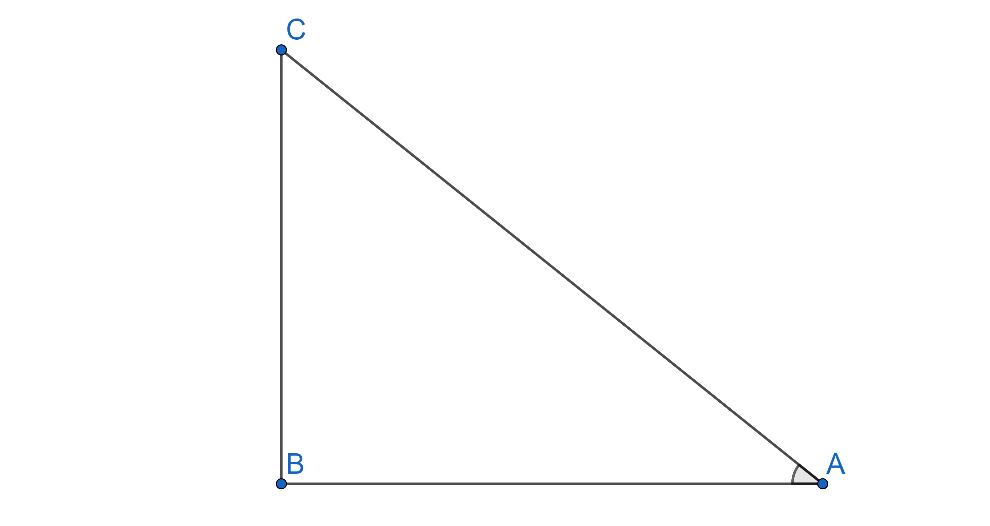
Consider a right angled triangle ABC ,
Given :
\[\dfrac{{(\cos {\text{ A)}}}}{3} = \dfrac{{(\cos {\text{ B)}}}}{4} = \dfrac{1}{5}\], first we take the terms ,
\[\dfrac{{(\cos {\text{ A)}}}}{3} = \dfrac{1}{5}\] , on solving it we get ,
\[\cos {\text{ A}} = \dfrac{3}{5}\] , on comparing with trigonometric ratios of cosine \[ = \dfrac{{base}}{{hypotenuse}}\] , we have
\[base = 3\] and \[hypotenuse = 5\] , therefore
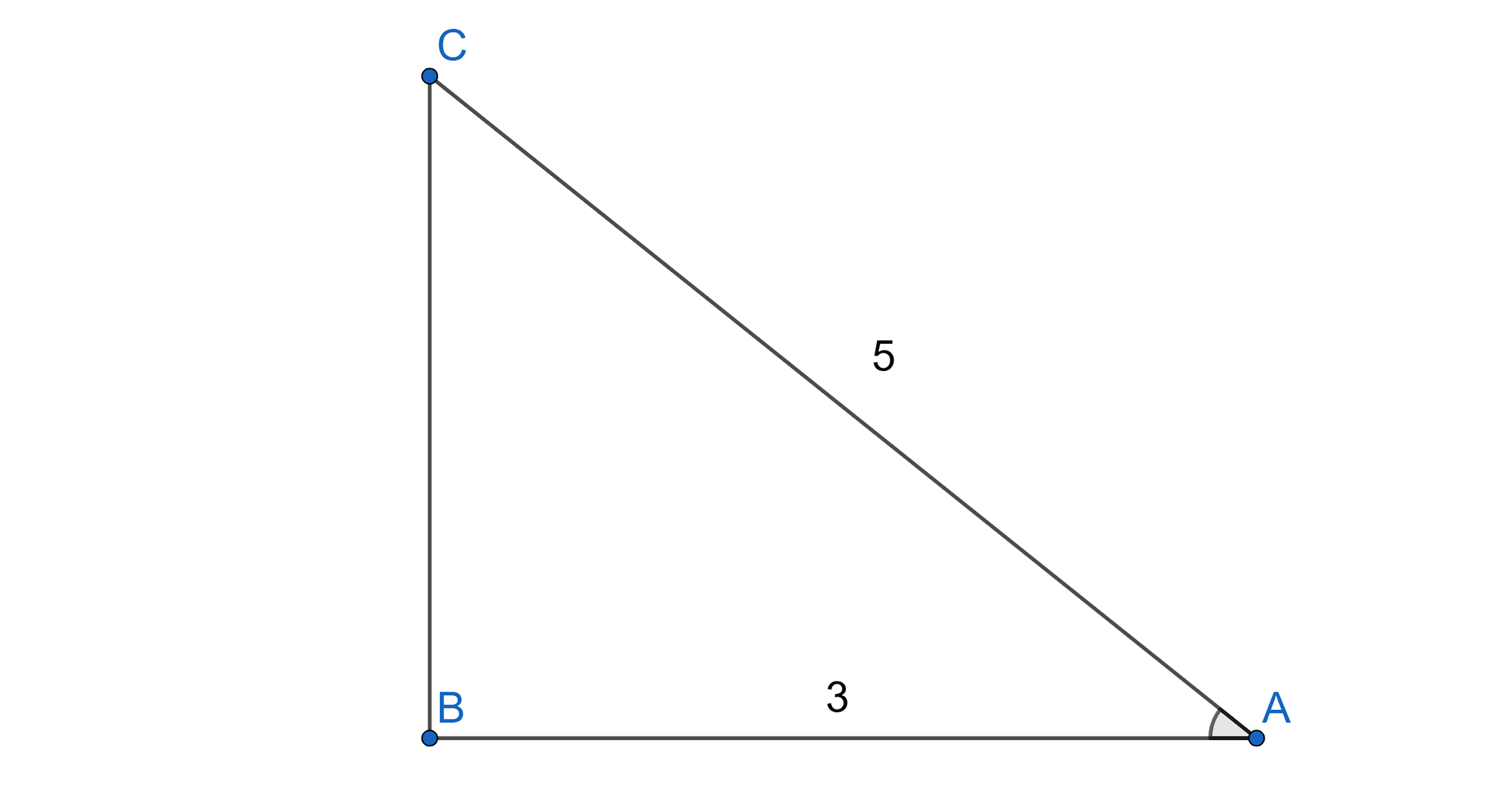
In the question we have to solve for \[\sin \], so trigonometric ratios for sine is \[\dfrac{{perpendicular}}{{hypotenuse}}\], so for perpendicular , we will use Pythagoras theorem , therefore we have \[A{B^2} + B{C^2} = A{C^2}\] ,
Putting the values of \[AB\] and \[AC\] we have ,
\[B{C^2} + {3^2} = {5^2}\]
\[B{C^2} = {5^2} - {3^2}\]
On solving we get
\[B{C^2} = 25 - 9\]
\[B{C^2} = 16\]
Now taking square root on both the sides we have ,
\[\sqrt {B{C^2}} = \sqrt {16} \]
\[BC = 4\]
For \[\sin A\]we have \[\dfrac{{BC}}{{AC}}\] , now putting the values of \[BC\] and \[AC\] , we get
\[\sin A = \dfrac{4}{5}\] .
Now , we take the terms \[\dfrac{{(\cos {\text{ B)}}}}{4} = \dfrac{1}{5}\] ,
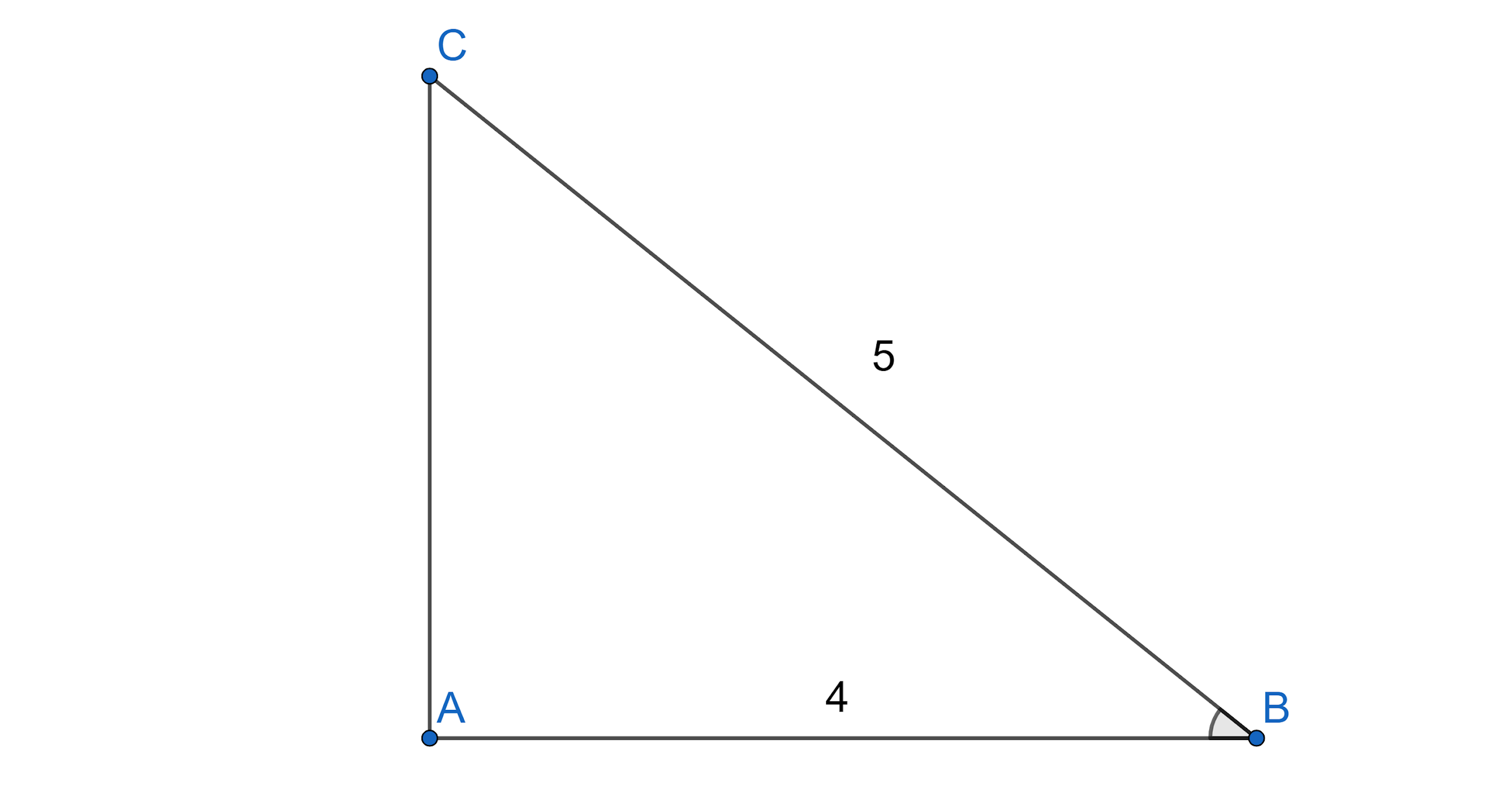
\[\cos B = \dfrac{4}{5}\] , similarly we can find \[\sin B\] using Pythagoras theorem , we get
\[A{B^2} + A{C^2} = B{C^2}\]
Putting the values we have
\[{4^2} + A{C^2} = {5^2}\]
\[A{C^2} = {5^2} - {4^2}\]
On solving further we get
\[A{C^2} = 16\]
Taking square root on both the sides
\[\sqrt {A{C^2}} = \sqrt 9 \]
\[AC = 3\]
For \[\sin {\text{ B}}\]we have \[\dfrac{{AC}}{{BC}}\] , now putting the values of \[BC\] and \[AC\] , we get
\[\sin {\text{ B = }}\dfrac{3}{5}\], now putting the values in the given question , we get
\[2\sin A + 4\sin B = \dfrac{8}{5} + \dfrac{{12}}{5}\] ,
\[2\sin A + 4\sin B = \dfrac{{20}}{5}\]
On further solving we get
\[2\sin A + 4\sin B = 4\].
So, the correct answer is “Option A”.
Note: Always remember the trigonometric ratios as without them questions related to it will not be solved . Try to solve using a triangle as it will help assigning the angles with corresponding sides such as base , hypotenuse and perpendicular .
Complete step by step answer:
Consider a right angled triangle ABC ,
Given :
\[\dfrac{{(\cos {\text{ A)}}}}{3} = \dfrac{{(\cos {\text{ B)}}}}{4} = \dfrac{1}{5}\], first we take the terms ,
\[\dfrac{{(\cos {\text{ A)}}}}{3} = \dfrac{1}{5}\] , on solving it we get ,
\[\cos {\text{ A}} = \dfrac{3}{5}\] , on comparing with trigonometric ratios of cosine \[ = \dfrac{{base}}{{hypotenuse}}\] , we have
\[base = 3\] and \[hypotenuse = 5\] , therefore
In the question we have to solve for \[\sin \], so trigonometric ratios for sine is \[\dfrac{{perpendicular}}{{hypotenuse}}\], so for perpendicular , we will use Pythagoras theorem , therefore we have \[A{B^2} + B{C^2} = A{C^2}\] ,
Putting the values of \[AB\] and \[AC\] we have ,
\[B{C^2} + {3^2} = {5^2}\]
\[B{C^2} = {5^2} - {3^2}\]
On solving we get
\[B{C^2} = 25 - 9\]
\[B{C^2} = 16\]
Now taking square root on both the sides we have ,
\[\sqrt {B{C^2}} = \sqrt {16} \]
\[BC = 4\]
For \[\sin A\]we have \[\dfrac{{BC}}{{AC}}\] , now putting the values of \[BC\] and \[AC\] , we get
\[\sin A = \dfrac{4}{5}\] .
Now , we take the terms \[\dfrac{{(\cos {\text{ B)}}}}{4} = \dfrac{1}{5}\] ,
\[\cos B = \dfrac{4}{5}\] , similarly we can find \[\sin B\] using Pythagoras theorem , we get
\[A{B^2} + A{C^2} = B{C^2}\]
Putting the values we have
\[{4^2} + A{C^2} = {5^2}\]
\[A{C^2} = {5^2} - {4^2}\]
On solving further we get
\[A{C^2} = 16\]
Taking square root on both the sides
\[\sqrt {A{C^2}} = \sqrt 9 \]
\[AC = 3\]
For \[\sin {\text{ B}}\]we have \[\dfrac{{AC}}{{BC}}\] , now putting the values of \[BC\] and \[AC\] , we get
\[\sin {\text{ B = }}\dfrac{3}{5}\], now putting the values in the given question , we get
\[2\sin A + 4\sin B = \dfrac{8}{5} + \dfrac{{12}}{5}\] ,
\[2\sin A + 4\sin B = \dfrac{{20}}{5}\]
On further solving we get
\[2\sin A + 4\sin B = 4\].
So, the correct answer is “Option A”.
Note: Always remember the trigonometric ratios as without them questions related to it will not be solved . Try to solve using a triangle as it will help assigning the angles with corresponding sides such as base , hypotenuse and perpendicular .
Recently Updated Pages
Master Class 10 Computer Science: Engaging Questions & Answers for Success

Master Class 10 General Knowledge: Engaging Questions & Answers for Success
Master Class 10 English: Engaging Questions & Answers for Success
Master Class 10 Social Science: Engaging Questions & Answers for Success
Master Class 10 Maths: Engaging Questions & Answers for Success
Master Class 10 Science: Engaging Questions & Answers for Success
Trending doubts
What is the median of the first 10 natural numbers class 10 maths CBSE
Which women's tennis player has 24 Grand Slam singles titles?
Who is the Brand Ambassador of Incredible India?
Why is there a time difference of about 5 hours between class 10 social science CBSE
Write a letter to the principal requesting him to grant class 10 english CBSE
State and prove converse of BPT Basic Proportionality class 10 maths CBSE