




If $\angle B\ and\ \angle Q$ are acute angles such that $\sin B=\sin Q$, then prove that $\angle B=\angle Q$.
Answer
 Verified
614.1k+ views
Hint: For the above question we will first assume two different right angled triangle say ABC and PQR and then we will use the concept that sine of any angle is equal to the ratio of perpendicular to hypotenuse of that right angled triangle and we will get the required result.
Complete step-by-step answer:
We have been given that $\angle B\ and\ \angle Q$ are acute angles such that $\sin B=\sin Q$ and we need to prove $\angle B=\angle Q$.
Let us suppose $\Delta ABC\ and\ \Delta PQR$ right angled at C and R respectively.
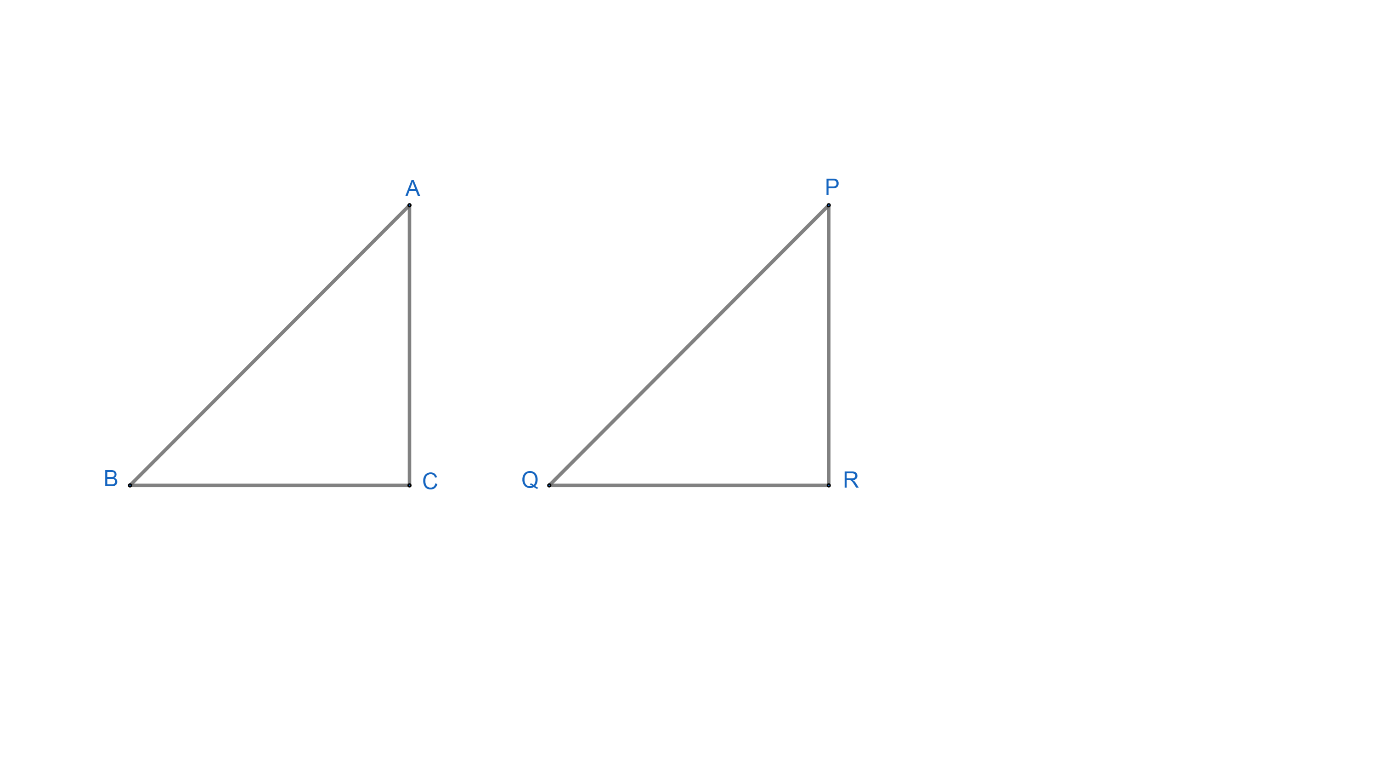
In $\Delta ABC$,
$\sin B=\dfrac{AC}{AB}$
In $\Delta PQR$,
$\sin Q=\dfrac{PR}{PQ}$
Since, sine of any angle is the ratio of perpendicular to hypotenuse.
Now, according to question we have,
$\begin{align}
& \sin B=\sin Q \\
& \Rightarrow \dfrac{AC}{AB}=\dfrac{PR}{PQ} \\
& \Rightarrow \dfrac{AC}{PR}=\dfrac{AB}{PQ} \\
& Let,\dfrac{AC}{PR}=\dfrac{AB}{PQ}=K.........\left( 1 \right) \\
\end{align}$
Now, in $\Delta ABC$, using Pythagoras theorem we have,
$BC=\sqrt{A{{B}^{2}}-A{{C}^{2}}}$
Using (i) we get $AB=K.PQ\ and\ AC=K.PR$.
\[\begin{align}
& \Rightarrow BC=\sqrt{{{\left( K.PQ \right)}^{2}}-{{\left( K.PR \right)}^{2}}} \\
& =\sqrt{{{K}^{2}}P{{Q}^{2}}-{{K}^{2}}P{{R}^{2}}} \\
& =\sqrt{{{K}^{2}}\left( P{{Q}^{2}}-P{{R}^{2}} \right)} \\
& =K\sqrt{P{{Q}^{2}}-P{{R}^{2}}}...........\left( 2 \right) \\
\end{align}\]
In $\Delta PQR$, using Pythagoras Theorem we have,
$QR=\sqrt{P{{Q}^{2}}-P{{R}^{2}}}$
From equation (2) we have $BC=K\sqrt{P{{Q}^{2}}-P{{R}^{2}}}$.
$\Rightarrow \dfrac{BC}{QR}=\dfrac{K\sqrt{P{{Q}^{2}}-P{{R}^{2}}}}{\sqrt{P{{Q}^{2}}-P{{R}^{2}}}}=K............\left( 3 \right)$
On comparing (1) and (3), we get,
$\dfrac{AC}{PR}=\dfrac{AB}{PQ}=\dfrac{BC}{QR}$
So, by using SSS a similar condition which states that two triangles are similar if their corresponding sides are proportional.
$\Rightarrow \Delta ABC\sim \Delta PQR$
According to corresponding part of similar triangle we have,
$\angle B=\angle Q$
Hence, it is proved.
Note: Remember that Pythagoras Theorem states that in a right angled triangle the sum of square of perpendicular and base is equal to square of hypotenuse of the triangle. While applying it in the solution, we must not make any mistake in the ratio of sides. Also, remember the property of a similar triangle that two similar triangles have corresponding angles are congruent and their corresponding sides are in proportion.
Complete step-by-step answer:
We have been given that $\angle B\ and\ \angle Q$ are acute angles such that $\sin B=\sin Q$ and we need to prove $\angle B=\angle Q$.
Let us suppose $\Delta ABC\ and\ \Delta PQR$ right angled at C and R respectively.
In $\Delta ABC$,
$\sin B=\dfrac{AC}{AB}$
In $\Delta PQR$,
$\sin Q=\dfrac{PR}{PQ}$
Since, sine of any angle is the ratio of perpendicular to hypotenuse.
Now, according to question we have,
$\begin{align}
& \sin B=\sin Q \\
& \Rightarrow \dfrac{AC}{AB}=\dfrac{PR}{PQ} \\
& \Rightarrow \dfrac{AC}{PR}=\dfrac{AB}{PQ} \\
& Let,\dfrac{AC}{PR}=\dfrac{AB}{PQ}=K.........\left( 1 \right) \\
\end{align}$
Now, in $\Delta ABC$, using Pythagoras theorem we have,
$BC=\sqrt{A{{B}^{2}}-A{{C}^{2}}}$
Using (i) we get $AB=K.PQ\ and\ AC=K.PR$.
\[\begin{align}
& \Rightarrow BC=\sqrt{{{\left( K.PQ \right)}^{2}}-{{\left( K.PR \right)}^{2}}} \\
& =\sqrt{{{K}^{2}}P{{Q}^{2}}-{{K}^{2}}P{{R}^{2}}} \\
& =\sqrt{{{K}^{2}}\left( P{{Q}^{2}}-P{{R}^{2}} \right)} \\
& =K\sqrt{P{{Q}^{2}}-P{{R}^{2}}}...........\left( 2 \right) \\
\end{align}\]
In $\Delta PQR$, using Pythagoras Theorem we have,
$QR=\sqrt{P{{Q}^{2}}-P{{R}^{2}}}$
From equation (2) we have $BC=K\sqrt{P{{Q}^{2}}-P{{R}^{2}}}$.
$\Rightarrow \dfrac{BC}{QR}=\dfrac{K\sqrt{P{{Q}^{2}}-P{{R}^{2}}}}{\sqrt{P{{Q}^{2}}-P{{R}^{2}}}}=K............\left( 3 \right)$
On comparing (1) and (3), we get,
$\dfrac{AC}{PR}=\dfrac{AB}{PQ}=\dfrac{BC}{QR}$
So, by using SSS a similar condition which states that two triangles are similar if their corresponding sides are proportional.
$\Rightarrow \Delta ABC\sim \Delta PQR$
According to corresponding part of similar triangle we have,
$\angle B=\angle Q$
Hence, it is proved.
Note: Remember that Pythagoras Theorem states that in a right angled triangle the sum of square of perpendicular and base is equal to square of hypotenuse of the triangle. While applying it in the solution, we must not make any mistake in the ratio of sides. Also, remember the property of a similar triangle that two similar triangles have corresponding angles are congruent and their corresponding sides are in proportion.
Recently Updated Pages
Basicity of sulphurous acid and sulphuric acid are

Master Class 11 Business Studies: Engaging Questions & Answers for Success
Master Class 11 Computer Science: Engaging Questions & Answers for Success
Master Class 11 Economics: Engaging Questions & Answers for Success
Master Class 11 Social Science: Engaging Questions & Answers for Success
Master Class 11 English: Engaging Questions & Answers for Success
Trending doubts
One Metric ton is equal to kg A 10000 B 1000 C 100 class 11 physics CBSE
The largest wind power cluster is located in the state class 11 social science CBSE
Explain zero factorial class 11 maths CBSE
State and prove Bernoullis theorem class 11 physics CBSE
What steps did the French revolutionaries take to create class 11 social science CBSE
Which among the following are examples of coming together class 11 social science CBSE