




If \[\alpha \] and \[\beta \] are the root of the equations \[\left( 2\sin x-\cos x \right)\left( 1+\cos x \right)=\sin x\] and \[3{{\sin }^{2}}x-10\cos x+3=0\], respectively and \[\alpha ,\beta \in \left[ 0,\dfrac{\pi }{2} \right]\]. So, find the value of \[\sin \left( \alpha -\beta \right)\].
a) 1
b) 0
c) $\dfrac{1-2\sqrt{6}}{6}$
d) $\dfrac{\sqrt{3}-2\sqrt{2}}{6}$
Answer
 Verified
611.7k+ views
Hint: Solve both the equations to get the values of $\sin \alpha ,\cos \alpha ,\sin \beta $ and $\cos \beta $. Use the condition that $\alpha ,\beta $ will lie in 0 to $\dfrac{\pi }{2}$ only. Identity of $\sin \left( \alpha -\beta \right)$ can be given as
\[\sin \left( \alpha -\beta \right)=\sin \alpha \cos \beta -\cos \alpha \sin \beta \]
Put the evaluated values of $\sin \alpha ,\cos \alpha ,\sin \beta $ and $\cos \beta $ to the above equation to get value of \[\sin \left( \alpha -\beta \right)\].
Complete step-by-step answer:
So, \[\alpha \] is the root of the equation
\[\left( 2\sin x-\cos x \right)\left( 1+\sin x \right)={{\sin }^{2}}x\] ….......................................(i)
So, let us simplify the above equation.
So, we can multiply the brackets of equation (i) on the L.H.S side. So, we get
\[\left( 2\sin x-\cos x \right)\left( 1+\cos x \right)={{\sin }^{2}}x\]
\[2\sin x+2\sin x\cos x-\cos x-{{\cos }^{2}}x={{\sin }^{2}}x\]
\[2\sin x+2\sin x\cos x-\cos x-{{\cos }^{2}}x-{{\sin }^{2}}x=0\]
$2\sin x+2\sin x\cos x-\cos x-\left( {{\cos }^{2}}x+{{\sin }^{2}}x \right)=0$
We know the value of ${{\sin }^{2}}x+{{\cos }^{2}}x=1$ . So, we get the above expression as
$2\sin x+2\sin x\cos x-\cos x-1=0$
Now, taking $2\sin x$ as common from the first two terms of the above equation and ‘ $-1$ ’ from the last two terms. So, we get
$2\sin x+\left( 1+\cos x \right)-1\left( \cos x+1 \right)=0$
$\Rightarrow 2\sin x+\left( 1+\cos x \right)-1\left( 1+\cos x \right)=0$
$\left( 2\sin x-1 \right)\left( 1+\cos x \right)=0$
Now, we know multiplication of two numbers can be equals to 0, if either of them is 0.
So, we get
$2\sin x-1=0$ and $1+\cos x=0$
$\sin x=\dfrac{1}{2}$ and $\cos x=-1$
Now, as we know root of the given equation is $\alpha $ , so, we cannot take $\cos x=-1$ , as $\alpha $ is lying in $\left[ 0,\dfrac{\pi }{2} \right]$, where value of all the trigonometric functions is positive. Hence, $\cos x=-1$ can be ignored. So, we get
$\sin x=\dfrac{1}{2}$ ……………………………….(ii)
Now, we know the relation between $\sin \alpha $ and $\cos \alpha $ is given as
${{\sin }^{2}}\alpha +{{\cos }^{2}}\alpha =1$
So, put $\sin \alpha =\dfrac{1}{2}$ to the above equation; so, we get
${{\left( \dfrac{1}{2} \right)}^{2}}+{{\cos }^{2}}\alpha =1$
${{\cos }^{2}}\alpha =1-\dfrac{1}{4}=\dfrac{3}{4}$
$\cos \alpha =\dfrac{\sqrt{3}}{2}$ , $\cos \alpha \ne \dfrac{-\sqrt{3}}{2}$
$\cos \alpha \ne \dfrac{-\sqrt{3}}{2}$, as $\alpha $ is lying in $\left[ 0,\dfrac{\pi }{2} \right]$.
Hence, we get
$\sin \alpha =\dfrac{1}{2}$ , $\cos \alpha =\dfrac{\sqrt{3}}{2}$ ……………………………..(iii)
Now, we know $\beta $ is the root of the equation
$3{{\cos }^{2}}x-10\cos x+3=0$ ………………………………….(iv)
Now, split the middle term of the above equation to $-9$ and $-1$ , to factorize the equation. So, we get
$3{{\cos }^{2}}x-9\cos x-\cos x+3=0$
Take $3\cos x$ common from the first two terms and $-1$ from the last two terms. So, we get
$3\cos x\left( \cos x-3 \right)-1\left( \cos x-3 \right)=0$
$\left( 3\cos x-1 \right)\left( \cos x-3 \right)=0$
So, we get $3\cos x-1=0$ or $\cos x-3=0$
$\cos x=\dfrac{1}{3}$ or $\cos x=3$
$\cos x\ne 3$, as the range of cosine functions is $\left[ -1,1 \right]$. So, ignore $\cos x=3$.
Now, we get the root of the equation (iv) is $\beta $. So, we get
$\cos \beta =\dfrac{1}{3}$
Now, we know
${{\sin }^{2}}\theta +{{\cos }^{2}}\theta =1$
Hence, we can get the value of $\sin \beta $ using the above equation. So, we get
${{\sin }^{2}}\beta +{{\cos }^{2}}\beta =1$
${{\sin }^{2}}\beta +{{\left( \dfrac{1}{3} \right)}^{2}}=1$
${{\sin }^{2}}\beta =1-\dfrac{1}{9}=\dfrac{8}{9}$
$\sin \beta =\sqrt{\dfrac{8}{9}}=\dfrac{2\sqrt{2}}{3}$
Hence, we get
$\sin \beta =\dfrac{2\sqrt{2}}{3}$ , $\cos \beta =\dfrac{1}{3}$ ………………………………..(v)
Now, as we need to calculate the value of $\sin \left( \alpha -\beta \right)$. So, we know the
identity of $\sin \left( \alpha -\beta \right)$ as
\[\sin \left( \alpha -\beta \right)=\sin \alpha \cos \beta -\cos \alpha \sin \beta \]
Now, use the equation (iii) and (v) to the above equation. So, we get
$\sin \left( \alpha -\beta \right)=\dfrac{1}{2}\times \dfrac{1}{3}-\dfrac{\sqrt{3}}{2}\times \dfrac{2\sqrt{2}}{3}$
$=\dfrac{1}{6}-\dfrac{2\sqrt{6}}{6}$
$\sin \left( \alpha -\beta \right)=\dfrac{1-2\sqrt{6}}{6}$
Hence, option (c) is the correct answer.
Note: Don’t take $\cos x=-1$ in the first equation, as $\alpha $ and $\beta $ are lying in $\left[ 0{}^\circ ,90{}^\circ \right]$ only, where $\left[ 0{}^\circ ,90{}^\circ \right]$ can never be negative. So, clear with this step and use all the information given in the problem.
One may use triangle approach as well to get $\cos \alpha $ using $\sin \alpha =\dfrac{1}{2}$ from first equation, and $\sin \beta $ by using $\cos \beta =\dfrac{1}{3}$ from the second equation. It can be done as
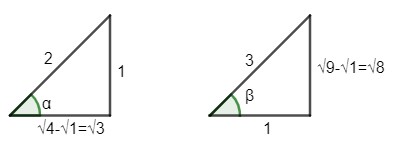
$\cos \alpha =\dfrac{\sqrt{3}}{2}$ , $\sin \beta =\dfrac{\sqrt{8}}{3}$
\[\sin \left( \alpha -\beta \right)=\sin \alpha \cos \beta -\cos \alpha \sin \beta \]
Put the evaluated values of $\sin \alpha ,\cos \alpha ,\sin \beta $ and $\cos \beta $ to the above equation to get value of \[\sin \left( \alpha -\beta \right)\].
Complete step-by-step answer:
So, \[\alpha \] is the root of the equation
\[\left( 2\sin x-\cos x \right)\left( 1+\sin x \right)={{\sin }^{2}}x\] ….......................................(i)
So, let us simplify the above equation.
So, we can multiply the brackets of equation (i) on the L.H.S side. So, we get
\[\left( 2\sin x-\cos x \right)\left( 1+\cos x \right)={{\sin }^{2}}x\]
\[2\sin x+2\sin x\cos x-\cos x-{{\cos }^{2}}x={{\sin }^{2}}x\]
\[2\sin x+2\sin x\cos x-\cos x-{{\cos }^{2}}x-{{\sin }^{2}}x=0\]
$2\sin x+2\sin x\cos x-\cos x-\left( {{\cos }^{2}}x+{{\sin }^{2}}x \right)=0$
We know the value of ${{\sin }^{2}}x+{{\cos }^{2}}x=1$ . So, we get the above expression as
$2\sin x+2\sin x\cos x-\cos x-1=0$
Now, taking $2\sin x$ as common from the first two terms of the above equation and ‘ $-1$ ’ from the last two terms. So, we get
$2\sin x+\left( 1+\cos x \right)-1\left( \cos x+1 \right)=0$
$\Rightarrow 2\sin x+\left( 1+\cos x \right)-1\left( 1+\cos x \right)=0$
$\left( 2\sin x-1 \right)\left( 1+\cos x \right)=0$
Now, we know multiplication of two numbers can be equals to 0, if either of them is 0.
So, we get
$2\sin x-1=0$ and $1+\cos x=0$
$\sin x=\dfrac{1}{2}$ and $\cos x=-1$
Now, as we know root of the given equation is $\alpha $ , so, we cannot take $\cos x=-1$ , as $\alpha $ is lying in $\left[ 0,\dfrac{\pi }{2} \right]$, where value of all the trigonometric functions is positive. Hence, $\cos x=-1$ can be ignored. So, we get
$\sin x=\dfrac{1}{2}$ ……………………………….(ii)
Now, we know the relation between $\sin \alpha $ and $\cos \alpha $ is given as
${{\sin }^{2}}\alpha +{{\cos }^{2}}\alpha =1$
So, put $\sin \alpha =\dfrac{1}{2}$ to the above equation; so, we get
${{\left( \dfrac{1}{2} \right)}^{2}}+{{\cos }^{2}}\alpha =1$
${{\cos }^{2}}\alpha =1-\dfrac{1}{4}=\dfrac{3}{4}$
$\cos \alpha =\dfrac{\sqrt{3}}{2}$ , $\cos \alpha \ne \dfrac{-\sqrt{3}}{2}$
$\cos \alpha \ne \dfrac{-\sqrt{3}}{2}$, as $\alpha $ is lying in $\left[ 0,\dfrac{\pi }{2} \right]$.
Hence, we get
$\sin \alpha =\dfrac{1}{2}$ , $\cos \alpha =\dfrac{\sqrt{3}}{2}$ ……………………………..(iii)
Now, we know $\beta $ is the root of the equation
$3{{\cos }^{2}}x-10\cos x+3=0$ ………………………………….(iv)
Now, split the middle term of the above equation to $-9$ and $-1$ , to factorize the equation. So, we get
$3{{\cos }^{2}}x-9\cos x-\cos x+3=0$
Take $3\cos x$ common from the first two terms and $-1$ from the last two terms. So, we get
$3\cos x\left( \cos x-3 \right)-1\left( \cos x-3 \right)=0$
$\left( 3\cos x-1 \right)\left( \cos x-3 \right)=0$
So, we get $3\cos x-1=0$ or $\cos x-3=0$
$\cos x=\dfrac{1}{3}$ or $\cos x=3$
$\cos x\ne 3$, as the range of cosine functions is $\left[ -1,1 \right]$. So, ignore $\cos x=3$.
Now, we get the root of the equation (iv) is $\beta $. So, we get
$\cos \beta =\dfrac{1}{3}$
Now, we know
${{\sin }^{2}}\theta +{{\cos }^{2}}\theta =1$
Hence, we can get the value of $\sin \beta $ using the above equation. So, we get
${{\sin }^{2}}\beta +{{\cos }^{2}}\beta =1$
${{\sin }^{2}}\beta +{{\left( \dfrac{1}{3} \right)}^{2}}=1$
${{\sin }^{2}}\beta =1-\dfrac{1}{9}=\dfrac{8}{9}$
$\sin \beta =\sqrt{\dfrac{8}{9}}=\dfrac{2\sqrt{2}}{3}$
Hence, we get
$\sin \beta =\dfrac{2\sqrt{2}}{3}$ , $\cos \beta =\dfrac{1}{3}$ ………………………………..(v)
Now, as we need to calculate the value of $\sin \left( \alpha -\beta \right)$. So, we know the
identity of $\sin \left( \alpha -\beta \right)$ as
\[\sin \left( \alpha -\beta \right)=\sin \alpha \cos \beta -\cos \alpha \sin \beta \]
Now, use the equation (iii) and (v) to the above equation. So, we get
$\sin \left( \alpha -\beta \right)=\dfrac{1}{2}\times \dfrac{1}{3}-\dfrac{\sqrt{3}}{2}\times \dfrac{2\sqrt{2}}{3}$
$=\dfrac{1}{6}-\dfrac{2\sqrt{6}}{6}$
$\sin \left( \alpha -\beta \right)=\dfrac{1-2\sqrt{6}}{6}$
Hence, option (c) is the correct answer.
Note: Don’t take $\cos x=-1$ in the first equation, as $\alpha $ and $\beta $ are lying in $\left[ 0{}^\circ ,90{}^\circ \right]$ only, where $\left[ 0{}^\circ ,90{}^\circ \right]$ can never be negative. So, clear with this step and use all the information given in the problem.
One may use triangle approach as well to get $\cos \alpha $ using $\sin \alpha =\dfrac{1}{2}$ from first equation, and $\sin \beta $ by using $\cos \beta =\dfrac{1}{3}$ from the second equation. It can be done as
$\cos \alpha =\dfrac{\sqrt{3}}{2}$ , $\sin \beta =\dfrac{\sqrt{8}}{3}$
Recently Updated Pages
Master Class 10 Computer Science: Engaging Questions & Answers for Success

Master Class 10 General Knowledge: Engaging Questions & Answers for Success
Master Class 10 English: Engaging Questions & Answers for Success
Master Class 10 Social Science: Engaging Questions & Answers for Success
Master Class 10 Maths: Engaging Questions & Answers for Success
Master Class 10 Science: Engaging Questions & Answers for Success
Trending doubts
What is the median of the first 10 natural numbers class 10 maths CBSE
Which women's tennis player has 24 Grand Slam singles titles?
Who is the Brand Ambassador of Incredible India?
Why is there a time difference of about 5 hours between class 10 social science CBSE
Write a letter to the principal requesting him to grant class 10 english CBSE
State and prove converse of BPT Basic Proportionality class 10 maths CBSE