




If all the sides of a parallelogram touches a circle, show that the parallelogram is a rhombus.
Answer
 Verified
651.6k+ views
Hint: In this question prove that all sides that are LM, MN, NO, OL are equal. Use the property that tangents drawn from external sides are equal in length. This will help proving that parallelogram is a rhombus.
Complete step-by-step answer:
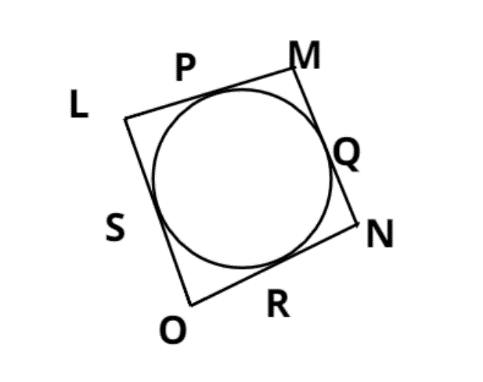
Let LMNO be the quadrilateral that touches a circle at P, Q, R, S respectively. (See figure)
Now we have to prove Parallelogram is a rhombus.
Proof:
For a parallelogram to be a rhombus it is necessary that all the sides of the parallelogram should be equal.
As we know that the tangents drawn from the external point on the circle are equal.
$ \Rightarrow LP = LS...............\left( 1 \right)$ (Tangent from point L)
$ \Rightarrow MP = MQ...............\left( 2 \right)$ (Tangent from point M)
$ \Rightarrow NR = NQ...............\left( 3 \right)$ (Tangent from point N)
$ \Rightarrow OR = OS...............\left( 4 \right)$ (Tangent from point O)
Adding equation (1), (2), (3) and (4) we get.
$LP + MP + NR + OR = LS + MQ + NQ + OS$
$\left( {LP + MP} \right) + \left( {NR + OR} \right) = \left( {OS + LS} \right) + \left( {MQ + NQ} \right)$
Now from figure
$
LP + MP = LM,{\text{ }}NR + OR = NO \\
OS + LS = OL,{\text{ }}MQ + NQ = MN \\
$
Substitute these values in the above equation we have
$\left( {LM} \right) + \left( {NO} \right) = \left( {OL} \right) + \left( {MN} \right)$
Now as we know that in a parallelogram opposite sides are equal.
$ \Rightarrow LM = NO,\;OL = MN$
Therefore above equation becomes,
$
\left( {LM} \right) + \left( {LM} \right) = \left( {OL} \right) + \left( {OL} \right) \\
\Rightarrow 2LM = 2OL \\
\Rightarrow LM = OL................\left( 5 \right) \\
$
But, $\left( {LM = NO{\text{ & }}OL = MN} \right)..............\left( 6 \right)$
Therefore from equation (5) and (6)
$LM = MN = NO = OL$
Therefore all the sides of a parallelogram are equal.
Hence, Parallelogram LMNO is a rhombus.
Hence proved.
Note: A rhombus is flat shape with 4 equal straight sides, opposite sides are parallel and opposite angles are equal. However a parallelogram is a quadrilateral with opposite sides parallel thus a quadrilateral with equal sides is a rhombus therefore we have proved the sides equal, another interesting point associated with parallelogram is that parallelogram whose angles are all right angles is a rectangle.
Complete step-by-step answer:
Let LMNO be the quadrilateral that touches a circle at P, Q, R, S respectively. (See figure)
Now we have to prove Parallelogram is a rhombus.
Proof:
For a parallelogram to be a rhombus it is necessary that all the sides of the parallelogram should be equal.
As we know that the tangents drawn from the external point on the circle are equal.
$ \Rightarrow LP = LS...............\left( 1 \right)$ (Tangent from point L)
$ \Rightarrow MP = MQ...............\left( 2 \right)$ (Tangent from point M)
$ \Rightarrow NR = NQ...............\left( 3 \right)$ (Tangent from point N)
$ \Rightarrow OR = OS...............\left( 4 \right)$ (Tangent from point O)
Adding equation (1), (2), (3) and (4) we get.
$LP + MP + NR + OR = LS + MQ + NQ + OS$
$\left( {LP + MP} \right) + \left( {NR + OR} \right) = \left( {OS + LS} \right) + \left( {MQ + NQ} \right)$
Now from figure
$
LP + MP = LM,{\text{ }}NR + OR = NO \\
OS + LS = OL,{\text{ }}MQ + NQ = MN \\
$
Substitute these values in the above equation we have
$\left( {LM} \right) + \left( {NO} \right) = \left( {OL} \right) + \left( {MN} \right)$
Now as we know that in a parallelogram opposite sides are equal.
$ \Rightarrow LM = NO,\;OL = MN$
Therefore above equation becomes,
$
\left( {LM} \right) + \left( {LM} \right) = \left( {OL} \right) + \left( {OL} \right) \\
\Rightarrow 2LM = 2OL \\
\Rightarrow LM = OL................\left( 5 \right) \\
$
But, $\left( {LM = NO{\text{ & }}OL = MN} \right)..............\left( 6 \right)$
Therefore from equation (5) and (6)
$LM = MN = NO = OL$
Therefore all the sides of a parallelogram are equal.
Hence, Parallelogram LMNO is a rhombus.
Hence proved.
Note: A rhombus is flat shape with 4 equal straight sides, opposite sides are parallel and opposite angles are equal. However a parallelogram is a quadrilateral with opposite sides parallel thus a quadrilateral with equal sides is a rhombus therefore we have proved the sides equal, another interesting point associated with parallelogram is that parallelogram whose angles are all right angles is a rectangle.
Recently Updated Pages
Master Class 11 Social Science: Engaging Questions & Answers for Success

Master Class 11 English: Engaging Questions & Answers for Success
Master Class 11 Maths: Engaging Questions & Answers for Success
Master Class 11 Chemistry: Engaging Questions & Answers for Success
Master Class 11 Biology: Engaging Questions & Answers for Success
Class 11 Question and Answer - Your Ultimate Solutions Guide
Trending doubts
Explain the Treaty of Vienna of 1815 class 10 social science CBSE
Why is it 530 pm in india when it is 1200 afternoon class 10 social science CBSE
What is the full form of POSCO class 10 social science CBSE
Define Potential, Developed, Stock and Reserved resources
Which Country Has the Largest Border with India?
Choose the feminine form of the given noun Fox AFoxess class 10 english CBSE