




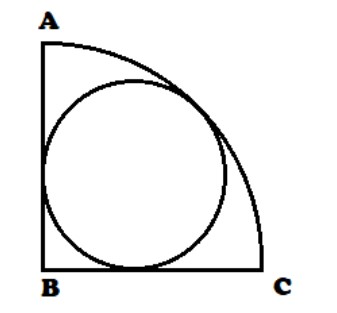
If \[ABC\] is a quarter circle and a circle is inscribed in it and if \[AB = 1cm\], find a radius of a smaller circle.
A. $\sqrt 2 - 1$.
B. $\dfrac{{\sqrt 2 - 1}}{2}$.
C. $\dfrac{{\sqrt 2 + 1}}{2}$.
D. $1 - 2\sqrt 2 $.
Answer
 Verified
630.3k+ views
Hint: In this question we will use some basic properties of circles and Pythagoras theorem. Here we have to find the radius of a circle that is inscribed in a quarter circle of given radius. To solve this question we will apply Pythagoras theorem i.e. ${(Perpendicular)^2} + {(Base)^2} = {(hypotenuse)^2}$, to find the radius of the inner circle, with the help of the radius given of the quarter circle.
Complete step-by-step answer:
Given that, the radius of the quarter circle, \[AB = 1cm\].
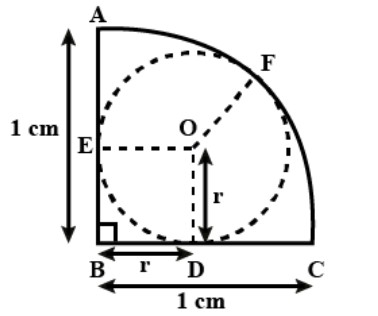
We know that a line joining the circumference to the centre of the circle is the radius of that circle.
So, $OE = OF = OD$ (radius of the inner circle)
According to Pythagoras theorem,
$ \Rightarrow {(Perpendicular)^2} + {(Base)^2} = {(hypotenuse)^2}$
Therefore,
$
\Rightarrow {(OB)^2} = {(BD)^2} + {(OD)^2}. \\
\Rightarrow {(OB)^2} = {(r)^2} + {(r)^2} \\
\Rightarrow {(OB)^2} = 2{(r)^2} \\
\Rightarrow (OB) = \sqrt 2 {\text{ }}r \\
$
Now, we have $BF = 1cm$
$OB + OF = 1cm$
We have , \[(OB) = \sqrt 2 {\text{ }}r\] and $OF = r$
Then,
$
\Rightarrow \sqrt 2 {\text{ }}r + r = 1 \\
\Rightarrow \left( {\sqrt 2 + 1} \right)r = 1 \\
\Rightarrow r = \dfrac{1}{{\left( {\sqrt 2 + 1} \right)}} \\
$
Now we will rationalise this value of r,
$
\Rightarrow r = \dfrac{1}{{\left( {\sqrt 2 + 1} \right)}} \times \dfrac{{\left( {\sqrt 2 - 1} \right)}}{{\left( {\sqrt 2 - 1} \right)}} \\
\Rightarrow r = \dfrac{{\left( {\sqrt 2 - 1} \right)}}{{2 - 1}} = \left( {\sqrt 2 - 1} \right) \\
$
Here we get, r= \[\left( {\sqrt 2 - 1} \right)\]
Hence, option (A) is correct.
Note: In this type of question first we will draw the proper figure as according to the statements given in the question. Then we will use the Pythagoras theorem to find out the radius of the inner circle . After that we will rationalise the radius that is obtained by the Pythagoras theorem and through this we will get the final required radius. Students should remember the formula of pythagoras and properties of the circle for solving these types of problems.
Complete step-by-step answer:
Given that, the radius of the quarter circle, \[AB = 1cm\].
We know that a line joining the circumference to the centre of the circle is the radius of that circle.
So, $OE = OF = OD$ (radius of the inner circle)
According to Pythagoras theorem,
$ \Rightarrow {(Perpendicular)^2} + {(Base)^2} = {(hypotenuse)^2}$
Therefore,
$
\Rightarrow {(OB)^2} = {(BD)^2} + {(OD)^2}. \\
\Rightarrow {(OB)^2} = {(r)^2} + {(r)^2} \\
\Rightarrow {(OB)^2} = 2{(r)^2} \\
\Rightarrow (OB) = \sqrt 2 {\text{ }}r \\
$
Now, we have $BF = 1cm$
$OB + OF = 1cm$
We have , \[(OB) = \sqrt 2 {\text{ }}r\] and $OF = r$
Then,
$
\Rightarrow \sqrt 2 {\text{ }}r + r = 1 \\
\Rightarrow \left( {\sqrt 2 + 1} \right)r = 1 \\
\Rightarrow r = \dfrac{1}{{\left( {\sqrt 2 + 1} \right)}} \\
$
Now we will rationalise this value of r,
$
\Rightarrow r = \dfrac{1}{{\left( {\sqrt 2 + 1} \right)}} \times \dfrac{{\left( {\sqrt 2 - 1} \right)}}{{\left( {\sqrt 2 - 1} \right)}} \\
\Rightarrow r = \dfrac{{\left( {\sqrt 2 - 1} \right)}}{{2 - 1}} = \left( {\sqrt 2 - 1} \right) \\
$
Here we get, r= \[\left( {\sqrt 2 - 1} \right)\]
Hence, option (A) is correct.
Note: In this type of question first we will draw the proper figure as according to the statements given in the question. Then we will use the Pythagoras theorem to find out the radius of the inner circle . After that we will rationalise the radius that is obtained by the Pythagoras theorem and through this we will get the final required radius. Students should remember the formula of pythagoras and properties of the circle for solving these types of problems.
Recently Updated Pages
Master Class 10 Social Science: Engaging Questions & Answers for Success

Master Class 10 Science: Engaging Questions & Answers for Success
Master Class 10 Maths: Engaging Questions & Answers for Success
Master Class 10 General Knowledge: Engaging Questions & Answers for Success
Master Class 10 Computer Science: Engaging Questions & Answers for Success
Class 10 Question and Answer - Your Ultimate Solutions Guide
Trending doubts
What is the full form of PNG A Petrol Natural Gas B class 10 chemistry CBSE
Explain the Treaty of Vienna of 1815 class 10 social science CBSE
In cricket, how many legal balls are there in a standard over?
Why is there a time difference of about 5 hours between class 10 social science CBSE
Who Won 36 Oscar Awards? Record Holder Revealed
What is the median of the first 10 natural numbers class 10 maths CBSE