




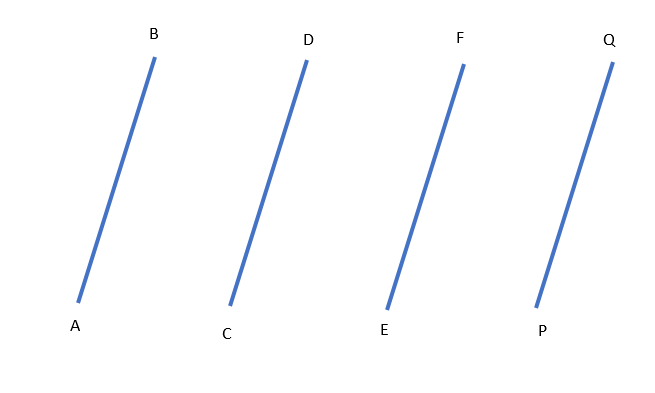
If AB = CD, CD = EF and EF = PQ, then which of the following is not true.
A. AB = PQ
B. CD = PQ
C. AB = EF
D. $AB \ne CD$
Answer
 Verified
598.8k+ views
Hint: We will first understand the fact that if line 1 is equal to line 2 and line 2 is equal to line 3, then line 3 and line 1 are also equal then find out which of the options is correct.
Complete step-by-step answer:
Since, it is given to us that AB = CD ……………(1)
Now it is also given that CD = EF ……………(2)
If we consider both the equations (1) and (2) and equate them, we will then get:-
$\Rightarrow$ AB = CD = EF
Now, we can remove CD from it, so we get AB = EF.
Hence, the option (C) is definitely correct.
Now, we are also given that EF = PQ ……………(3)
If we consider both the equations (2) and (3) and equate them, we will then get:-
$\Rightarrow$CD = EF = PQ
Now, we can remove EF from it, so we get CD = PQ.
Hence, the option (B) is definitely correct.
If we consider the equations (1), (2) and (3) and equate them, we will then get:-
$\Rightarrow$AB = CD = EF = PQ
Now, we can remove CD and EF from it, so we get AB = PQ.
Hence, the option (A) is definitely correct.
Now, since AB = CD. Therefore, $AB \ne CD$ is not possible.
Hence, the incorrect option is only (D).
Note:
The students must note that if one thing is equal to any other thing, then at the same time, they cannot be unequal to each other. Either they are equal or not, only one thing is possible at a time. Therefore, if AB was equal to CD, then AB not equal to CD is not possible.
The students might make the mistake of directly checking the option D, but verify all the options first, there may be more than one incorrect option as well.
Complete step-by-step answer:
Since, it is given to us that AB = CD ……………(1)
Now it is also given that CD = EF ……………(2)
If we consider both the equations (1) and (2) and equate them, we will then get:-
$\Rightarrow$ AB = CD = EF
Now, we can remove CD from it, so we get AB = EF.
Hence, the option (C) is definitely correct.
Now, we are also given that EF = PQ ……………(3)
If we consider both the equations (2) and (3) and equate them, we will then get:-
$\Rightarrow$CD = EF = PQ
Now, we can remove EF from it, so we get CD = PQ.
Hence, the option (B) is definitely correct.
If we consider the equations (1), (2) and (3) and equate them, we will then get:-
$\Rightarrow$AB = CD = EF = PQ
Now, we can remove CD and EF from it, so we get AB = PQ.
Hence, the option (A) is definitely correct.
Now, since AB = CD. Therefore, $AB \ne CD$ is not possible.
Hence, the incorrect option is only (D).
Note:
The students must note that if one thing is equal to any other thing, then at the same time, they cannot be unequal to each other. Either they are equal or not, only one thing is possible at a time. Therefore, if AB was equal to CD, then AB not equal to CD is not possible.
The students might make the mistake of directly checking the option D, but verify all the options first, there may be more than one incorrect option as well.
Recently Updated Pages
Master Class 12 Economics: Engaging Questions & Answers for Success

Master Class 12 English: Engaging Questions & Answers for Success
Master Class 12 Social Science: Engaging Questions & Answers for Success
Master Class 12 Maths: Engaging Questions & Answers for Success
Master Class 12 Physics: Engaging Questions & Answers for Success
Master Class 10 English: Engaging Questions & Answers for Success
Trending doubts
Explain the Treaty of Vienna of 1815 class 10 social science CBSE
Why is it 530 pm in india when it is 1200 afternoon class 10 social science CBSE
What is the full form of POSCO class 10 social science CBSE
Define Potential, Developed, Stock and Reserved resources
Which Country Has the Largest Border with India?
Choose the feminine form of the given noun Fox AFoxess class 10 english CBSE