




If \[AB\] and \[CD\] are two chords of a circle which when produced to meet at a point \[P\] such that \[AB = 5{\rm{cm}}\], \[AP = 8{\rm{cm}}\] and \[CD = 2{\rm{cm}}\] then \[PD = \]
A.12 cm
B.5 cm
C.6 cm
D.cm
Answer
 Verified
572.1k+ views
Hint: Here, we will first draw a figure using the given information. Then we will use the intersecting secant theorem to frame a quadratic equation. We will then solve the obtained equation by factorization method to the required length of \[PD\].
Complete step-by-step answer:
According to the question,
\[AB\]and \[CD\] are two chords of a circle
Also, they are produced to meet at a point \[P\].
It is given that \[AB = 5{\rm{cm}}\], \[AP = 8{\rm{cm}}\]and \[CD = 2{\rm{cm}}\]
And, we are required to find the length of \[PD\]
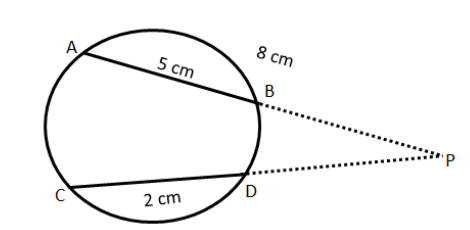
Now, by intersecting secant theorem, we know that,
\[PA \times PB = PC \times PD\]……………………………………\[\left( 1 \right)\]
Now from the figure we can see, \[PC = \left( {PD + CD} \right)\]
And, it is given that \[AP = 8{\rm{cm}}\]
Also, \[AB = 5{\rm{cm}}\] and \[AP = 8{\rm{cm}}\],
Therefore, \[PB = \left( {AP - AB} \right) = \left( {8 - 5} \right) = 3{\rm{cm}}\]
Hence, substituting these values in equation \[\left( 1 \right)\], we get,
\[8 \times 3 = \left( {PD + CD} \right) \times PD\]
According to the question, \[CD = 2{\rm{cm}}\], hence substituting this value,
\[ \Rightarrow 24 = \left( {PD + 2} \right) \times PD\]
Now, opening the brackets and solving further, we get,
\[ \Rightarrow P{D^2} + 2PD - 24 = 0\]
The above equation is a quadratic equation. We will factorize this equation to find the required value.
Splitting the middle term, we get
\[ \Rightarrow P{D^2} + 6PD - 4PD - 24 = 0\]
$\Rightarrow PD\left( PD+6 \right)-4\left( PD+6 \right)=0$
Taking the brackets common, we get
\[ \Rightarrow \left( {PD - 4} \right)\left( {PD + 6} \right) = 0\]
By zero product property, we get
\[ \Rightarrow \left( {PD - 4} \right) = 0\]
\[ \Rightarrow PD = 4{\rm{cm}}\]
Or
\[ \Rightarrow \left( {PD + 6} \right) = 0\]
\[ \Rightarrow PD = - 6{\rm{cm}}\]
But, length can’ be negative.
Therefore, rejecting the negative value, we get,
\[PD = 4{\rm{cm}}\]
Hence, option D is the correct answer.
Note: A chord of a circle is a straight line segment whose endpoints lie on the circumference of the circle. By intersecting secant theorem, we mean that if two secant segments are drawn to a circle from an external point then the product of one internal and external secant is equal to the product of the second internal and external secant. Here, secant is a straight line that cuts a circle at two or more parts.
Complete step-by-step answer:
According to the question,
\[AB\]and \[CD\] are two chords of a circle
Also, they are produced to meet at a point \[P\].
It is given that \[AB = 5{\rm{cm}}\], \[AP = 8{\rm{cm}}\]and \[CD = 2{\rm{cm}}\]
And, we are required to find the length of \[PD\]
Now, by intersecting secant theorem, we know that,
\[PA \times PB = PC \times PD\]……………………………………\[\left( 1 \right)\]
Now from the figure we can see, \[PC = \left( {PD + CD} \right)\]
And, it is given that \[AP = 8{\rm{cm}}\]
Also, \[AB = 5{\rm{cm}}\] and \[AP = 8{\rm{cm}}\],
Therefore, \[PB = \left( {AP - AB} \right) = \left( {8 - 5} \right) = 3{\rm{cm}}\]
Hence, substituting these values in equation \[\left( 1 \right)\], we get,
\[8 \times 3 = \left( {PD + CD} \right) \times PD\]
According to the question, \[CD = 2{\rm{cm}}\], hence substituting this value,
\[ \Rightarrow 24 = \left( {PD + 2} \right) \times PD\]
Now, opening the brackets and solving further, we get,
\[ \Rightarrow P{D^2} + 2PD - 24 = 0\]
The above equation is a quadratic equation. We will factorize this equation to find the required value.
Splitting the middle term, we get
\[ \Rightarrow P{D^2} + 6PD - 4PD - 24 = 0\]
$\Rightarrow PD\left( PD+6 \right)-4\left( PD+6 \right)=0$
Taking the brackets common, we get
\[ \Rightarrow \left( {PD - 4} \right)\left( {PD + 6} \right) = 0\]
By zero product property, we get
\[ \Rightarrow \left( {PD - 4} \right) = 0\]
\[ \Rightarrow PD = 4{\rm{cm}}\]
Or
\[ \Rightarrow \left( {PD + 6} \right) = 0\]
\[ \Rightarrow PD = - 6{\rm{cm}}\]
But, length can’ be negative.
Therefore, rejecting the negative value, we get,
\[PD = 4{\rm{cm}}\]
Hence, option D is the correct answer.
Note: A chord of a circle is a straight line segment whose endpoints lie on the circumference of the circle. By intersecting secant theorem, we mean that if two secant segments are drawn to a circle from an external point then the product of one internal and external secant is equal to the product of the second internal and external secant. Here, secant is a straight line that cuts a circle at two or more parts.
Recently Updated Pages
Master Class 11 Business Studies: Engaging Questions & Answers for Success

Master Class 11 Computer Science: Engaging Questions & Answers for Success
Master Class 11 Economics: Engaging Questions & Answers for Success
Master Class 11 Social Science: Engaging Questions & Answers for Success
Master Class 11 English: Engaging Questions & Answers for Success
Master Class 11 Chemistry: Engaging Questions & Answers for Success
Trending doubts
Draw a diagram of nephron and explain its structur class 11 biology CBSE
Explain zero factorial class 11 maths CBSE
Chemical formula of Bleaching powder is A Ca2OCl2 B class 11 chemistry CBSE
Name the part of the brain responsible for the precision class 11 biology CBSE
The growth of tendril in pea plants is due to AEffect class 11 biology CBSE
One Metric ton is equal to kg A 10000 B 1000 C 100 class 11 physics CBSE