




If a triangle and a parallelogram are on the same base and between the same parallels, then prove that the area of the triangles is equal to half the area of the parallelogram?
Answer
 Verified
622.8k+ views
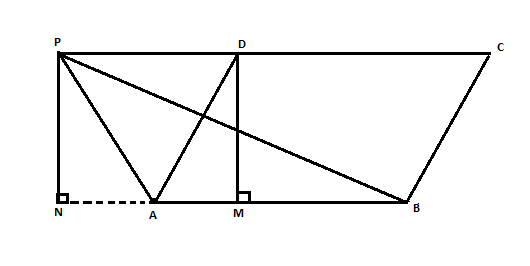
Hint: To prove the above statement we need to make some assumptions. We need to make a point outside the parallelogram and draw the line parallel to AB. Connect the point with A and B by drawing lines. Using the area of the triangle formulae we can prove the above given statement.
Complete step by step solution:
For parallelogram ABCD
Properties of Parallelogram:
1. Opposite sides are congruent (AB=DC).
2. Opposite angles are congruent (D=C).
3. Consecutive angles are supplementary (A+D= 180 degrees).
4. If one angle is the right angle, then all angles are right angles.
5. The diagonals of a parallelogram bisect each other.
6. Each diagonal of a parallelogram separates it into two congruent triangles.
Since $DM \bot AB$(DM is perpendicular to AB).
Height is DM, Base is AB
Area ABCD = Base $ \times $Height
Area ABCD = AB$ \times $DM … (1)
For $\vartriangle PAB$
Since $PN \bot AB$(PN is perpendicular to AB).
Height is PN, Base is AB
Area $\vartriangle PAB$=$\dfrac{1}{2} \times $Base$ \times $Height
$ \Rightarrow $Area $\vartriangle PAB$=$\dfrac{1}{2} \times $AB$ \times $PN
Since opposite sides of parallelogram are parallel
So, $AB\parallel CD$
$ \Rightarrow $Distances between parallel lines are equal
PN = DM (Based on the properties of Parallelogram).
$ \Rightarrow $Area $\vartriangle PAB$=$\dfrac{1}{2} \times $AB$ \times $DM … (2)
From (1) and (2)
Area $\vartriangle PAB$=$\dfrac{1}{2} \times $Area of ABCD.
Therefore, if a triangle and a parallelogram are on the same base and between the same parallels, then the area of the triangles is equal to half the area of the parallelogram.
Note: We can also prove the above statement by drawing the diagonal and the perpendiculars meeting at some point. Based on the lines collinear and parallel lines we can say the perpendiculars drawn are equal. Therefore the area of the triangle is half the area of parallelogram when having the same height and same base. (Since diagonals of a parallelogram divide it into two congruent triangles).
Complete step by step solution:
For parallelogram ABCD
Properties of Parallelogram:
1. Opposite sides are congruent (AB=DC).
2. Opposite angles are congruent (D=C).
3. Consecutive angles are supplementary (A+D= 180 degrees).
4. If one angle is the right angle, then all angles are right angles.
5. The diagonals of a parallelogram bisect each other.
6. Each diagonal of a parallelogram separates it into two congruent triangles.
Since $DM \bot AB$(DM is perpendicular to AB).
Height is DM, Base is AB
Area ABCD = Base $ \times $Height
Area ABCD = AB$ \times $DM … (1)
For $\vartriangle PAB$
Since $PN \bot AB$(PN is perpendicular to AB).
Height is PN, Base is AB
Area $\vartriangle PAB$=$\dfrac{1}{2} \times $Base$ \times $Height
$ \Rightarrow $Area $\vartriangle PAB$=$\dfrac{1}{2} \times $AB$ \times $PN
Since opposite sides of parallelogram are parallel
So, $AB\parallel CD$
$ \Rightarrow $Distances between parallel lines are equal
PN = DM (Based on the properties of Parallelogram).
$ \Rightarrow $Area $\vartriangle PAB$=$\dfrac{1}{2} \times $AB$ \times $DM … (2)
From (1) and (2)
Area $\vartriangle PAB$=$\dfrac{1}{2} \times $Area of ABCD.
Therefore, if a triangle and a parallelogram are on the same base and between the same parallels, then the area of the triangles is equal to half the area of the parallelogram.
Note: We can also prove the above statement by drawing the diagonal and the perpendiculars meeting at some point. Based on the lines collinear and parallel lines we can say the perpendiculars drawn are equal. Therefore the area of the triangle is half the area of parallelogram when having the same height and same base. (Since diagonals of a parallelogram divide it into two congruent triangles).
Recently Updated Pages
Master Class 11 English: Engaging Questions & Answers for Success

Master Class 11 Maths: Engaging Questions & Answers for Success
Class 11 Question and Answer - Your Ultimate Solutions Guide
Master Class 11 Biology: Engaging Questions & Answers for Success
Master Class 11 Physics: Engaging Questions & Answers for Success
Master Class 11 Accountancy: Engaging Questions & Answers for Success
Trending doubts
Explain the Treaty of Vienna of 1815 class 10 social science CBSE
Who Won 36 Oscar Awards? Record Holder Revealed
What is the median of the first 10 natural numbers class 10 maths CBSE
Why is it 530 pm in india when it is 1200 afternoon class 10 social science CBSE
Select the word that is correctly spelled a Twelveth class 10 english CBSE
Why is there a time difference of about 5 hours between class 10 social science CBSE