




If a square and an equilateral triangle have equal perimeters, what is the ratio of the area of the triangle to the area of the square?
Answer
 Verified
481.2k+ views
Hint: The perimeter of any figure formed by straight lines is the sum of the lengths of all the sides. A square is a figure with all four sides being equal and perpendicular to each other. An equilateral triangle has all three sides equal and all interior angles equal. Consider the perimeter as a and using the perimeter formula, find the length of sides of the square and triangle.
Complete step-by-step answer:
Let’s draw a diagram which depicts the question for better understanding.
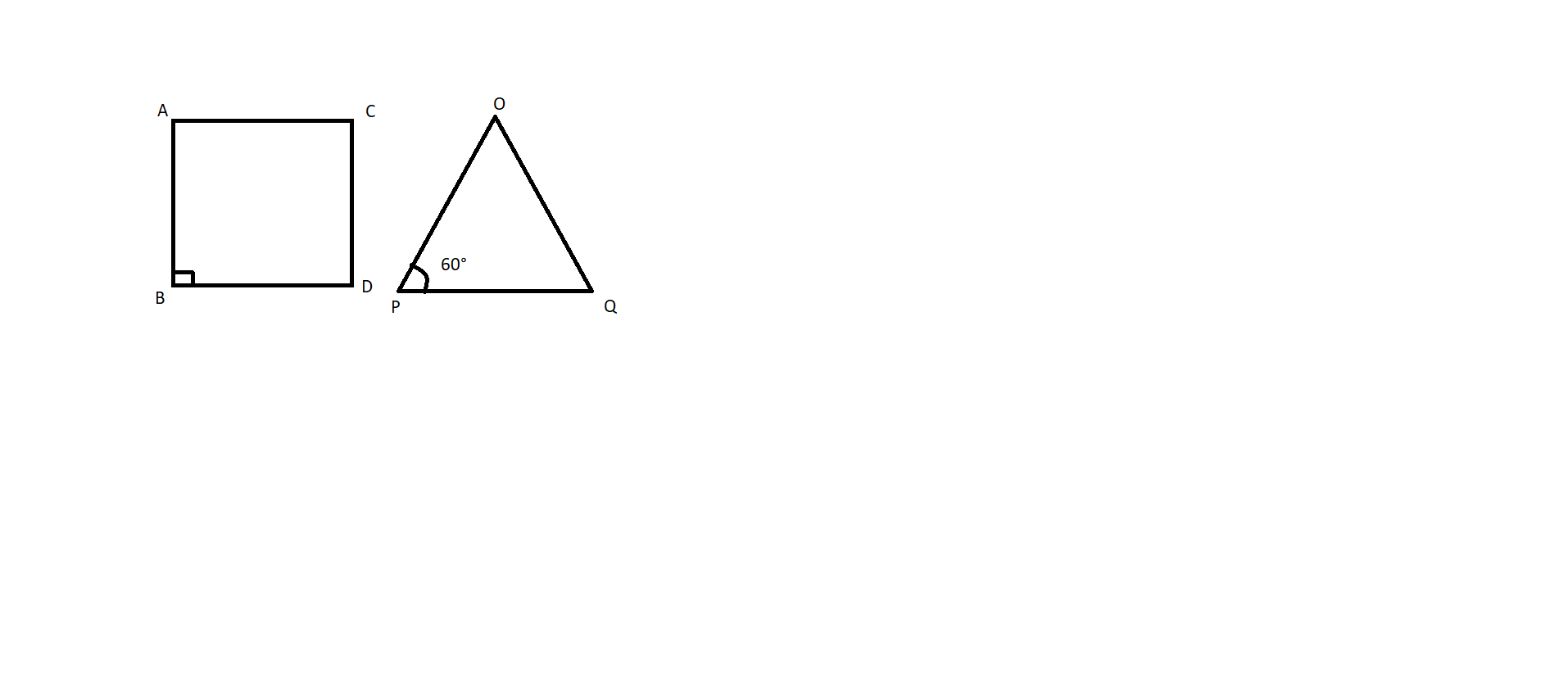
ABCD is a square and OPQ is the equilateral triangle.
The perimeter of the square = $4 \times (x)$ (where x is the length of each side in the square)
The perimeter of equilateral triangle = $3 \times (y)$ (where y is the length of each side in the triangle)
The area of the square = ${x^2}$
The area of the equilateral triangle = $\dfrac{{\sqrt 3 }}{4}{y^2}$
Since the perimeters of the square and equilateral triangle are equal to a,
$4x = 3y = a$
Which implies:
$x = \dfrac{a}{4}$ and $y = \dfrac{a}{3}$
Area of the square = ${x^2}$= ${(\dfrac{a}{4})^2}$ = $\dfrac{{{a^2}}}{{16}}$
Area of the equilateral triangle = $\dfrac{{\sqrt 3 }}{4}{y^2}$= $\dfrac{{\sqrt 3 }}{4}{(\dfrac{a}{3})^2}$= $\dfrac{{\sqrt 3 }}{4} \times \dfrac{{{a^2}}}{9}$
The ratio of area of triangle to the area of the square:
area of the triangle/area of the square
$\dfrac{{\dfrac{{\sqrt 3 }}{4} \times \dfrac{{{a^2}}}{9}}}{{\dfrac{{{a^2}}}{{16}}}}$
After further simplification, we get:
$\dfrac{{4\sqrt 3 }}{9}$ = $\dfrac{4}{{3\sqrt 3 }}$= 0.769
Hence the ratio of area of square to the area of triangle = $\dfrac{4}{{3\sqrt 3 }}$
Note: We have to be careful while reading the question because it is given that the perimeters of square and equilateral triangle are equal, not that the sides of square and the triangle are equal. The calculation becomes easier if we remember that the area of the equilateral triangle = $\dfrac{{\sqrt 3 }}{4}{y^2}$ which makes the calculation easier instead of using $\dfrac{1}{2}hb$ where h is the height and b is the base of the triangle.
Complete step-by-step answer:
Let’s draw a diagram which depicts the question for better understanding.
ABCD is a square and OPQ is the equilateral triangle.
The perimeter of the square = $4 \times (x)$ (where x is the length of each side in the square)
The perimeter of equilateral triangle = $3 \times (y)$ (where y is the length of each side in the triangle)
The area of the square = ${x^2}$
The area of the equilateral triangle = $\dfrac{{\sqrt 3 }}{4}{y^2}$
Since the perimeters of the square and equilateral triangle are equal to a,
$4x = 3y = a$
Which implies:
$x = \dfrac{a}{4}$ and $y = \dfrac{a}{3}$
Area of the square = ${x^2}$= ${(\dfrac{a}{4})^2}$ = $\dfrac{{{a^2}}}{{16}}$
Area of the equilateral triangle = $\dfrac{{\sqrt 3 }}{4}{y^2}$= $\dfrac{{\sqrt 3 }}{4}{(\dfrac{a}{3})^2}$= $\dfrac{{\sqrt 3 }}{4} \times \dfrac{{{a^2}}}{9}$
The ratio of area of triangle to the area of the square:
area of the triangle/area of the square
$\dfrac{{\dfrac{{\sqrt 3 }}{4} \times \dfrac{{{a^2}}}{9}}}{{\dfrac{{{a^2}}}{{16}}}}$
After further simplification, we get:
$\dfrac{{4\sqrt 3 }}{9}$ = $\dfrac{4}{{3\sqrt 3 }}$= 0.769
Hence the ratio of area of square to the area of triangle = $\dfrac{4}{{3\sqrt 3 }}$
Note: We have to be careful while reading the question because it is given that the perimeters of square and equilateral triangle are equal, not that the sides of square and the triangle are equal. The calculation becomes easier if we remember that the area of the equilateral triangle = $\dfrac{{\sqrt 3 }}{4}{y^2}$ which makes the calculation easier instead of using $\dfrac{1}{2}hb$ where h is the height and b is the base of the triangle.
Recently Updated Pages
Master Class 10 Computer Science: Engaging Questions & Answers for Success

Master Class 10 General Knowledge: Engaging Questions & Answers for Success
Master Class 10 English: Engaging Questions & Answers for Success
Master Class 10 Social Science: Engaging Questions & Answers for Success
Master Class 10 Maths: Engaging Questions & Answers for Success
Master Class 10 Science: Engaging Questions & Answers for Success
Trending doubts
What is the median of the first 10 natural numbers class 10 maths CBSE
Which women's tennis player has 24 Grand Slam singles titles?
Who is the Brand Ambassador of Incredible India?
Why is there a time difference of about 5 hours between class 10 social science CBSE
Write a letter to the principal requesting him to grant class 10 english CBSE
State and prove converse of BPT Basic Proportionality class 10 maths CBSE