




If a single cell starts out with 98 chromosomes and undergoes mitosis, how many new cells will be formed and how many chromosomes will each have??
Answer
 Verified
586.8k+ views
Hint: Mitosis is the division of a single cell into two daughter cells that are similar (cell division). Mitosis is the process by which one cell divides into two separate cells. Mitosis is primarily responsible for cell growth and replacement.
Complete answer:
Mitosis often results in the formation of two daughter cells with the same chromosome number as the parent cell.
2 cells, each with 98 chromosomes
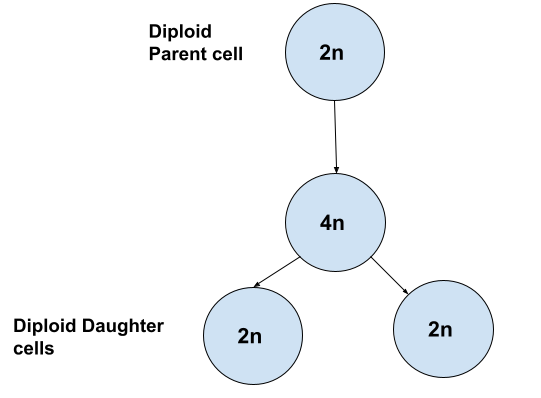
When the Daughter cells split, the original cell will duplicate the DNA, bringing Diploid (2n) to (4n) and then splitting back to Diploid (2n).
Prophase, metaphase, anaphase, and telophase are the four basic stages of mitosis. Both phases occur in a strict order, and cytokinesis (the process of splitting a cell's contents into two new cells) begins in either anaphase or telophase.
Mitosis and Its Importance
- Mitosis is responsible for the zygote's transformation into an adult.
- Each daughter cell receives an equal number of chromosomes.
- It is in control of an individual's growth and development.
- It ensures that all of an organism's body cells have the same number of chromosomes.
- Mitosis is necessary for asexual reproduction as well as vegetative propagation in plants.
- Mitosis is essential for asexual reproduction, vegetative propagation, and the repair and regeneration of damaged tissues in plants.
- Mitosis helps to keep the genome pure by preventing recombination and crossover.
- It is in charge of repairing and regenerating old and damaged cells in animals, such as the gut epithelium, blood cells, and so on.
Note: The two most important functions of mitosis are as follows:
i) Mitosis is a process that aids in the growth of an organism. Mitosis is the asexual reproduction mechanism of single-celled species.
ii) Mitosis aids in the regeneration of tissues that have been affected. When cells near damaged cells are unable to sense their neighbours, they begin mitosis. The dividing cells communicate with one another and cover the damaged cells.
Complete answer:
Mitosis often results in the formation of two daughter cells with the same chromosome number as the parent cell.
2 cells, each with 98 chromosomes
When the Daughter cells split, the original cell will duplicate the DNA, bringing Diploid (2n) to (4n) and then splitting back to Diploid (2n).
Prophase, metaphase, anaphase, and telophase are the four basic stages of mitosis. Both phases occur in a strict order, and cytokinesis (the process of splitting a cell's contents into two new cells) begins in either anaphase or telophase.
Mitosis and Its Importance
- Mitosis is responsible for the zygote's transformation into an adult.
- Each daughter cell receives an equal number of chromosomes.
- It is in control of an individual's growth and development.
- It ensures that all of an organism's body cells have the same number of chromosomes.
- Mitosis is necessary for asexual reproduction as well as vegetative propagation in plants.
- Mitosis is essential for asexual reproduction, vegetative propagation, and the repair and regeneration of damaged tissues in plants.
- Mitosis helps to keep the genome pure by preventing recombination and crossover.
- It is in charge of repairing and regenerating old and damaged cells in animals, such as the gut epithelium, blood cells, and so on.
Note: The two most important functions of mitosis are as follows:
i) Mitosis is a process that aids in the growth of an organism. Mitosis is the asexual reproduction mechanism of single-celled species.
ii) Mitosis aids in the regeneration of tissues that have been affected. When cells near damaged cells are unable to sense their neighbours, they begin mitosis. The dividing cells communicate with one another and cover the damaged cells.
Recently Updated Pages
Basicity of sulphurous acid and sulphuric acid are

Master Class 10 Computer Science: Engaging Questions & Answers for Success
Master Class 10 Social Science: Engaging Questions & Answers for Success
Master Class 10 Science: Engaging Questions & Answers for Success
Class 10 Question and Answer - Your Ultimate Solutions Guide
Master Class 10 Maths: Engaging Questions & Answers for Success
Trending doubts
What is the Total Duration of Football Match?
In football, which nation is called "La Roja"?
What is the award for the best player at the FIFA World Cup?
Differentiate between Xylem and phloem class 10 biology CBSE
Fill the blanks with proper collective nouns 1 A of class 10 english CBSE
In the event of the resignation or death of the Prime class 10 social science CBSE