




If a full wave rectifier circuit is operating from \[\text{50Hz}\] mains, the fundamental frequency in the ripple will be
\[\begin{align}
& A)25Hz \\
& B)50Hz \\
& C)70.7Hz \\
& D)100Hz \\
\end{align}\]
Answer
 Verified
599.7k+ views
Hint: A circuit which converts alternating current into direct current is known as rectifier. A full wave rectifier produces output for both positive and negative half cycles of input. Hence, we get twice the input value at the output terminal.
Formula used:
\[{{f}_{output}}=2{{f}_{input}}\]
Complete answer:
A full-wave rectifier rectifies the negative component of the input voltage to a positive voltage, and converts the AC input into DC. In a full wave rectifier, when the AC voltage is applied at the input, during positive and negative half cycles, current flows through the load in the same direction. And it is achieved by using diodes. For \[n\] cycles, a full wave rectifier generates \[2n\] cycles as the output.
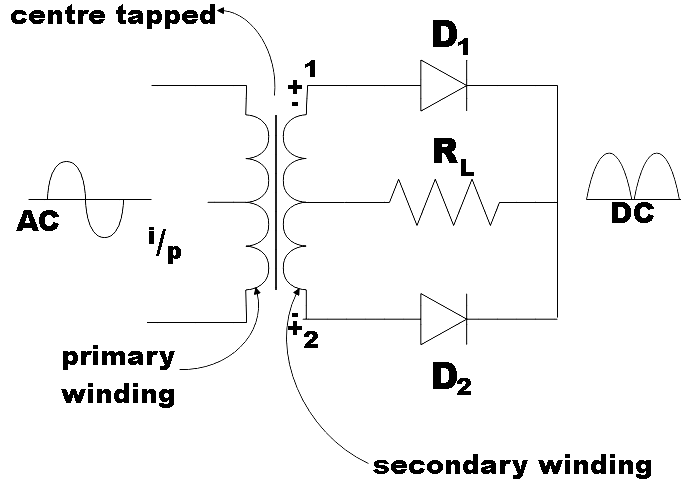
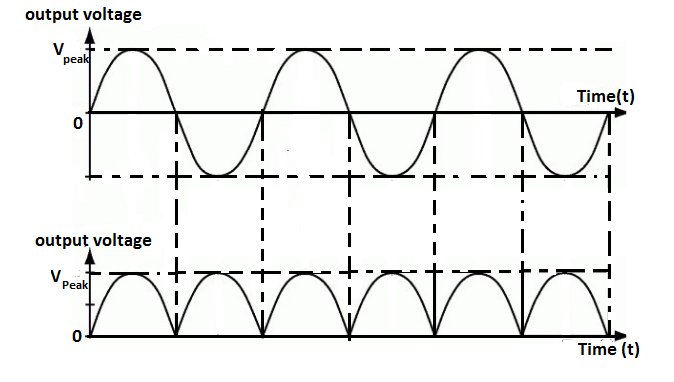
Figure shows the input and output voltage graph of a full wave rectifier. For positive and negative half cycles, a positive output is generated across the load resistor.
Hence, if \[nHz\] frequency is applied at the input then, we get \[2nHz\] as output frequency.
i.e.,
\[{{f}_{output}}=2{{f}_{input}}\]
Here, the full wave rectifier circuit is operating from \[\text{50Hz}\] mains, the fundamental frequency in the ripple will be\[100Hz\].
Answer is option D.
Note:
Compared to a half wave rectifier, full wave rectifiers have higher rectifying efficiency, as they convert AC to DC more efficiently.
Since, no voltage signal is wasted in the rectification process; these rectifiers have low power loss. Its output has fewer ripples compared to half wave rectifiers. This makes it easier to produce a smooth output waveform.
Formula used:
\[{{f}_{output}}=2{{f}_{input}}\]
Complete answer:
A full-wave rectifier rectifies the negative component of the input voltage to a positive voltage, and converts the AC input into DC. In a full wave rectifier, when the AC voltage is applied at the input, during positive and negative half cycles, current flows through the load in the same direction. And it is achieved by using diodes. For \[n\] cycles, a full wave rectifier generates \[2n\] cycles as the output.
Figure shows the input and output voltage graph of a full wave rectifier. For positive and negative half cycles, a positive output is generated across the load resistor.
Hence, if \[nHz\] frequency is applied at the input then, we get \[2nHz\] as output frequency.
i.e.,
\[{{f}_{output}}=2{{f}_{input}}\]
Here, the full wave rectifier circuit is operating from \[\text{50Hz}\] mains, the fundamental frequency in the ripple will be\[100Hz\].
Answer is option D.
Note:
Compared to a half wave rectifier, full wave rectifiers have higher rectifying efficiency, as they convert AC to DC more efficiently.
Since, no voltage signal is wasted in the rectification process; these rectifiers have low power loss. Its output has fewer ripples compared to half wave rectifiers. This makes it easier to produce a smooth output waveform.
Recently Updated Pages
Master Class 5 English: Engaging Questions & Answers for Success

Master Class 5 Maths: Engaging Questions & Answers for Success
Master Class 5 Social Science: Engaging Questions & Answers for Success
Master Class 5 Science: Engaging Questions & Answers for Success
Class 5 Question and Answer - Your Ultimate Solutions Guide
Master Class 9 General Knowledge: Engaging Questions & Answers for Success
Trending doubts
Which are the Top 10 Largest Countries of the World?
The total number of vertebrae in man is a30 b31 c32 class 12 biology CBSE
Draw a labelled sketch of the human eye class 12 physics CBSE
The number of cranial nerves in a frog is A 10 pairs class 12 biology CBSE
Differentiate between homogeneous and heterogeneous class 12 chemistry CBSE
Antibodies present in colostrum which protect the new class 12 biology CBSE