




If A can do a piece of work in $4$ hours, B and C together in $3$ hours and A and C together in $2$ hours. How long will B be alone taken to do it?
(A)$10$ hours
(B)$12$ hours
(C)$8$ hours
(D)$24$ hours
Answer
 Verified
616.5k+ views
Hint:
If a piece of work is done in $x$ hours, then the work done in one hour will be $\dfrac{1}{x}$. Use this approach to find the work done by A alone, B and C together & A and C together in one hour.
Complete step by step solution:
Let $a,b\& c$be the number of hours taken by A, B & C to complete the work alone.
Given, A can do a piece of work in $4$ hours.
As we know that if a piece of work is done in $x$ hours, then the work done in one hour will be $\dfrac{1}{x}$.
$\therefore $Work done by A in $1$ hour$ = \dfrac{1}{4}$$ \Rightarrow \dfrac{1}{a}$$ = \dfrac{1}{4}$ ….. (1)
Similarly, B and C together can do a piece of work in $3$ hours.
$\therefore $Work done by B and C together in $1$ hour$ = \dfrac{1}{3}$$ \Rightarrow \dfrac{1}{b} + \dfrac{1}{c}$ $ = \dfrac{1}{3}$ ….. (2)
A and C together can do a piece of work in $2$ hours.
$\therefore $Work done by A and C together in $1$ hour$\dfrac{1}{2}$$ \Rightarrow \dfrac{1}{a} + \dfrac{1}{c} = $$\dfrac{1}{2}$ ….. (3)
Now, subtracting (1) from (3);
$\left( {\dfrac{1}{a} + \dfrac{1}{c}} \right) - \dfrac{1}{a} = \dfrac{1}{2} - \dfrac{1}{4}$
$ \Rightarrow \dfrac{1}{c} = \dfrac{{2 - 1}}{4}$
$ \Rightarrow \dfrac{1}{c} = \dfrac{1}{4}$ ….. (4)
Now, subtracting (4) from (2);
$\left( {\dfrac{1}{b} + \dfrac{1}{c}} \right) - \dfrac{1}{c} = \dfrac{1}{3} - \dfrac{1}{4}$
$ \Rightarrow \dfrac{1}{b} = \dfrac{{4 - 3}}{{12}}$
$ \Rightarrow \dfrac{1}{b} = \dfrac{1}{{12}}$
$ \Rightarrow b = 12$
Therefore, time taken by B to complete the work alone is $12$ hours.
Hence, option (B) is the correct answer.
Note:
An another method to solve this question is described below:
The formula of total work (in term of hours and efficiency) is given by,
Total work = Efficiency $ \times $ Time
Given, A can do a piece of work in $4$ hours, B and C together in $3$ hours and A and C together in $2$ hours. The total work can be obtained by taking the LCM of all these given times.
$\therefore $ Total work = LCM of $4$, $3$& $2$
$ \Rightarrow $Total work =$12$
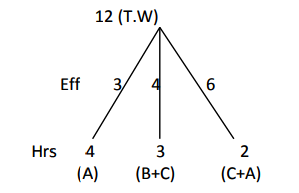
Use formula, Total work = Efficiency $ \times $ Time to find the efficiencies of A,B and C.
A’s efficiency = $\dfrac{{12}}{4}$
$ \Rightarrow $ A’s efficiency $ = 3$work per hour …. (1)
Similarly, (C+A)’s efficiency $ = \dfrac{{12}}{2}$ [Using formula, Total work = Efficiency $ \times $ Time]
$ \Rightarrow $ (C+A)’s efficiency $ = 6$work per hour
$\therefore $C’s efficiency$ = 6 - $A’s efficiency
$ \Rightarrow $ C’s efficiency$ = 6 - $ $3$ [Using (1)]
$ \Rightarrow $ C’s efficiency$ = 3$work per hour ….. (2)
Similarly, (B+C)’s efficiency $ = \dfrac{{12}}{3}$ [Using formula, Total work = Efficiency $ \times $ Time]
$ \Rightarrow $ (B+C)’s efficiency $ = 4$work per hour
$\therefore $B’s efficiency$ = 4 - $C’s efficiency
$ \Rightarrow $ B’s efficiency$ = 4 - $ $3$ [Using (2)]
$ \Rightarrow $ B’s efficiency=$1$work per hour ….. (3)
Therefore, time taken by B alone to complete the work$ = \dfrac{{12}}{1}$$ = 12$hours [Using formula, Total work = Efficiency $ \times $ Time]
Therefore, time taken by B to complete the work alone is $12$ hours.
Hence, option (B) is the correct answer.
If a piece of work is done in $x$ hours, then the work done in one hour will be $\dfrac{1}{x}$. Use this approach to find the work done by A alone, B and C together & A and C together in one hour.
Complete step by step solution:
Let $a,b\& c$be the number of hours taken by A, B & C to complete the work alone.
Given, A can do a piece of work in $4$ hours.
As we know that if a piece of work is done in $x$ hours, then the work done in one hour will be $\dfrac{1}{x}$.
$\therefore $Work done by A in $1$ hour$ = \dfrac{1}{4}$$ \Rightarrow \dfrac{1}{a}$$ = \dfrac{1}{4}$ ….. (1)
Similarly, B and C together can do a piece of work in $3$ hours.
$\therefore $Work done by B and C together in $1$ hour$ = \dfrac{1}{3}$$ \Rightarrow \dfrac{1}{b} + \dfrac{1}{c}$ $ = \dfrac{1}{3}$ ….. (2)
A and C together can do a piece of work in $2$ hours.
$\therefore $Work done by A and C together in $1$ hour$\dfrac{1}{2}$$ \Rightarrow \dfrac{1}{a} + \dfrac{1}{c} = $$\dfrac{1}{2}$ ….. (3)
Now, subtracting (1) from (3);
$\left( {\dfrac{1}{a} + \dfrac{1}{c}} \right) - \dfrac{1}{a} = \dfrac{1}{2} - \dfrac{1}{4}$
$ \Rightarrow \dfrac{1}{c} = \dfrac{{2 - 1}}{4}$
$ \Rightarrow \dfrac{1}{c} = \dfrac{1}{4}$ ….. (4)
Now, subtracting (4) from (2);
$\left( {\dfrac{1}{b} + \dfrac{1}{c}} \right) - \dfrac{1}{c} = \dfrac{1}{3} - \dfrac{1}{4}$
$ \Rightarrow \dfrac{1}{b} = \dfrac{{4 - 3}}{{12}}$
$ \Rightarrow \dfrac{1}{b} = \dfrac{1}{{12}}$
$ \Rightarrow b = 12$
Therefore, time taken by B to complete the work alone is $12$ hours.
Hence, option (B) is the correct answer.
Note:
An another method to solve this question is described below:
The formula of total work (in term of hours and efficiency) is given by,
Total work = Efficiency $ \times $ Time
Given, A can do a piece of work in $4$ hours, B and C together in $3$ hours and A and C together in $2$ hours. The total work can be obtained by taking the LCM of all these given times.
$\therefore $ Total work = LCM of $4$, $3$& $2$
$ \Rightarrow $Total work =$12$
Use formula, Total work = Efficiency $ \times $ Time to find the efficiencies of A,B and C.
A’s efficiency = $\dfrac{{12}}{4}$
$ \Rightarrow $ A’s efficiency $ = 3$work per hour …. (1)
Similarly, (C+A)’s efficiency $ = \dfrac{{12}}{2}$ [Using formula, Total work = Efficiency $ \times $ Time]
$ \Rightarrow $ (C+A)’s efficiency $ = 6$work per hour
$\therefore $C’s efficiency$ = 6 - $A’s efficiency
$ \Rightarrow $ C’s efficiency$ = 6 - $ $3$ [Using (1)]
$ \Rightarrow $ C’s efficiency$ = 3$work per hour ….. (2)
Similarly, (B+C)’s efficiency $ = \dfrac{{12}}{3}$ [Using formula, Total work = Efficiency $ \times $ Time]
$ \Rightarrow $ (B+C)’s efficiency $ = 4$work per hour
$\therefore $B’s efficiency$ = 4 - $C’s efficiency
$ \Rightarrow $ B’s efficiency$ = 4 - $ $3$ [Using (2)]
$ \Rightarrow $ B’s efficiency=$1$work per hour ….. (3)
Therefore, time taken by B alone to complete the work$ = \dfrac{{12}}{1}$$ = 12$hours [Using formula, Total work = Efficiency $ \times $ Time]
Therefore, time taken by B to complete the work alone is $12$ hours.
Hence, option (B) is the correct answer.
Recently Updated Pages
Master Class 11 English: Engaging Questions & Answers for Success

Master Class 11 Social Science: Engaging Questions & Answers for Success
Master Class 11 Maths: Engaging Questions & Answers for Success
Master Class 11 Biology: Engaging Questions & Answers for Success
Master Class 11 Physics: Engaging Questions & Answers for Success
Master Class 11 Chemistry: Engaging Questions & Answers for Success
Trending doubts
Explain the Treaty of Vienna of 1815 class 10 social science CBSE
What is the full form of CNG A Complete Natural Gas class 10 social science CBSE
In cricket, what is a "Yorker" designed to do?
What is the full form of POSCO class 10 social science CBSE
Define Potential, Developed, Stock and Reserved resources
What were the majoritarian measures taken in Sri Lanka class 10 social science CBSE